Scientific Name
Curio talinoides (DC.) P. V. Heath
Synonym(s)
Kleinia talinoides, Senecio talinoides
Common Name(s)
Blue Chalk Sticks, Blue Fingers, Blue Ice Plant, Blue Senecio, Blue Straws, Narrow-leaf Chalksticks
Scientific Classification
Family: Asteraceae
Subfamily: Asteroideae
Tribe: Senecioneae
Subtribe: Senecioninae
Genus: Curio
Etymology
The specific epithet "talinoides" (pronounced "tal-IN-oh-id-eez") means "resembling Talinum" and refers to the likeness of the species to members of the genus Talinum.
Origin
Curio talinoides is native to South Africa (Eastern Cape).
Description
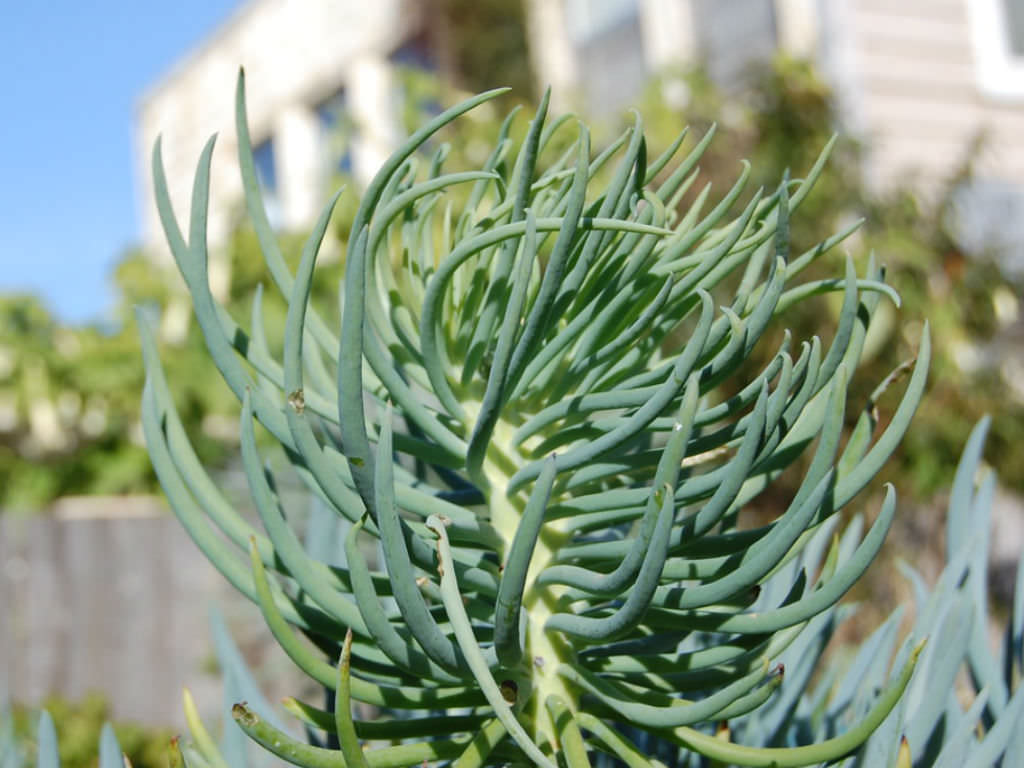
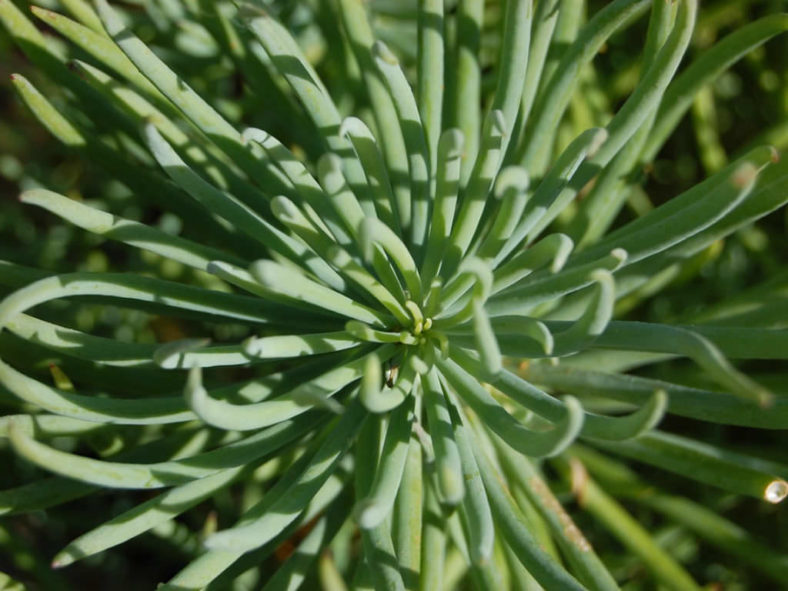
Curio talinoides, formerly known as Senecio talinoides or Kleinia talinoides, is a small succulent shrub with narrow, blue-green leaves. It can grow up to 2 feet (60 cm) tall and spread 3 feet (90 cm) wide. The leaves are upright, slightly upcurved, pointed, measuring up to 6 inches (15 cm) long and 0.4 inches (1 cm) in diameter. The stems are initially erect, becoming procumbent as they grow, and often root at the nodes when they touch the ground.
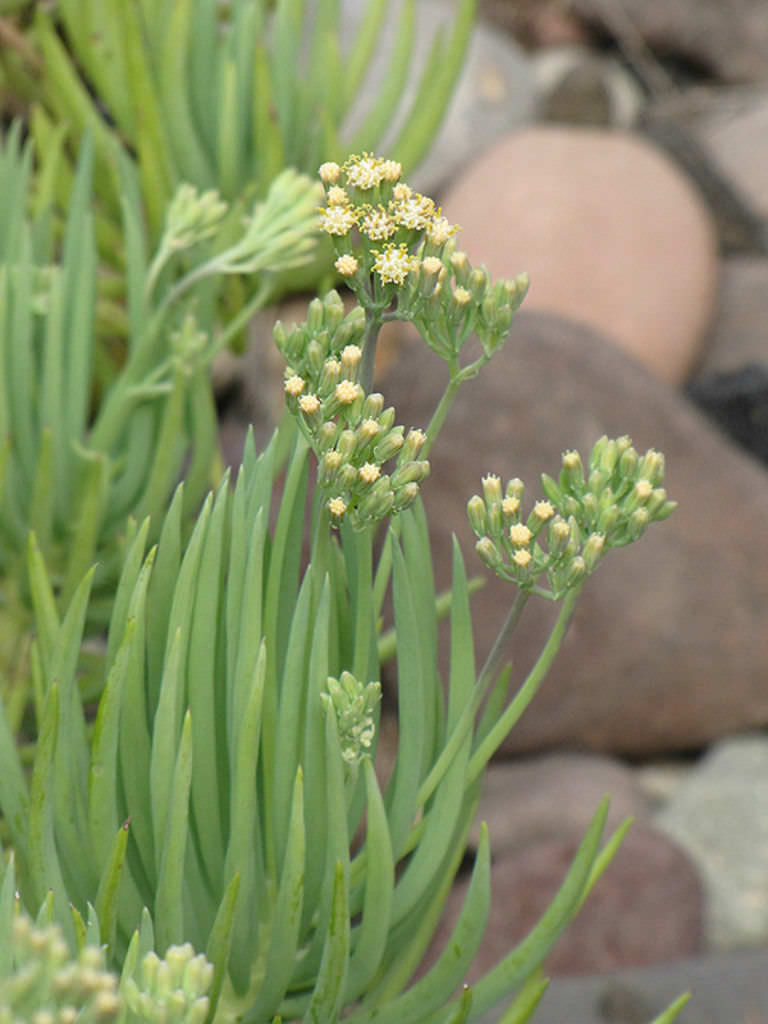
The flowers are white, held in corymbs, and appear at the ends of the stems in spring.
Varieties and Forms of Curio talinoides
- Curio talinoides var. aizoides
- Curio talinoides var. chordifolius
- Curio talinoides var. mandraliscae
- Curio talinoides var. talinoides
- Kleinia talinoides subsp. cylindricus (Although Kleinia talinoides is considered a synonym of Curio talinoides, the subspecies Kleinia talinoides subsp. cylindricus has not been formally accepted nor formally synonymized within Curio talinoides. Currently, it remains unplaced in both Plants of the World Online (POWO)🡕 and World Flora Online (WFO)🡕.)
Cultivars and Hybrids of Curio talinoides
How to Grow and Care for Curio talinoides
Light: Keep your C. talinoides in partial shade outdoors and bright sunlight indoors. Avoid intense afternoon sun in summer. It will grow in full shade but will become lanky and leggy.
Soil: Like most succulents, this plant prefers a well-draining soil mix. To grow C. talinoides indoors, using a container with at least one drainage hole at the bottom is essential.
Hardiness: C. talinoides can withstand temperatures as low as 25 to 50 °F (-3.9 to 10 °C), USDA hardiness zones 9b to 11b. The plant will not survive consistently freezing temperatures.
Watering: Water regularly during the growing season, allowing the soil to dry out between waterings. This plant is drought-tolerant, but the soil should never be left dry for too long. Reduce watering frequency during the winter months. Water only if the soil is completely dry.
Fertilizing: C. talinoides requires a bit more fertilizer than other succulents if you want it to grow fast. In summer, feed your plant a dilute solution of a balanced, water-soluble fertilizer once a year.
Repotting: You do not need to repot this plant often. You can do it when the container becomes too small or shallow.
Propagation: This plant can be grown from seeds or cuttings. Seeds need warm temperatures or a seed warmer and constant moisture to germinate. Take cuttings during the spring and summer.
Learn more at How to Grow and Care for Curio.
Toxicity of Curio talinoides
C. talinoides is a toxic plant. Grow it with great care if you have children, pets, or livestock.
Links
- Back to genus Curio
- Succupedia: Browse succulents by Scientific Name, Common Name, Genus, Family, USDA Hardiness Zone, Origin, or cacti by Genus
Photo Gallery
Click on a photo to see a larger version.