

Schwantesia marlothii is a rare, compact succulent native to South Africa. It is highly valued by collectors for its unique geometric shape and tooth-edged leaves. This species resembles Schwantesia ruedebuschii, and some botanists consider them to be variations of the same species.
Taxonomy of Schwantesia marlothii
Scientific Name
Schwantesia marlothii L. Bolus
Scientific Classification
Family: Aizoaceae
Genus: Schwantesia
Etymology
The generic name "Schwantesia" (pronounced "shwan-TEZ-ee-uh") honors Martin Heinrich Gustav Schwantes🡕 (1881–1960), a German archaeologist and botanist specializing in the former family Mesembryanthemaceae, now included in Aizoaceae.
The specific epithet "marlothii" (pronounced "mar-LOTH-ee-eye") honors Rudolf Marloth🡕 (1855–1931), a German-born South African botanist, pharmacist, and analytical chemist best known for his The Flora of South Africa, published in six volumes over nearly 20 years.
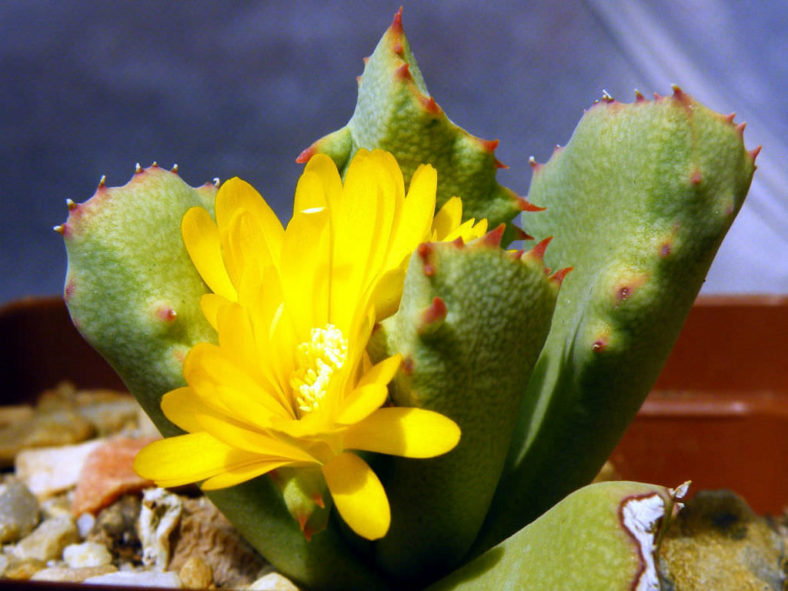
Description
Schwantesia marlothii is a small succulent with 3-angled leaves that gradually widen from the base to the apex and have semi-soft, reddish teeth along the angles. It is a compact, branching grower very similar to Schwantesia ruedebuschii. The leaves are lime green or green and can grow up to 1.8 inches (4.5 cm) long.
The flowers are scentless and yellow, opening in fall from mid-afternoon to sundown.
Origin
Schwantesia marlothii is native to South Africa. It grows among large quartz stones and in crevices in Northern Namaqualand, west of Pofadder, in South Africa.
How to Grow and Care for Schwantesia marlothii
Light: Schwantesia marlothii thrives in bright light and can tolerate full sun or partial shade. It benefits from several hours of direct sunlight, especially during the cooler months. However, protect it from intense afternoon sunlight during hot summer days to prevent sunburn.
Soil: This plant requires a porous, well-draining soil mix that prevents excess moisture from accumulating around its roots. Use a commercial succulent potting mix or make your own.
Temperature: Schwantesia marlothii tolerates warm conditions but prefers cooler temperatures during its active growing season. Protect it from prolonged extreme heat and freezing temperatures. This plant is hardy in USDA Plant Hardiness Zones 10a-11b, which have average annual extreme minimum winter temperatures ranging from 30°F to 50°F (-1.1°C to 10°C).
Watering: As a primarily winter-growing succulent, Schwantesia borcherdsii enters dormancy during the warmer months. Water moderately from fall through spring, allowing the soil to dry out completely between waterings. During summer dormancy, reduce watering significantly and water only occasionally if the leaves appear noticeably shriveled. Avoid overwatering, especially in hot weather, as it can lead to root rot.
Fertilizing: This plant has low nutrient needs and generally does not need additional fertilizer if you repot it into fresh soil every two to three years. If necessary, apply a diluted, low-nitrogen fertilizer formulated for cacti and succulents once or twice during the active growing season. Avoid fertilizing during summer dormancy.
Repotting: The best time to repot Schwantesia marlothii is in early fall, when it begins its active growing season. You can also repot during active growth if needed. Use a container with drainage holes and avoid watering immediately after repotting, especially if the roots have been damaged, to allow them time to heal.
Propagation: Schwantesia marlothii is primarily propagated from seeds, which are best sown in the fall under mild temperatures. You can also propagate mature plants with multiple heads by carefully dividing them, as long as each section has enough roots. Division is best performed near the beginning of the active growing season. Allow any damaged surfaces to dry before planting the divisions in a well-draining substrate.
Learn more at How to Grow and Care for Mesembs.
Toxicity of Schwantesia marlothii
Schwantesia marlothii is considered non-toxic, making it safe to grow around children and pets.
Photo Gallery
Click on a photo to see a larger version.


Internal Links
- Explore all plants within the genus Schwantesia.
- Explore all plants within the family Aizoaceae.