

Scientific Name
Gasteria carinata (Mill.) Duval
Synonym(s)
Aloe carinata
Common Name(s)
Bredasdorp Gasteria, Keeled Gasteria, Keeled Ox Tongue
Scientific Classification
Family: Asphodelaceae
Subfamily: Asphodeloideae
Tribe: Aloeae
Genus: Gasteria
Etymology
The specific epithet "carinata" (pronounced "kar-IN-uh-tuh") means "carinate; keeled or having a keel-shaped ridge" and refers to the leaves of this species, which usually have keels in mature plants.
Origin
The native range of Gasteria carinata extends from Bredasdorp to the Great Brak River in the Western Cape, South Africa. It occurs in dry river valleys, on shale banks, and on outcrops in the shade of xerophytic shrubs, alongside other succulent species.
Description
Gasteria carinata is a stemless succulent with dark green leaves spotted with white domed, raised, or immersed tubercles arranged in obscure transverse bands. It can grow up to 7.2 inches (18 cm) tall and produce offsets from the base, forming small clusters over time. The leaves are usually spirally arranged or rarely in two opposite vertical rows. They are triangular to triangular-lanceolate, channeled on their upper surfaces, and end in a sharp point, measuring up to 7.2 inches (18 cm) long and 2 inches (5 cm) wide. Juvenile and adult leaves always have a similar texture.
The flowers are white to light pink with central green stripes and can reach up to 1.6 inches (4 cm) in length. They appear on spreading, slightly curved racemose inflorescences in winter and spring. The inflorescences can grow up to 3 feet (90 cm) long.
Gasteria carinata is the most variable species in the genus, and it isn't easy to define.
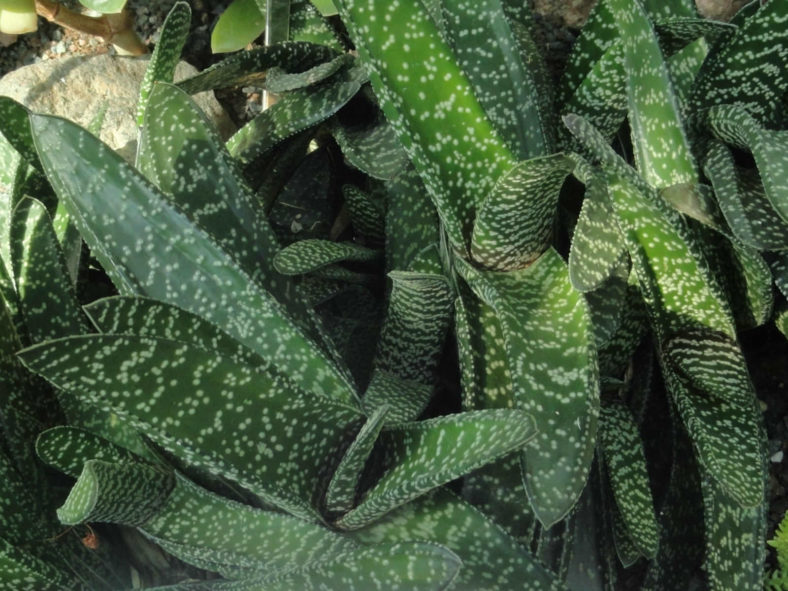
Varieties and Forms of Gasteria carinata
- Gasteria carinata var. carinata
- Gasteria carinata var. retusa
- Gasteria carinata var. thunbergii
- Gasteria carinata var. verrucosa
- Gasteria carinata f. variegata
Hybrids of Gasteria carinata
How to Grow and Care for Gasteria carinata
Hardiness: USDA hardiness zone 9b to 11b: from 25°F (-3.9°C) to 50°F (10°C).
These plants are often grouped with Haworthias because they have similar cultural requirements. Both are attractive, small succulents that can tolerate somewhat more shade than many succulents, making them more suitable as houseplants.
Gasterias are susceptible to fungal infections, which usually appear as black spots on the leaves. These result from too much humidity or water on the leaves, but they should not spread too quickly. They have a natural defense mechanism against such fungal attacks, which attack the invading organism and seal off the wounded spot. In general, any place where Haworthia and Aloe thrive will be hospitable to a Gasteria.
These succulents are small, shallow-rooted, and relatively slow-growing. Therefore, they are often grown in small clusters in wide, shallow dishes. Over time, clusters will naturally enlarge as the mother plant sends off small plantlets.
See more at How to Grow and Care for Gasteria.
Links
- Back to genus Gasteria
- Succupedia: Browse succulents by Scientific Name, Common Name, Genus, Family, USDA Hardiness Zone, Origin, or cacti by Genus
Photo Gallery
Click on a photo to see a larger version.

