

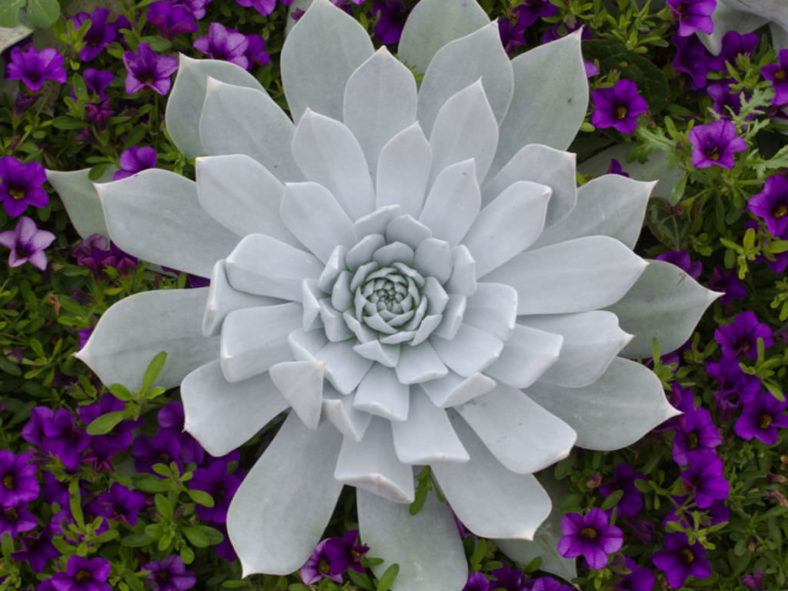
Dudleya brittonii, commonly known as Britton's Dudleya or Giant Chalk Dudleya, is a beautiful succulent native to the northern coast of Baja California, Mexico. It is one of the largest species within its genus and is known for having the highest measured ultraviolet reflectivity of any plant, due to its thick, chalky-white coating.
Taxonomy of Dudleya brittonii
Scientific Name
Dudleya brittonii D. A. Johans.
Common Name(s)
Giant Chalk Dudleya, Britton's Dudleya, Britton's Liveforever, Silver Dollar Plant
Scientific Classification
Family: Crassulaceae
Subfamily: Sempervivoideae
Tribe: Sedeae
Genus: Dudleya
Etymology
The specific epithet "brittonii" (pronounced "brit-TON-ee-eye") honors Nathaniel Lord Britton🡕 (1859–1934), an American botanist, taxonomist, and co-founder and the first Director of the New York Botanical Garden.
Origin of Dudleya brittonii
Dudleya brittonii is native to o the coast of northern Baja California, Mexico. It occurs on bluff faces and steep slopes from extreme northwest Baja California, from La Misión south to the vicinity of Eréndira, and on the island of Todos Santos.
Description of Dudleya brittonii
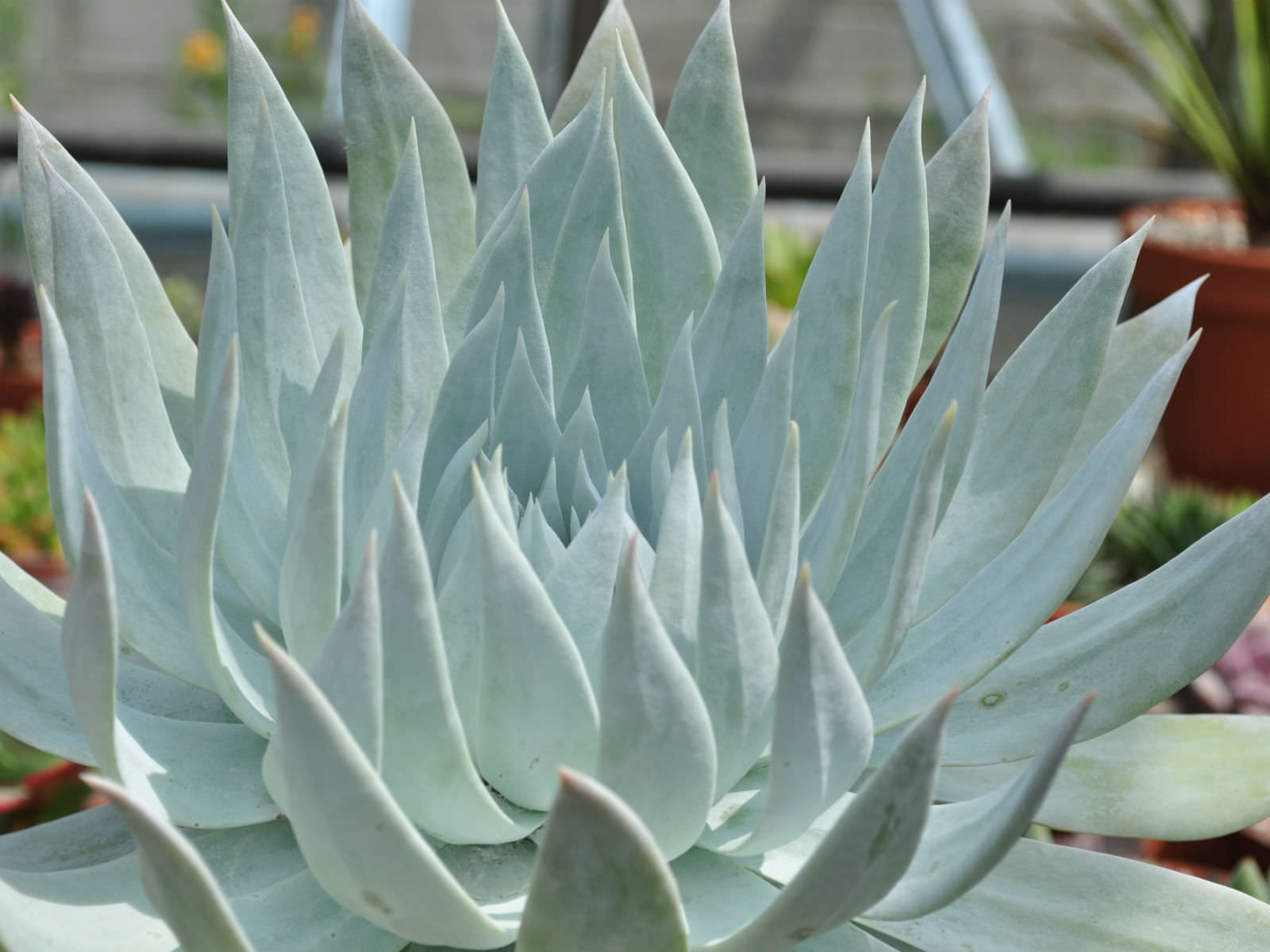
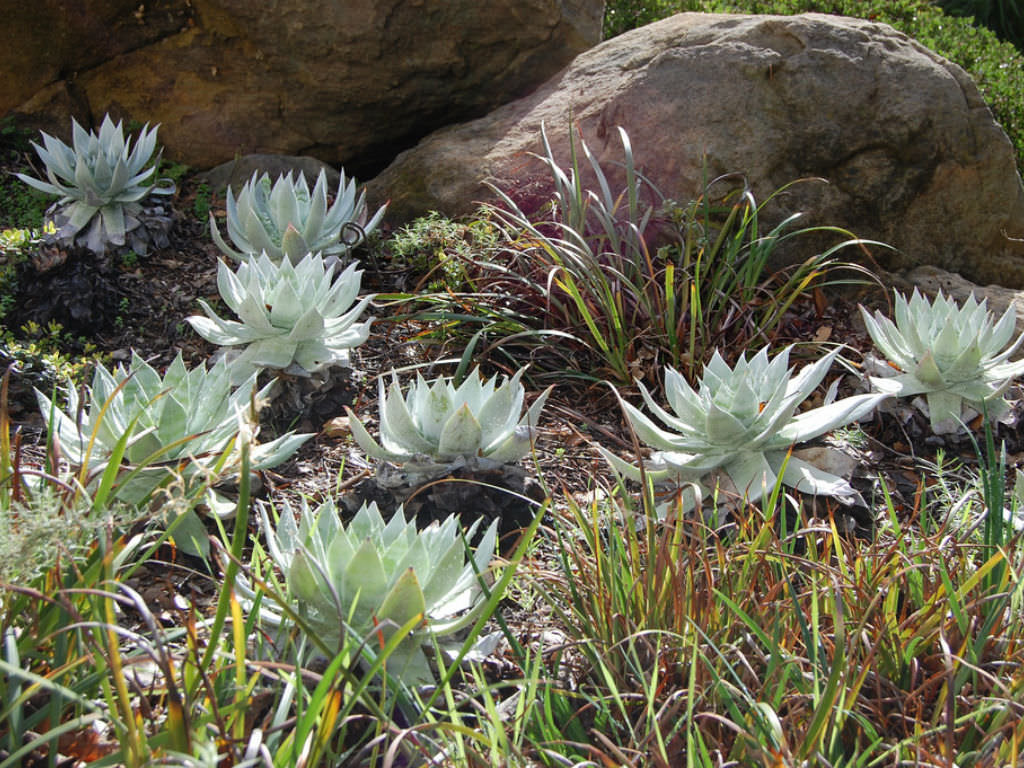
Dudleya brittonii is a stunning succulent with a short, thick basal stem topped by a rosette of green leaves, coated in a chalky-white, powdery coating, and often with reddish tips. The rosettes usually grow solitary or, rarely, in groups of 2 to 10, and can reach a diameter of up to 20 inches (50 cm). The leaves are linear to lance-shaped, measuring up to 10 inches (25 cm) long and 3.4 inches (8.5 cm) wide.
The flowers are translucent or sometimes whitish, with a yellowish keel. They are urn-shaped and appear in late winter and spring on stout, reddish-violet spikes with branchlets holding slender pedicels. The flower spikes can grow up to 3 feet (90 cm) long.
How to Grow and Care for Dudleya brittonii
Hardiness: USDA hardiness zones 9a to 11b: from 20°F (-6.7°C) to 50°F (10°C).
Most of the various habitats Dudleyas occupy become dry in summer. Therefore, cutting off water to Dudleyas in your garden during the summer is important. Plants grown in sandy soils or containers are exceptions. They will accept infrequent summer watering as long as the soil drains well. The onset of fall or winter rains reawakens Dudleyas from drought-induced dormancy. Their shriveled leaves plump up quickly, growth resumes, and flowering occurs during the following spring or summer. These plants are amazingly resilient. If a portion of a colony sloughs off a cliff face or is uprooted by a burrowing animal, it can persist for months until it re-establishes soil contact. Species that naturally grow on ocean bluffs are also salt-spray tolerant.
Dudleyas have their share of disease and pest problems. If you can prevent Argentine Ants from introducing mealybugs or aphids to your Dudleyas, they will be healthier. Mealybugs nestle in the deep recesses of the leaves, and their feeding weakens the plants.
Learn more in "How to Grow and Care for Dudleya."
Photo Gallery
Click on a photo to see a larger version.

Internal Links
- Explore all plants within the genus Dudleya.
- Explore all plants within the family Crassulaceae.