Scientific Name
Ariocarpus retusus Scheidw.
Synonym(s)
Anhalonium prismaticum, Ariocarpus prismaticus
Common Name(s)
False Peyote, Living Rock, Living Rock Cactus, Star Rock
Scientific Classification
Family: Cactaceae
Subfamily: Cactoideae
Tribe: Cacteae
Genus: Ariocarpus
Etymology
The specific epithet "retusus" (pronounced "re-TOO-sus") means "retuse" or "blunt" and refers to the somewhat blunted tips of the tubercles of this species.
Forms of Ariocarpus retusus
- Ariocarpus retusus var. furfuraceus (not accepted as a separate variety and is treated as a synonym of Ariocarpus retusus)
Origin of Ariocarpus retusus
The native range of Ariocarpus retusus extends from Coahuila and Nuevo León to San Luis Potosí in Mexico. It grows on limestone or rocky slopes.
Description of Ariocarpus retusus
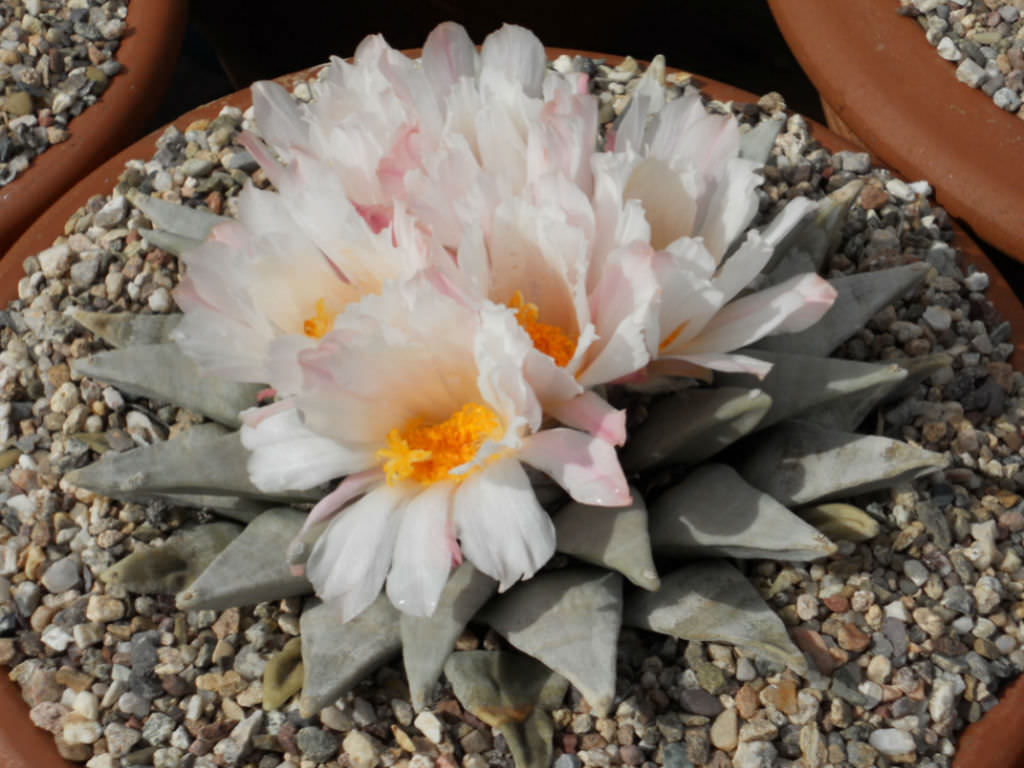
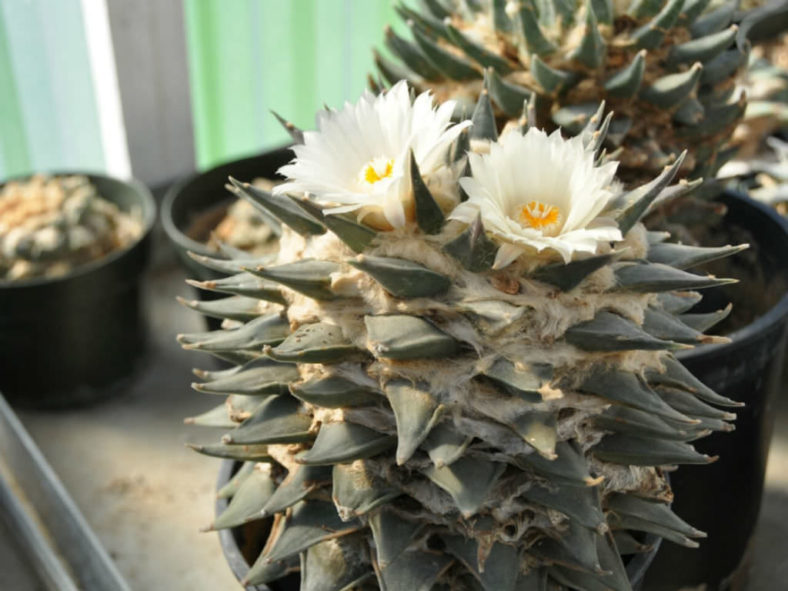
Ariocarpus retusus is an unusual, slow-growing cactus with a solitary, flattened-globose stem covered with long, pyramidal tubercles that have woolly bases, resembling a rosette. The stem is grey-green or blue-green and can grow up to 5 inches (12.5 cm) tall and 10 inches (25 cm) in diameter. The tubercles can measure up to 1.6 inches (4 cm) in length and up to 1.4 inches (3.5 cm) in width.
The diurnal flowers are white to pink, sometimes with reddish midribs, and appear in the fall. They can reach a length of 1.7 inches (4.2 cm) and a diameter of 2 inches (5 cm). The fruits are white, green, or rarely pinkish, and can grow up to 1 inch (2.5 cm) long and up to 0.4 inches (1 cm) in diameter.
Despite its slow growth, often taking ten years to reach flowering age, Ariocarpus retusus is a desirable cactus for cultivation because of its interesting form and attractive flowers.
How to Grow and Care for Ariocarpus retusus
Hardiness: USDA hardiness zones 9b to 11b: from 25°F (-3.9°C) to 50°F (10°C).
Plant your Ariocarpus in soil specifically formulated for cacti. You can buy a cactus mix at your local nursery. Avoid using generic soil mixes, as they will not provide sufficient aeration and drainage. Additionally, using a container without a hole, whether a pot or a terrarium, is a bad idea for the same reason.
Ariocarpus needs a lot of sunlight. However, in hot, dry areas, they can be damaged by excessive sunlight, so you should use a shade cloth to limit their exposure or move them out of direct sunlight during the hottest hours of the day. In more temperate areas, direct sunlight is fine.
These cacti prefer to be kept at room temperature or slightly lower and in low humidity.
Water your Ariocarpus when it is dry, but wait until the soil dries out completely before watering again.
See more at How to Grow and Care for Ariocarpus.
Links
- Back to genus Ariocarpus
- Succupedia: Browse succulents by Scientific Name, Common Name, Genus, Family, USDA Hardiness Zone, Origin, or cacti by Genus
Photo Gallery
Click on a photo to see a larger version.