

The world of plants is often one of strange beauty and pure wonder. Coming in many shapes and sizes, plants are all unique in some way, yet cacti are among the most remarkable plants in the world. An outer layer of spines protects cacti, helping them endure the harshest and most demanding environments. Relying on their incredible water storage abilities and thick skin to prevent water loss, they are hidden deep in the driest deserts and even up on the peaks of some mountains. While cacti are unique amongst other plants, some are bizarre, even by cacti standards.
1. Agave Cactus (Leuchtenbergia principis)
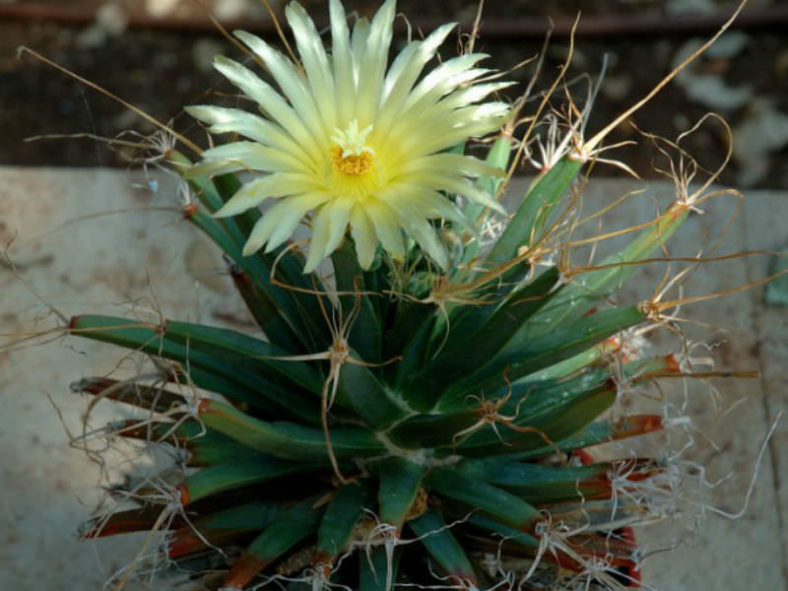
Known as the Agave Cactus, Leuchtenbergia principis is unique due to the straight, finger-like protrusions from its main stem. These "fingers" are tipped with small clusters of spines that, in older specimens, can grow into a tangled, protective web on the top portion of the plant. The Agave Cactus starts as a normal cactus seedling and soon develops its distinctive points. As it ages, these form into its thick photosynthetic "fingers." Once the protrusions have formed, the Agave Cactus maintains its shape, becoming broader and sturdier, yet remains a single plant. This is abnormal because most cacti typically begin producing offspring at some point, or even "arms" in taller species.
2. Living Rocks (Ariocarpus fissuratus)
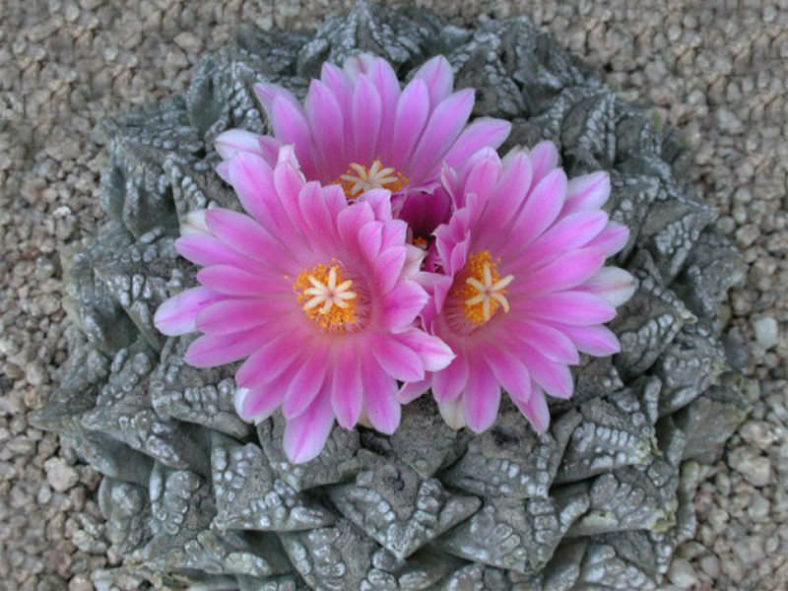
Cacti are often associated with spines, yet a few species have no spines or lose them as they mature. Ariocarpus fissuratus is a highly slow-growing example of spineless cacti. Some can take up to 50 years to get a diameter of 4 to 5 inches (10 to 12.5 cm). As a seedling, these plants have tiny, weak spines that grow from the points of their geophytic structure. As the plant ages, these spines fall off, and no new ones grow to replace them. This results in a plant with an unusual appearance and no defense, which appears counterintuitive to the species' health. Because it lacks defenses, Ariocarpus fissuratus grows in hard-to-reach crevices and similar habitats, producing small amounts of psychoactive compounds to deter herbivores.
3. Astrophytum caput-medusae
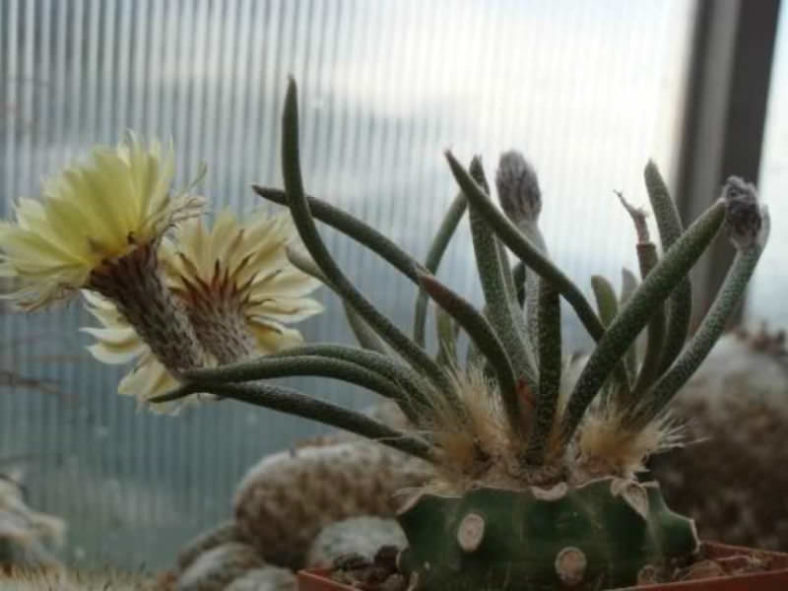
One of a kind in form, Astrophytum caput-medusae grows as its name implies, like the snake hair of Medusa. It was first classified until it was discovered that its flowers were identical to those of the Astrophytum genus, and its small tufts of soft, wool-like hairs on its stem. This secured its place as an Astrophytum species. Producing brilliant yellow flowers with red centers, A. caput-medusae readily produces some of the largest seeds among cacti.
4. Peyote (Lophophora williamsii)
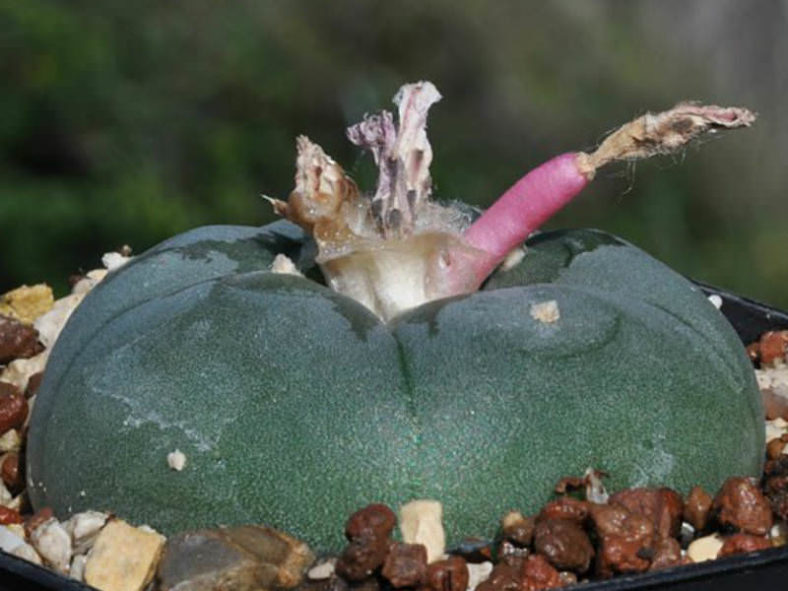
One of the most well-known and well-regulated cacti is Lophophora williamsii, commonly known as Peyote. Illegal to grow or own, Peyote is known for its powerful psychedelic effects, thanks to high mescaline concentrations. It is only legal for use by members of Native American tribes because Peyote has long been a central aspect of Native American rituals. According to these tribes, the use of Peyote often led to an understanding of spirits and other intangible entities.
5. Discocactus horstii
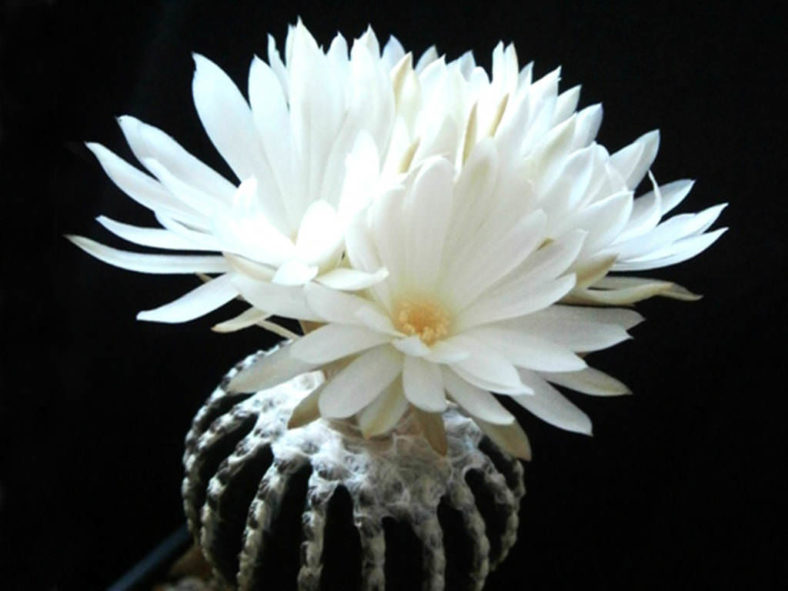
When mature, Discocactus horstii develops a cephalium, a densely spiked growth from which its large white flowers appear. While it is green in the early stages of its life, Discocactus eventually develops a red tint. However, it resembles a standard desert cactus when young. These cacti grow around 1,000 feet (304 m) above sea level. Discocactus can be challenging to grow since they tend to rot if overwatered and dry out completely if left without water for shorter periods than most cacti can endure.
6. Dragon Fruit (Hylocereus undatus)
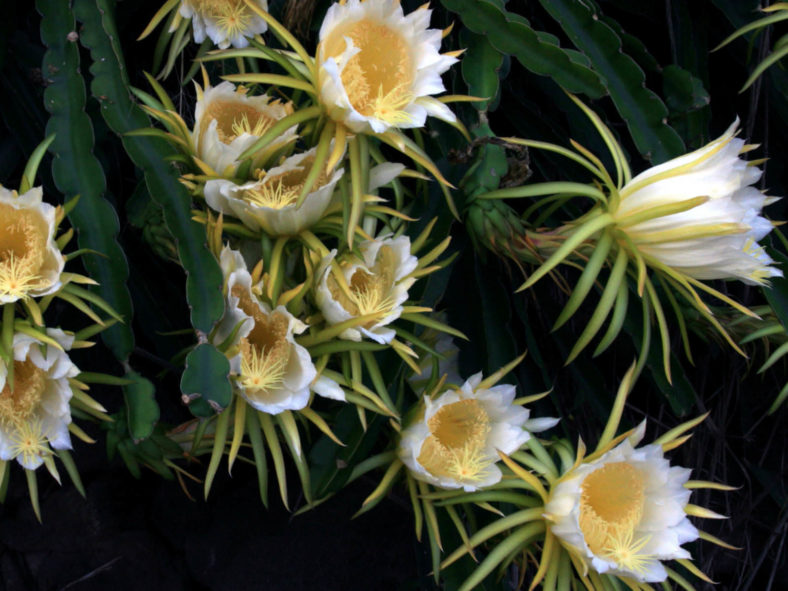
When someone brings up flowers, cacti do not immediately spring to mind, even though cacti can be enormous and beautiful. The Hylocereus undatus flower can exceed 14 inches (35 cm) in length and 9 inches (22.5 cm) in diameter. Hylocereus undatus blooms only at night, and each flower opens only once before seeding and becoming a dragon fruit or falling off and dying. The flowers emit an extremely potent vanilla fragrance that can be overwhelming when smelled directly.
7. Alfilerillo (Pereskiopsis diguetii)
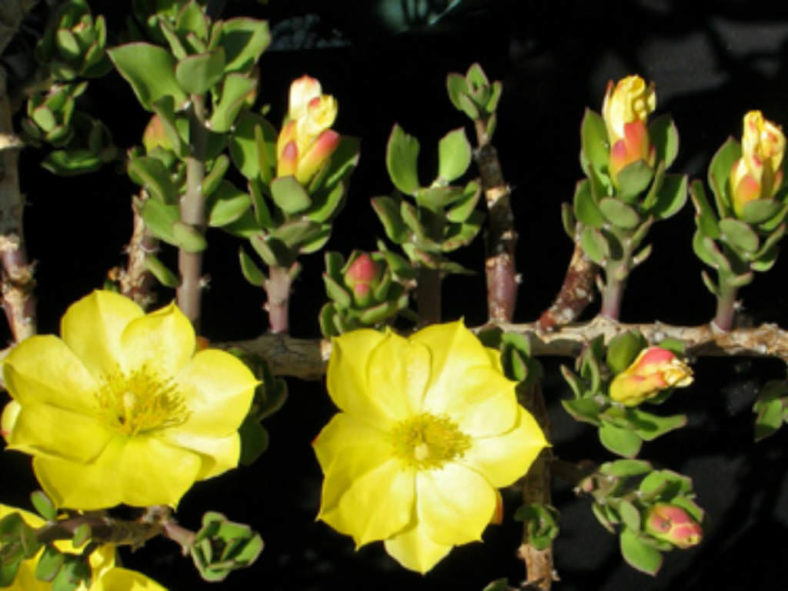
Some cacti are in a primitive enough state that they have both leaves and spines. Pereskiopsis diguetii is one of these, characterized by small spines, glochids, and leaves that sprout from a single point. Tropical and extremely fast-growing by nature, Pereskiopsis diguetii is often used as a grafting base to speed the growth process of seedlings of slow-growing species. While still capable of flowering, it is rare to find a Pereskiopsis diguetii grown for its appearance or flowers. Instead, most specimens are rooted cuttings from a mother plant, resulting in numerous clones that can be propagated by cuttings.
8. Turbinicarpus subterraneus
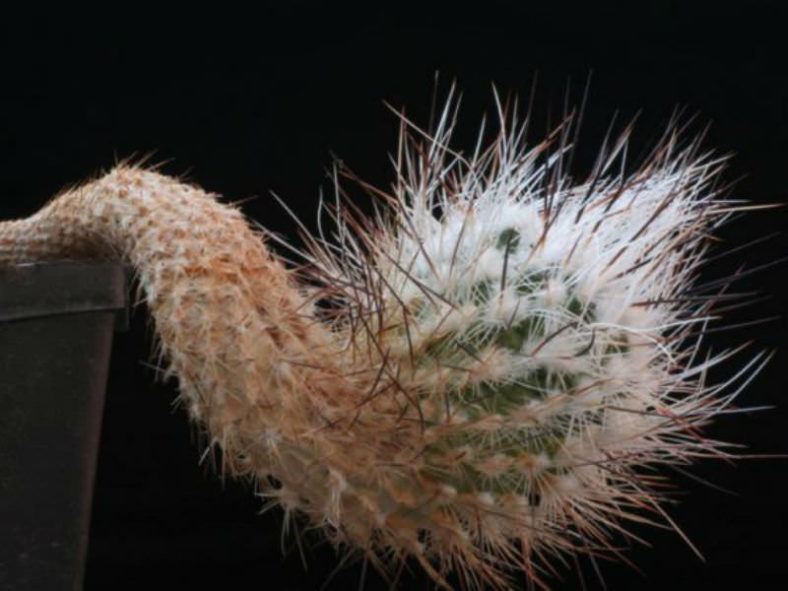
When thinking of cacti, we often think of tall, thick-stemmed plants coated in spikes, which is usually untrue. With the Turbinicarpus subterraneus, the true surprise is below the soil's surface. The small, club-like heads are supported by a tuberous root, often the same size as the exposed stems. This root enables T. subterraneus to survive prolonged drought by storing large amounts of water. Being below the surface also makes it sufficiently cold-resistant to endure short periods of exposure to temperatures as low as 25°F (-4°C).
9. Atrichoke Cactus (Obregonia denegrii)
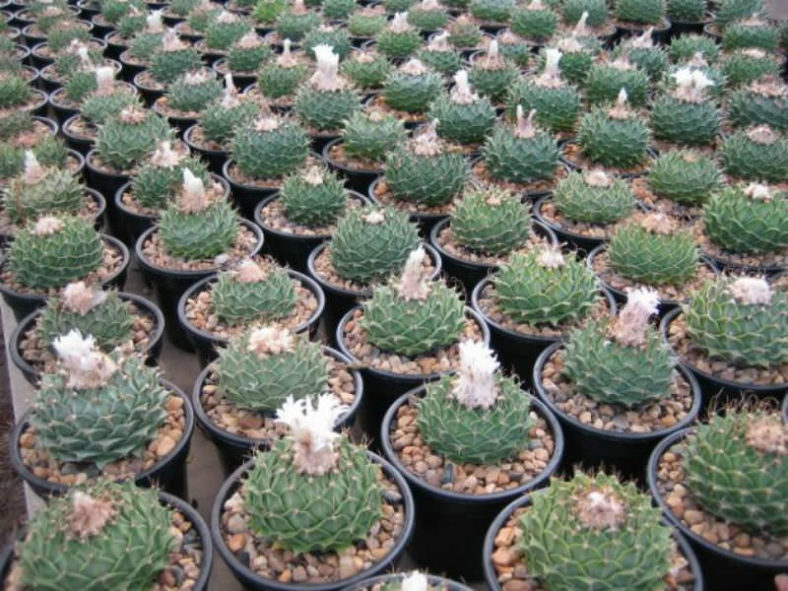
Commonly referred to as Artichoke Cactus, Obregonia denegrii is the only species in the Obregonia genus. Like the Ariocarpus and Leuchtenbergia genus, the Artichoke Cactus grows in a geophytic manner, with its body points spiraling from the growth point. While it does have spines, they are often shed from the plant, resulting in sparse patches of spines on the ends of the areoles. The spiraling, combined with the type of stem, results in the signature artichoke shape. Small flowers bloom from the tips of young growth in summer, resulting in an edible, fleshy fruit when fertilized and ripe.
10. Blossfeldia liliputana
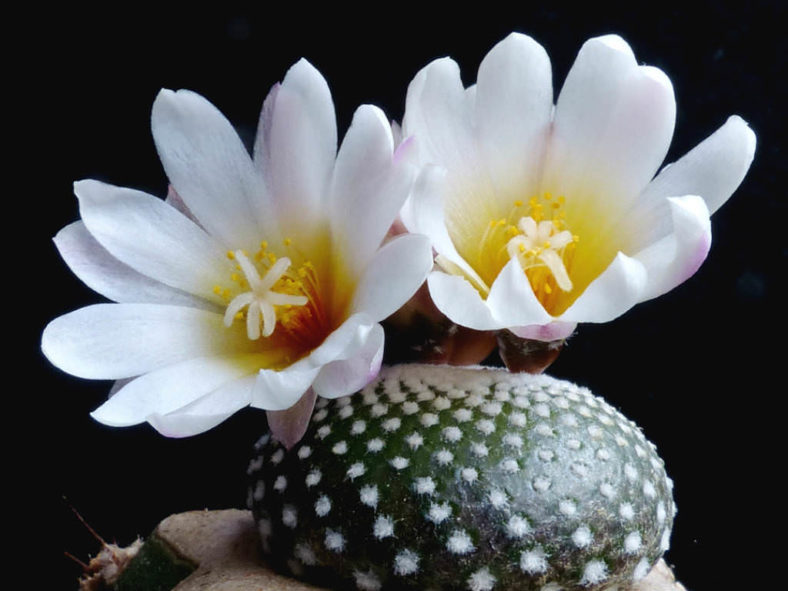
Often growing between rocks in the Andes mountains, Blossfeldia liliputana earns its name from the land of Lilliput in the novel Gulliver's Travels, where all its citizens were tiny to Gulliver. This is because Blossfeldia liliputana is the smallest cactus, maxing out at 0.5 inches (1.3 cm) in diameter. Its size, as well as its growth patterns, make this small wonder incredibly unique. Cacti often have a rounded growth point, yet B. liliputana grows from an indent at the center of the plant. Flowering during the summer months, B. liliputana self-fertilizes and produces seeds that are so small they easily blend in with the surrounding rock and sand.
Links
- Succupedia: Browse succulents by Scientific Name, Common Name, Genus, Family, USDA Hardiness Zone, Origin, or cacti by Genus