

Orbea sprengeri is a stunning succulent that is relatively easy to care for, making it a popular choice among succulent enthusiasts. It is known for its unique, star-shaped flowers and low-maintenance requirements. This species was first described in 1893 by Hildegard Dammann🡕 and Carl Ludwig Sprenger🡕 in their nursery catalog (Dammann & Co.), where it was listed as Huernia sprengeri.
Taxonomy of Orbea sprengeri
Scientific Name
Orbea sprengeri (E.Dammann & Sprenger) Bruyns
Synonym(s)
Angolluma sprengeri, Caralluma sprengeri, Ceropegia sprengeri, Huernia sprengeri, Pachycymbium sprengeri
Scientific Classification
Family: Apocynaceae
Subfamily: Asclepiadoideae
Tribe: Ceropegieae
Subtribe: Stapeliinae
Genus: Orbea
Etymology
The generic name "Orbea" (pronounced "ORB-ee-uh") refers to the conspicuous ring-shaped annulus in the flowers of this genus; thus, it may be interpreted as "the one with a ring."
The specific epithet "sprengeri" (pronounced "SPRENG-er-ee") honors Carl Ludwig Sprenger (1846-1917), a German botanist.
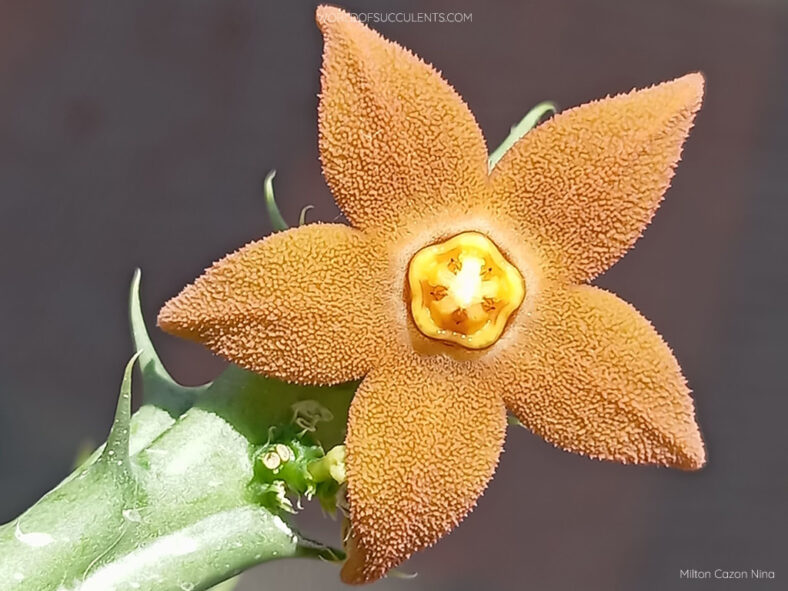
Description of Orbea sprengeri
Orbea sprengeri is a small succulent that forms clumps of green stems with tubercles arranged in four broad angles separated by grooves. The stems can grow up to 5 inches (12.5 cm) long and 0.75 inches (2 cm) thick.
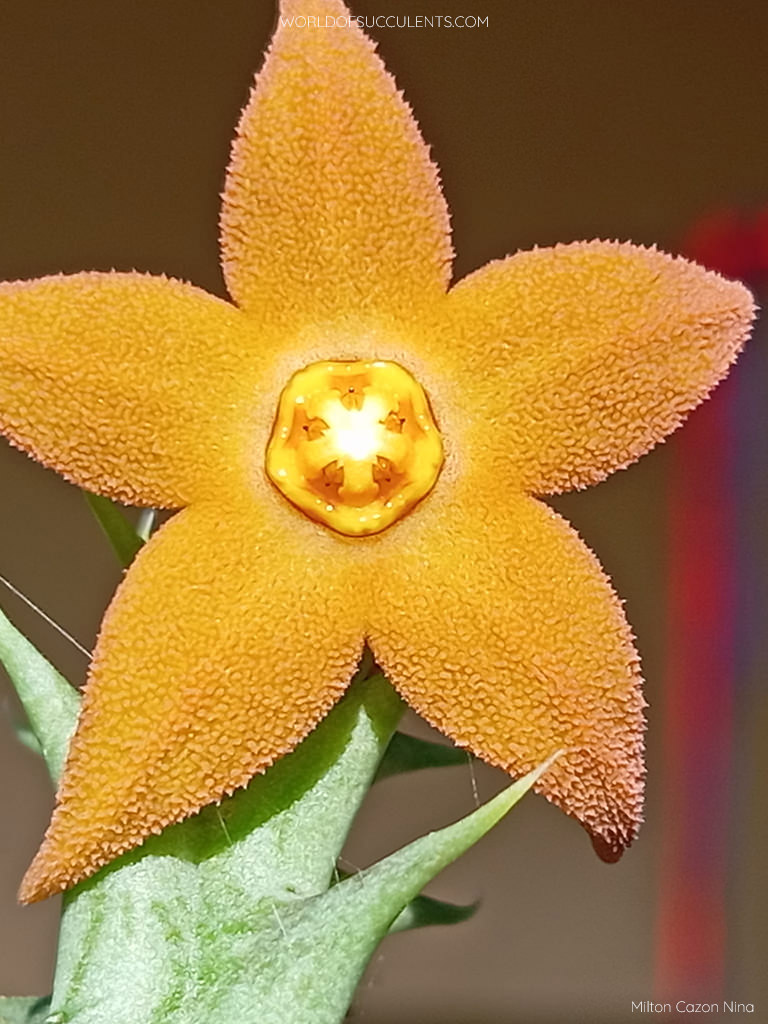
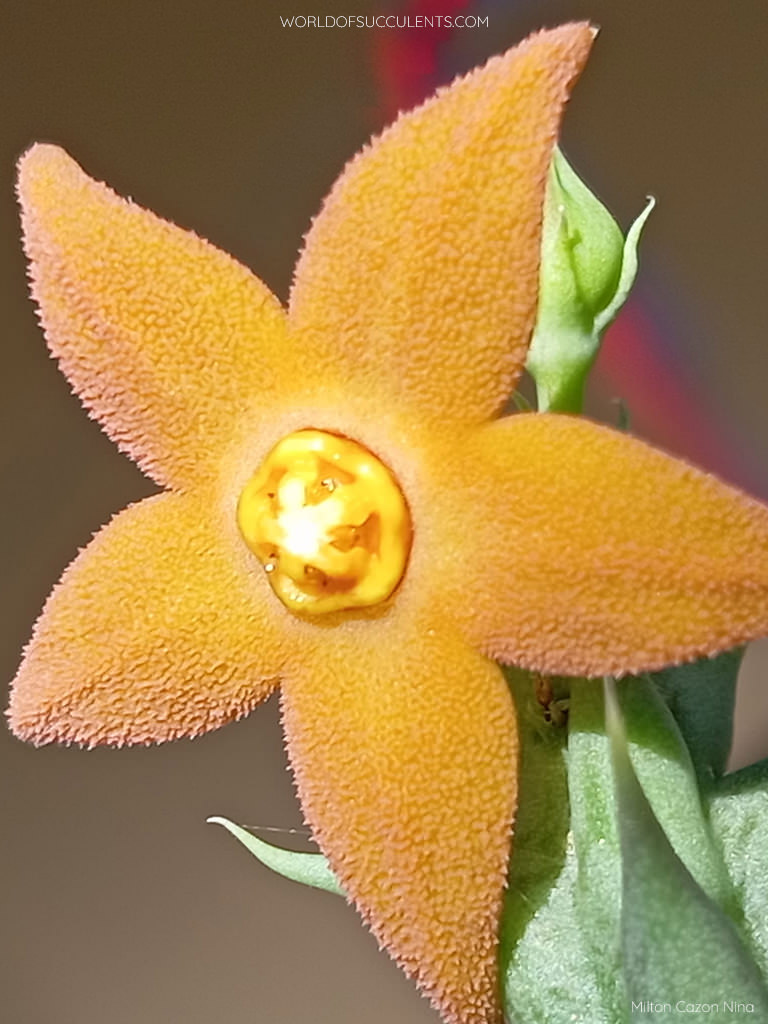
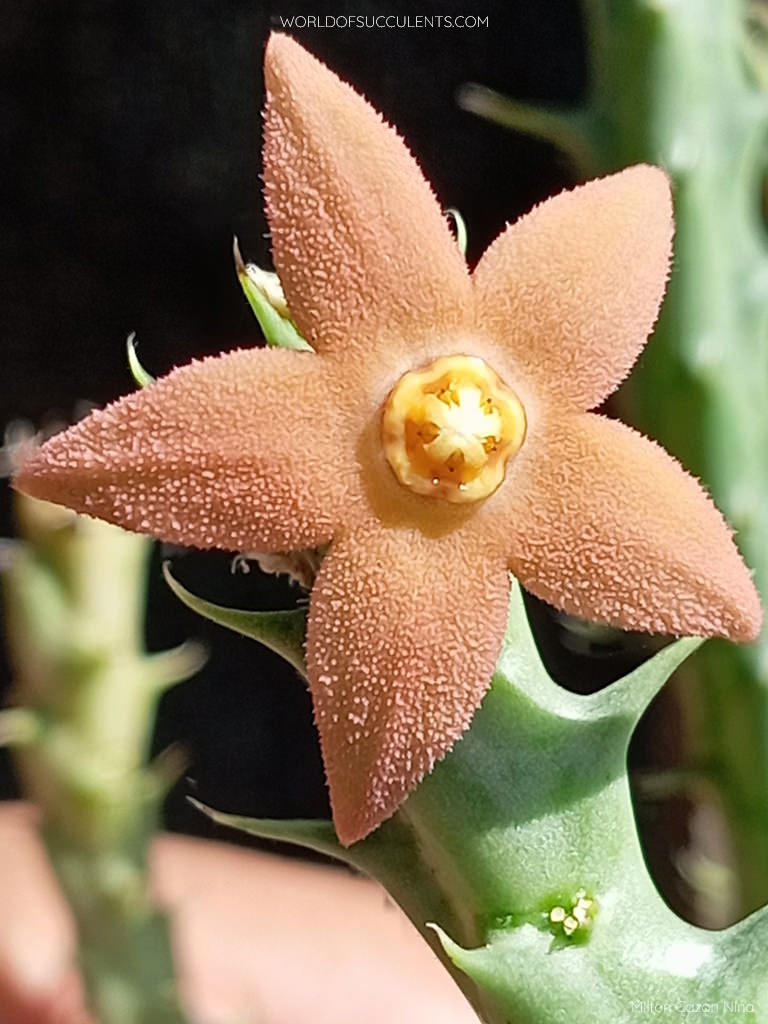
In the fall, Orbea sprengeri produces attractive, yellowish-brown flowers on very short stalks. The corolla of the flowers is rotate and can reach a diameter of 1 inch (2.5 cm).
Origin of Orbea sprengeri
Orbea sprengeri is native to Kenya, Somalia, Ethiopia, South Sudan, Eritrea, Yemen, and Saudi Arabia.
Subspecies of Orbea sprengeri
- Orbea sprengeri subsp. commutata
- Orbea sprengeri subsp. foetida
- Orbea sprengeri subsp. ogadensis
- Orbea sprengeri subsp. sprengeri
How to Grow and Care for Orbea sprengeri
Light: Orbea sprengeri thrives in full sun or partial shade during the hottest summer days. Too much sun causes the stems to develop a protective pigmentation or get sunburned. Not enough light leads to weak, thin stems and fewer flowers. Indoors, place the plant near a sunny window.
Soil: The right soil is crucial to growing a healthy plant. Use commercial soil for succulents, or prepare your own mix with 50% to 70% mineral grit, such as coarse sand, pumice, or perlite.
Temperature: This plant thrives in warm outdoor environments but dislikes winter cold and should remain moderately dry and warm during its winter dormancy. Orbea sprengeri is hardy in USDA Plant Hardiness Zones 11a-11b, which have average annual extreme minimum winter temperatures ranging from 40°F to 50°F (4.4°C to 10°C).
Watering: It has typical watering needs for a succulent. During the growing season, water your plant thoroughly and allow the soil to dry before watering again. The plant goes dormant in winter and needs almost no water, about once a month.
Fertilizing: To keep it thriving, fertilize during the growing season. Feed with water-soluble fertilizer diluted to half-strength.
Repotting: Orbea sprengeri will benefit from fresh potting soil every 2 or 3 years. Repot it in spring, just before the growing season starts. Pick a container with drainage holes.
Propagation: The best way to propagate this succulent is by stem cuttings. It is also easy to grow from seeds. Take cuttings during the growing season to ensure good rooting, and sow the seeds in spring.
Learn more in "How to Grow and Care for Stapelia."
Toxicity of Orbea sprengeri
Orbea sprengeri has no reported toxic effects. It is safe around pets and humans.
Photo Gallery
Click on a photo to see a larger version.
Internal Links
- Explore all plants within the genus Orbea.
- Explore all plants within the family Apocynaceae.
References
- Royal Botanic Gardens, Kew (1985). Bulletin of Miscellaneous Information, Vol. 40, p. 263.
- Orbea sprengeri (E.Dammann & Sprenger) Bruyns🡕. Plants of the World Online. Kew Science. Retrieved December 3, 2026.
- Orbea sprengeri (Schweinf.) Bruyns🡕. The World Flora Online. Retrieved December 3, 2026.