

The broad category of succulents encompasses thousands of plants, making it challenging to identify a specific genus and species. Identification can also be difficult because succulents often have multiple common names used interchangeably. A few steps you can take to get an accurate identification focus on using the plant's physical features as descriptors.
What is a Succulent?
Succulents are plants with fleshy leaves, stems, or roots that store water. Cacti, which tend to have spikes, fall under the broad succulent category, but not all succulents are cacti. For both cacti and other succulents, pure liquid water is unlikely to be found within the plant's foliage. Instead, the leaves, stems, or roots typically contain a gel-like, moist substance.
Generally, a plant that has evolved to live in warm, dry climates by storing water in its leaves and stems is considered a succulent. Popular succulents include Crassula, Haworthia, Mammillaria, Aloe, Sedum, and Lithops, each with unique traits.
Identification Process
One way to avoid a lengthy identification process is to ask the plant seller from whom the succulent plant is being purchased. If the seller doesn't know, or you can't ask, start by determining whether the plant is a succulent or a cactus. Then, get more specific by looking at the plant's leaf shape and overall configuration.
Leaf Shape
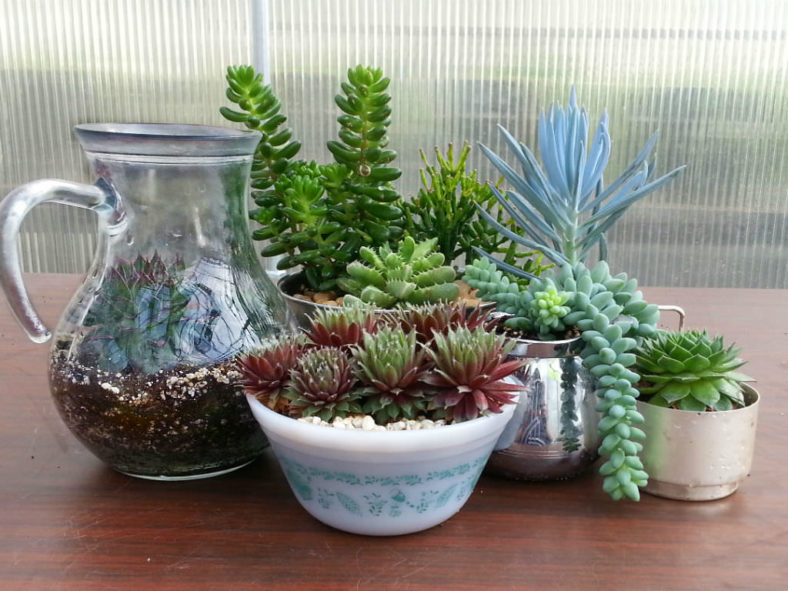
Succulents can have dramatically different leaves, from the long, thin, triangle-shaped leaves of Aloe vera to the small, almost perfectly spherical leaves of a Senecio rowleyanus, also known by its common name, String of Pearls. Leaf shape alone can help with quick identification, as with String of Pearls or succulents with unique leaf shapes; however, this is not always the case.
Rosette Shape
Some succulents have a rosette shape, with tight clusters of leaves radiating outward from a central point, much like a flower. Some rosette succulents have pointed leaves, while others have rounded leaves. Details like these help with identification.
Overall Configuration and Age
Succulent plants sometimes grow long stalks or strands, while others stay squat and close to the ground, growing outwards rather than upwards. Age can also affect a succulent's appearance, with some starting as a cluster of leaves poking out of the soil and growing into a tall, treelike structure with woody stems and leaves only on the outermost parts of the plant. For this reason, it may be easier to identify some succulents as they continue to grow and age.
Plant Size
A plant's overall size can also help with identification. For example, succulents that are just 2.8 or 3.1 inches (7 or 8 centimeters) tall or wide are generally indoor plants, while larger ones are typically grown in the garden. Therefore, a plant's size descriptors can help a succulent owner narrow down options.
Flower Color and Shape
If the succulent has distinctive flowers, that information can help with identification. The time of year the succulent blooms can also matter. For example, Christmas Cactus has long, bright flowers with petals, and it blooms in early to mid-winter, usually right in time for Christmas, hence its common name.
Other Significant Details
A few additional details can help identify a succulent plant. If the plant has easy-to-describe physical features, those words can be keywords that help identify it. For example, if a person owns a succulent with green, spiky leaves with white stripes, you most likely have a Haworthiopsis attenuata (formerly known as Haworthia attenuata) or Haworthiopsis fasciata (formerly known as Haworthia fasciata). If the succulent has long, overlapping leaves, the owner may have a Sedum morganianum, commonly known as Burro's Tail or Donkey's Tail.
Source: ebay.com
Links
- Succupedia: Browse succulents by Scientific Name, Common Name, Genus, Family, USDA Hardiness Zone, Origin, or cacti by Genus