

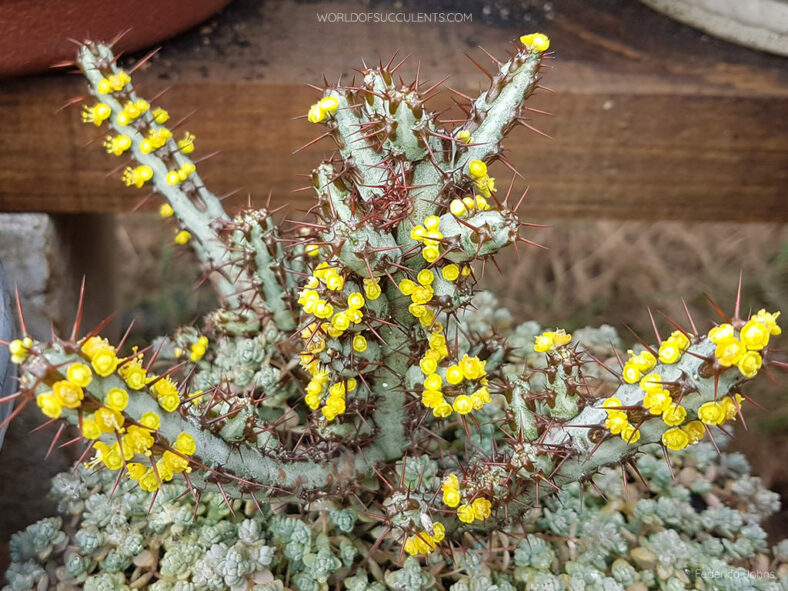
Euphorbia aeruginosa, commonly known as Verdigris Spiny Milkweed, is a dwarf succulent subshrub native to the Limpopo province of South Africa. This decorative plant has sculptural, copper-green stems adorned with contrasting reddish-brown spines.
Taxonomy of Euphorbia aeruginosa
Scientific Name
Euphorbia aeruginosa Schweick.
Common Name(s)
Miniature Saguaro, Verdigris Spiny Milkweed
Scientific Classification
Family: Euphorbiaceae
Subfamily: Euphorbioideae
Tribe: Euphorbieae
Subtribe: Euphorbiinae
Genus: Euphorbia
Etymology
The specific epithet "aeruginosa" (pronounced "air-oo-jin-OH-suh") means "rusty; covered with copper rust" and refers to the copper-green coloration of the plant's stems, resembling the verdigris or copper rust that forms on copper.
Description
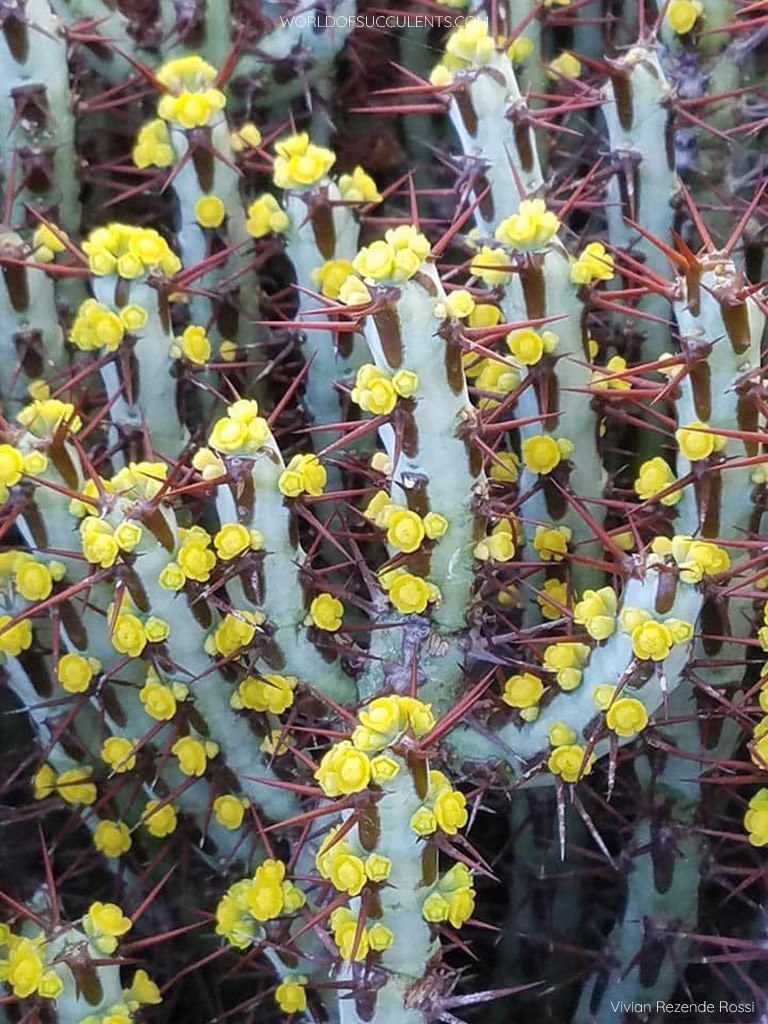
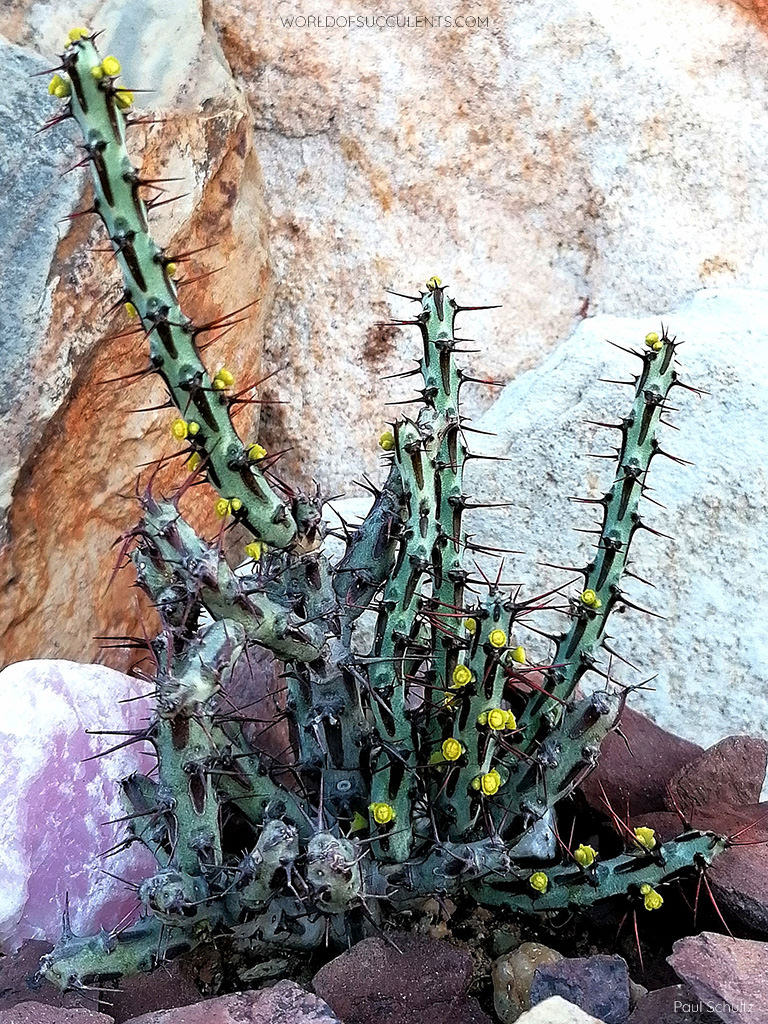
Euphorbia aeruginosa is a succulent subshrub with branching, copper-green stems armed with pairs of reddish-brown spines. It can grow up to 12 inches (30 cm) tall. The stems and branches are cylindrical or subcylindrical and have 4 to 5 angles that are not usually visible except by the arrangement of reddish spine shields. They can reach 6 inches (15 cm) in length and 0.3 inches (0.8 cm) in diameter.
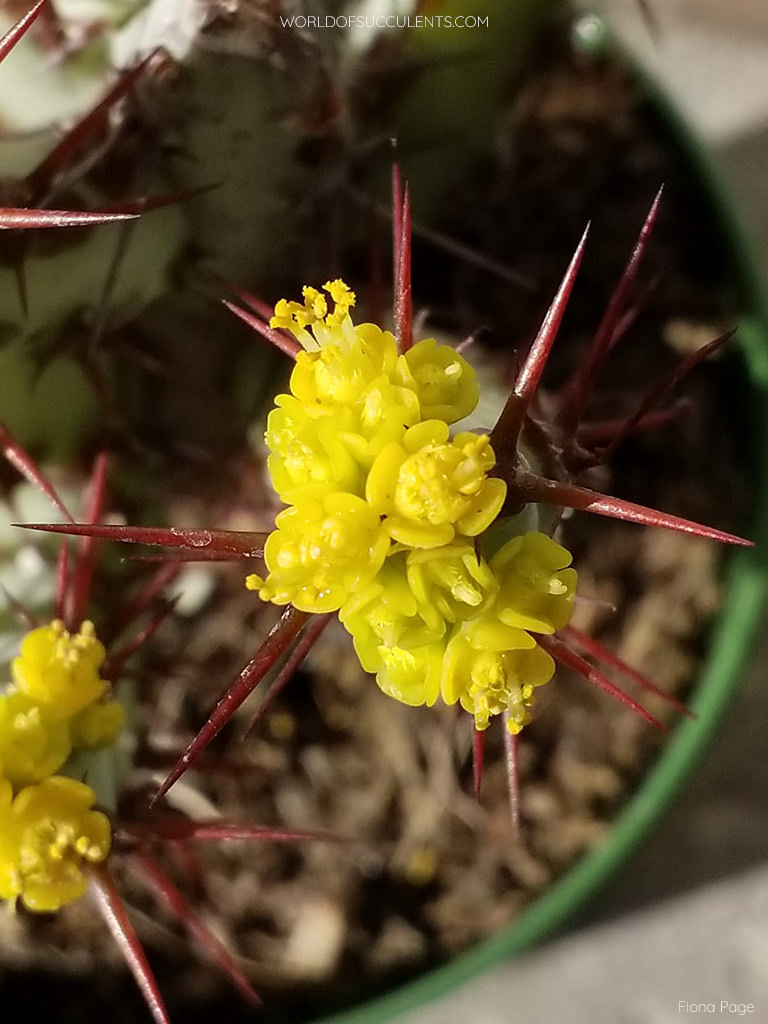
From late winter to spring, Euphorbia aeruginosa produces bright yellow to copper yellow cyathia that consist of petal-like modified leaves, a female flower, and several male flowers. The cyathia appear along the stem. The fruits are obtusely 3-lobed and contain three large seeds, measuring up to 0.12 inches (0.3 cm) in diameter.
Origin
Euphorbia aeruginosa is native to South Africa. It occurs in rocky woodland situations at elevations ranging from 1,000 to 2,900 feet (305 to 885 m) in Limpopo province.
How to Grow and Care for Euphorbia aeruginosa
Light: Providing your Euphorbia aeruginosa with plenty of sunlight is essential for optimal growth. Place it near a sunny window or move it to your balcony or garden during the warmer months, gradually increasing sun exposure to avoid sunburn.
Soil: Use a well-draining soil, either a commercial potting mix formulated for succulents or a mix you create yourself.
Temperature: High summer temperatures are not a problem, but low winter temperatures can damage or kill your plant. Euphorbia aeruginosa grows best in USDA Plant Hardiness Zones 10a to 11b, with average minimum winter temperatures ranging from 30°F to 50°F (-1.1°C to 10°C).
Watering: From spring to fall, water the plant when the top inch (2.5 cm) of soil feels dry. Reduce watering in winter and give it just enough water to prevent wilting. In the warm season, the evening is the best time to water.
Fertilizing: To ensure the potted plant receives sufficient nutrients, apply a balanced 10-10-10 NPK fertilizer diluted to 1/4 strength weekly during the growing season.
Repotting: Although your Euphorbia aeruginosa does not need to be repotted often, it will benefit from repotting when it outgrows its pot. Repotting is best done in early spring, at the beginning of the growing season. Wear gloves, protective clothing, and appropriate eye protection when handling this plant.
Propagation: The easiest and quickest way to propagate this plant is by stem cuttings. Although it can be propagated from seeds, germination can be difficult. Take cuttings during the growing season; spring is the best time to sow seeds.
Learn more at How to Grow and Care for Euphorbia.
Toxicity of Euphorbia aeruginosa
Euphorbia aeruginosa produces a poisonous white milky sap that may cause burns or irritation if in contact with the skin or eyes. Therefore, keep this plant away from children and pets.
Photo Gallery
Click on a photo to see a larger version.
Internal Links
- Explore all plants within the genus Euphorbia.
- Explore all plants within the family Apocynaceae.