

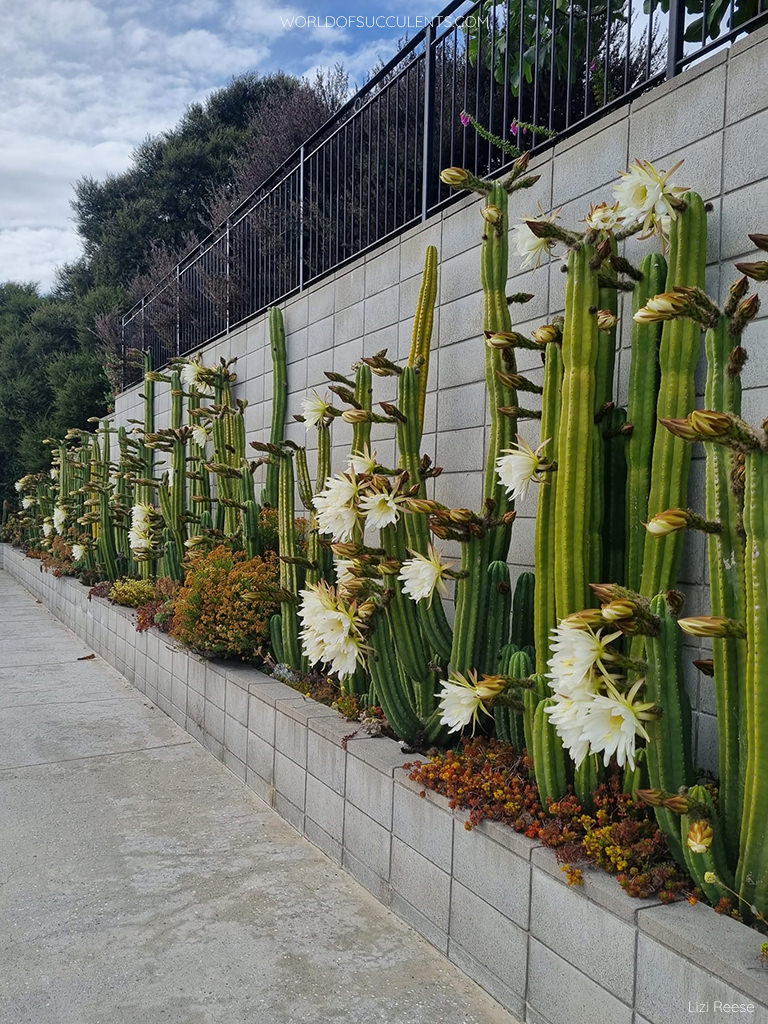
Trichocereus macrogonus var. pachanoi is a cactus commonly grown in Peru, Ecuador, and Bolivia as an ornamental plant or fence. It has a long history of use in the Andes Mountains, where it has been used for religious divination and healing for over 3,000 years. This species is commonly known as the San Pedro Cactus due to the belief that its hallucinogenic properties allow users to "reach heaven while still on earth," drawing a parallel to St. Peter, who is thought to hold the keys to heaven.
Taxonomy of Trichocereus macrogonus var. pachanoi
Scientific Name
Trichocereus macrogonus var. pachanoi (Britton & Rose) Albesiano & R.Kiesling
Common Name(s)
San Pedro Cactus
Synonym(s)
Cereus pachanoi, Echinopsis pachanoi, Trichocereus macrogonus subsp. sanpedro, Trichocereus pachanoi
Scientific Classification
Family: Cactaceae
Subfamily: Cactoideae
Tribe: Cereeae
Subtribe: Trichocereinae
Genus: Trichocereus
Etymology
The varietal epithet "pachanoi" (pronounced "puh-KAH-no-ee") honors Professor Abelardo Pachano (1885–1958), a famous Ecuadorian who assisted the American botanist Joseph Nelson Rose🡕 on his expedition to South America.
Description
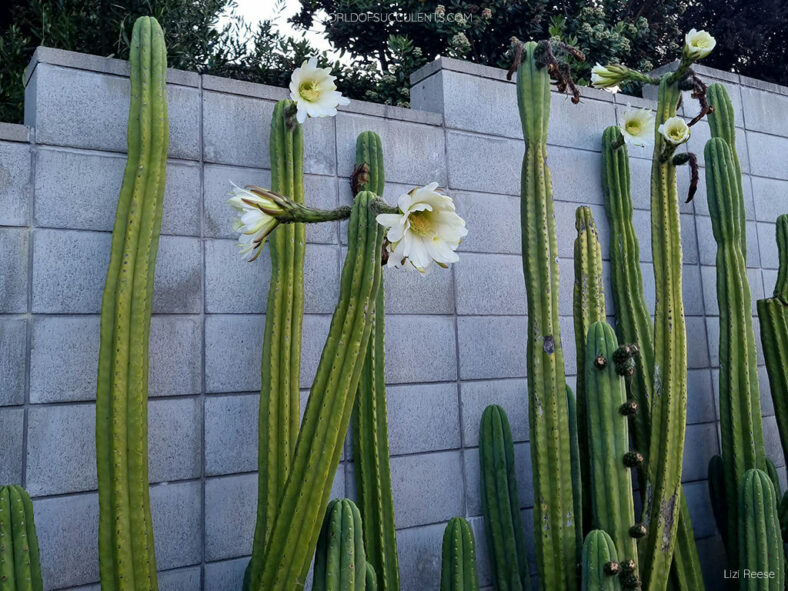
Trichocereus macrogonus var. pachanoi, formerly known as Trichocereus pachanoi or Echinopsis pachanoi, is a fast-growing columnar cactus with erect stems having 4 to 8 ribs lined with areoles armed with clusters of spines. It can grow up to 13.1 feet (4 m) and produce multiple branches, typically extending from the base. The branches are pale green when young, maturing to dark green, and can reach a diameter of 6 inches (15 cm). The round areoles are grey or dark brown and can bear 3 to 7 yellow to pale brown spines, all similar, growing up to 0.8 inches (2 cm) long. On older areoles, the spines are often absent.
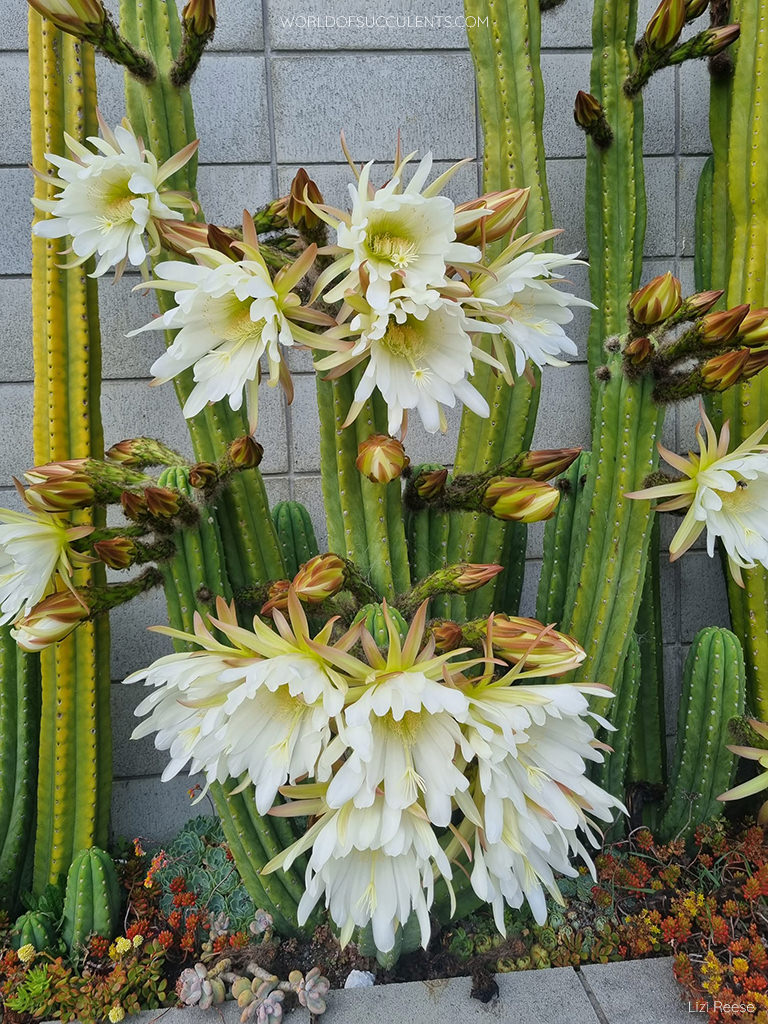
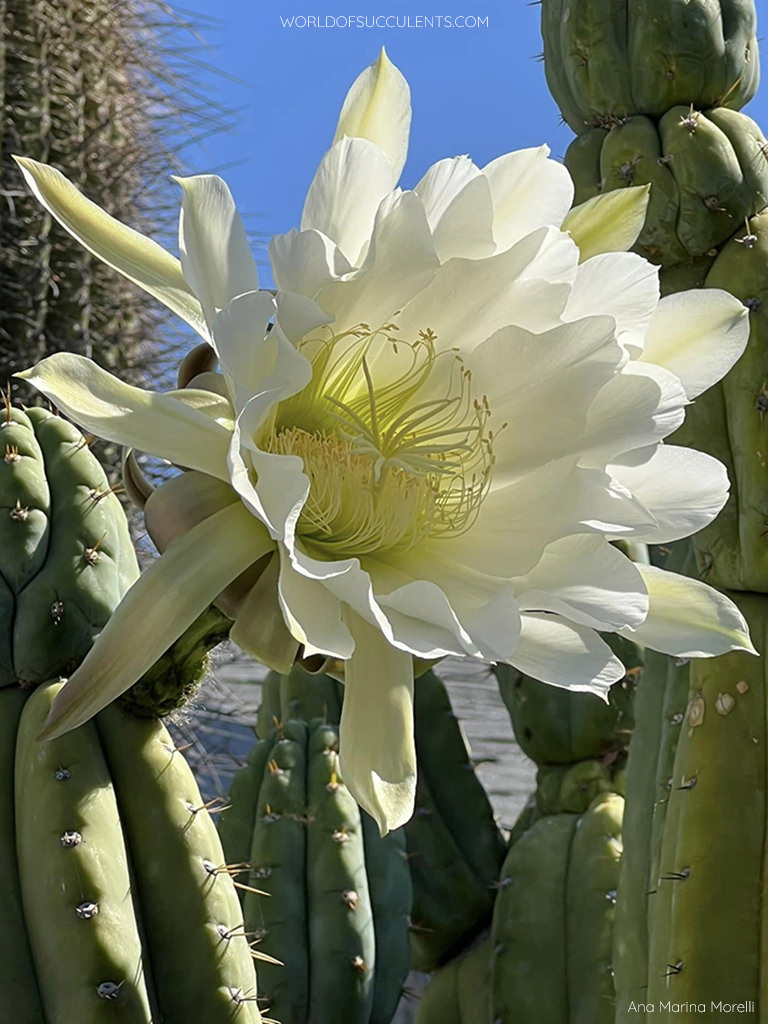
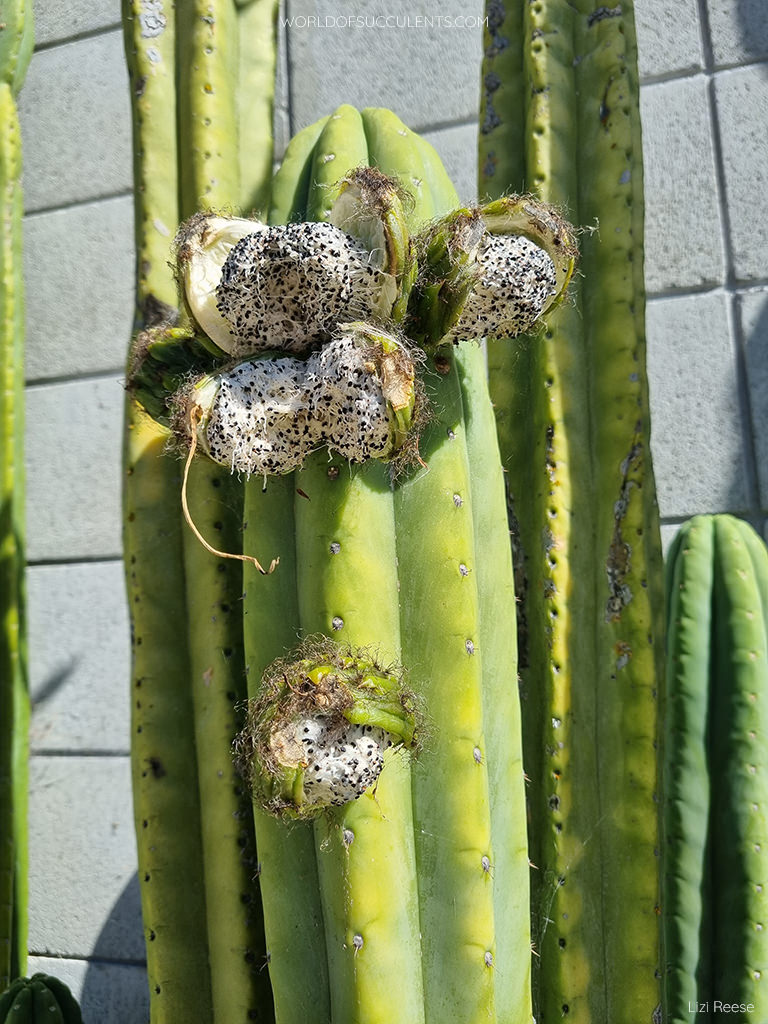
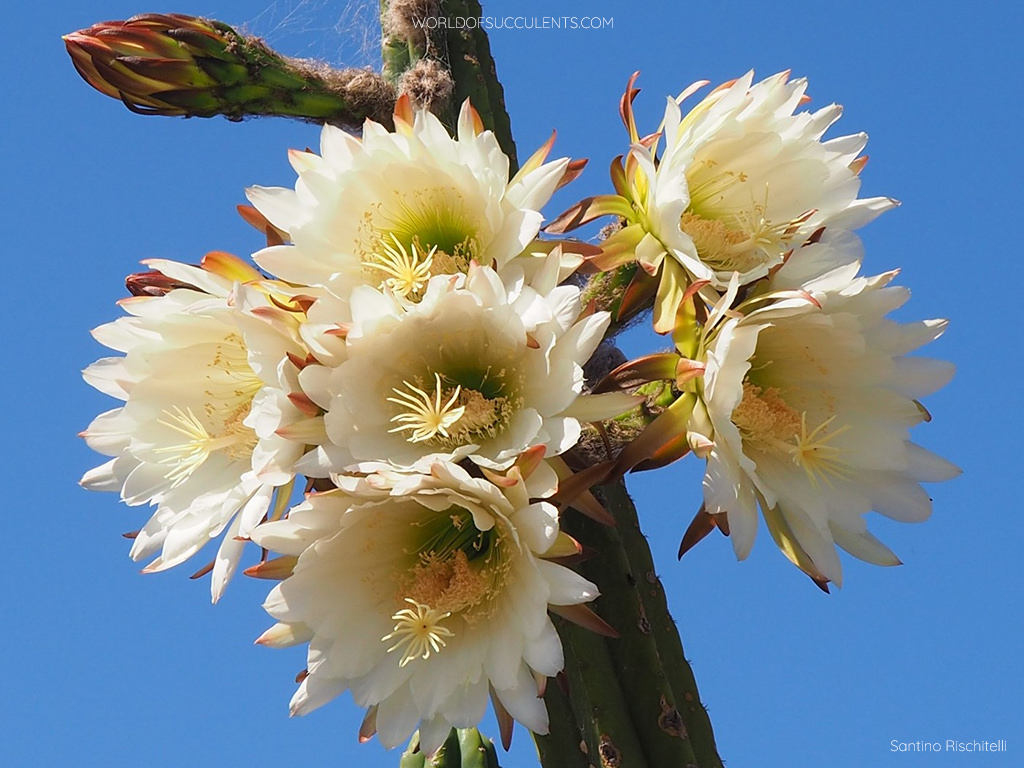
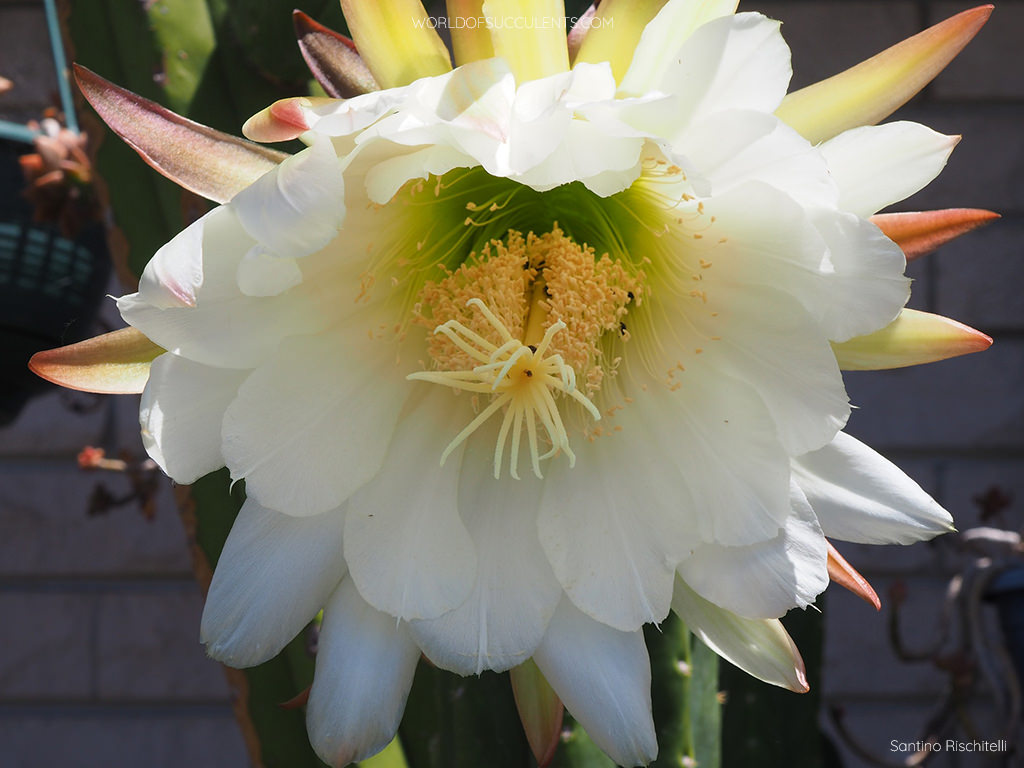
During the summer, Trichocereus macrogonus var. pachanoi produces white fragrant flowers near the top of the branches. The flowers appear at night and remain open the following day. They are trumpet-shaped and can reach lengths of 9.6 inches (24 cm) and diameters of 8 inches (20 cm). The fruits are dark green and, when mature, split open, revealing white flesh with tiny black seeds. They are oblong and can grow up to 2.4 inches (6 cm) long and 1.2 inches (3 cm) in diameter. The flower tube and fruits are covered with brown hairs.
Trichocereus macrogonus var. pachanoi can be distinguished from Trichocereus macrogonus var. macrogonus by the number and length of the spines. Trichocereus macrogonus var. pachanoi has no spines or 3 to 7 spines on older areoles. In comparison, the type variety has 18 to 20 spines, including three to four central ones that are longer, stronger, and more robust than the others. Additionally, the stems of Trichocereus macrogonus var. pachanoi are shorter and more slender than those of the type variety.
Origin
Trichocereus macrogonus var. pachanoi is native to the Andes Mountains in Ecuador, Peru, and Bolivia. It grows at elevations between 6,600 and 9,800 feet (2,000 and 3,000 m). This cactus has also been introduced to Venezuela, Argentina, Chile, and other tropical regions worldwide.
Forms of Trichocereus macrogonus var. pachanoi
How to Grow and Care for Trichocereus macrogonus var. pachanoi
Light: Although it can handle partial shade, Trichocereus macrogonus var. pachanoi thrives in full sun. If grown indoors, a sunny window is a good spot. To encourage balanced growth, rotate the pot a quarter turn every week or two. It is best to move it outdoors from spring to fall if possible.
Soil: This cactus grows best in well-draining soil. You can either use a commercial soil mix specifically designed for cacti or make your own.
Hardiness: During the growing season, Trichocereus macrogonus var. pachanoi thrives in warm temperatures, while in winter, it prefers cooler conditions. It grows best in USDA Plant Hardiness Zones 8b to 10b, with average minimum winter temperatures ranging from 15°F to 40°F (-9.4°C to 4.4°C).
Watering: To keep this cactus healthy, water it thoroughly, but allow the soil to dry out completely before watering again. As fall approaches, gradually reduce the frequency of watering. During the winter, when it is dormant, water this cactus only enough to prevent it from shriveling.
Fertilizing: During its growing season, this cactus requires regular fertilizing. A balanced, water-soluble fertilizer diluted to 1/4 strength can be added to each watering. A 10-10-10 fertilizer is ideal. You can also use dry fertilizers instead of making a water-fertilizer solution. However, stop fertilizing during the winter.
Repotting: You should repot Trichocereus macrogonus var. pachanoi once a year when it is young, and again when it outgrows its pot as it matures.
Propagation: The easiest method to propagate this cactus is by stem cuttings, as seed propagation is a slow process. Spring and summer are the best times to take cuttings and sow the seeds.
Learn more at How to Grow and Care for Cereus.
Toxicity of Trichocereus macrogonus var. pachanoi
Trichocereus macrogonus var. pachanoi is considered non-toxic.
Photo Gallery
Click on a photo to see a larger version.
Internal Links
- Explore all plants within the genus Trichocereus.
- Explore all plants within the family Cactaceae.