

Echeveria 'Sitifukumiama' is a charming succulent that captivates with its beautiful pastel colors that change with the seasons and under different stress levels. This succulent not only displays striking beauty but also requires minimal care, making it a perfect addition to any collection.
Taxonomy of Echeveria 'Sitifukumiama'
Scientific Name
Echeveria 'Sitifukumiama'
Scientific Classification
Family: Crassulaceae
Subfamily: Sempervivoideae
Tribe: Sedeae
Genus: Echeveria
Etymology
The generic name "Echeveria" (pronounced "ech-eh-VER-ee-a") honors Atanasio Echeverría y Godoy🡕 (fl.1771–1803), an 18th-century botanical artist and naturalist from New Spain who trained at the Royal Art Academy in Mexico City.
The cultivar epithet 'Sitifukumiama' is likely a romanized Japanese name. Echeveria 'Sitifukumiama' is also sold as Echeveria 'Shichifuku Bini', and 'Sitifukumiama' appears to be a variant spelling or a possible mistranscription of 'Shichifuku Bini.' However, no authoritative sources document the original kanji or explain the literal meaning of either name.
Origin of Echeveria 'Sitifukumiama'
Echeveria 'Sitifukumiama' is likely a Japanese hybrid created by Mr. Negishi. The exact parentage is unclear. Some sources suggest it may be a cross between Echeveria secunda and Echeveria minima, while others propose that it results from a cross between Echeveria peacockii (synonym of Echeveria desmetiana) and Echeveria bella. Additionally, there are plants with slightly different appearances and flowers that are sold under the names Echeveria 'Sitifukumiama' or Echeveria 'Shichifuku Bini,' which adds to the confusion.
Description of Echeveria 'Sitifukumiama'
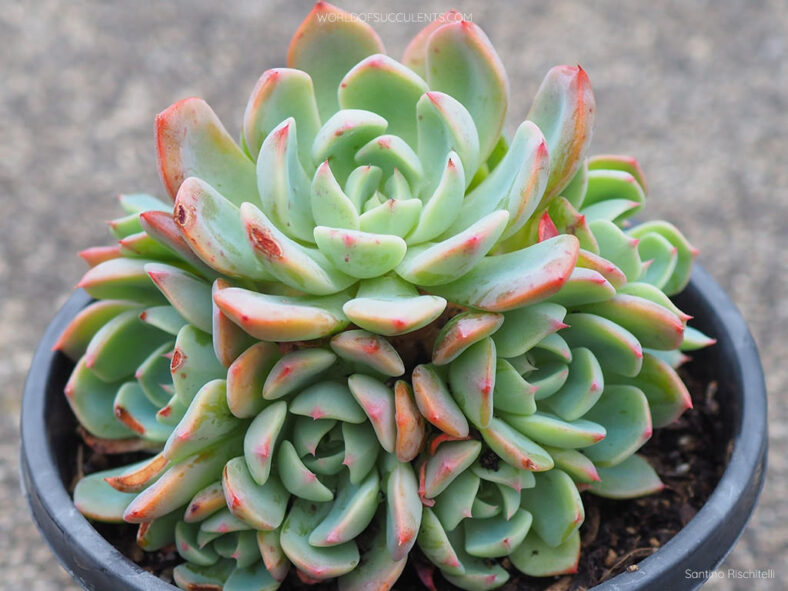
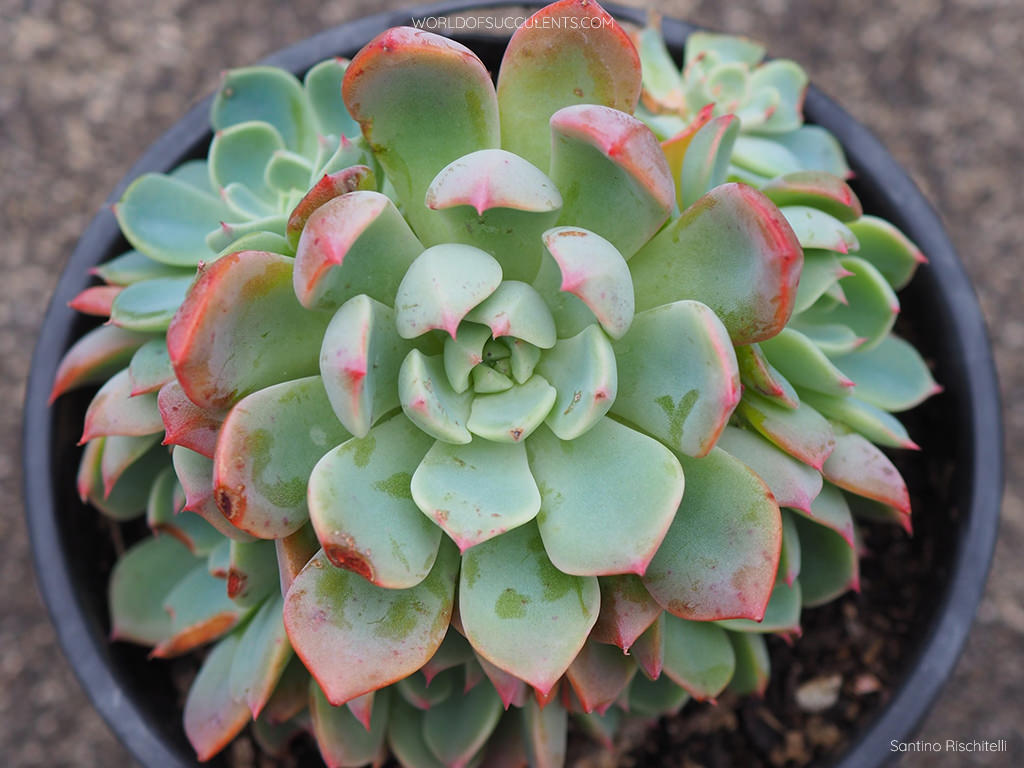
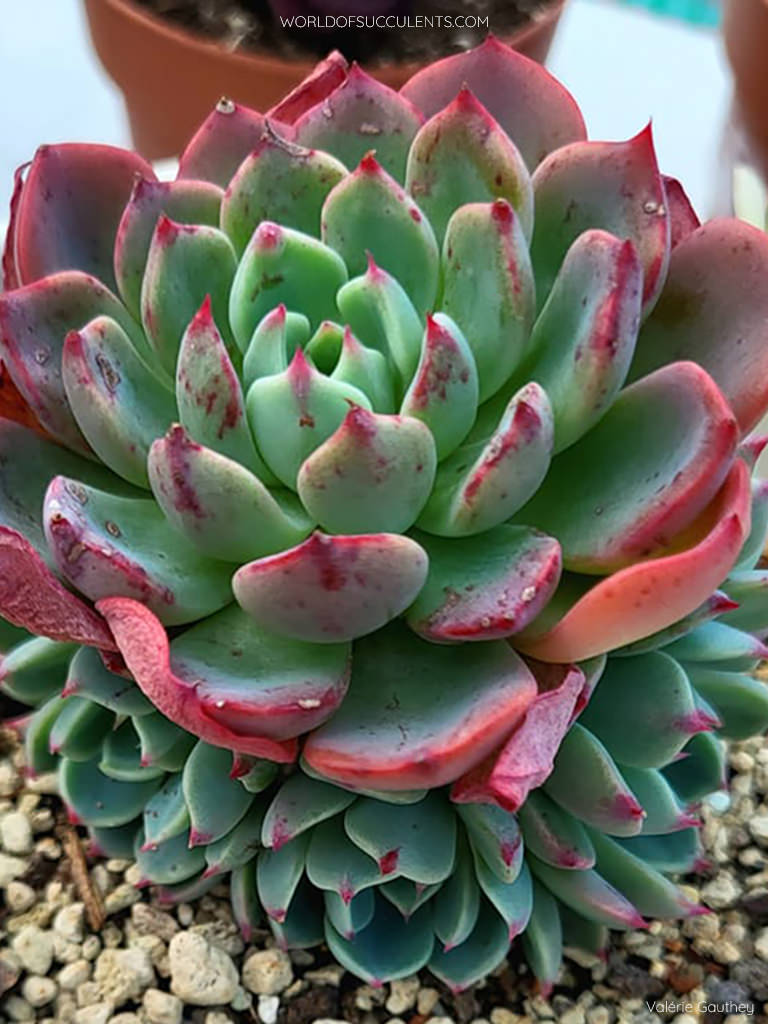
Echeveria 'Sitifukumiama', also known as Echeveria 'Shichifuku Bini', is a beautiful small succulent that forms rosettes of bluish-green leaves with reddish-pink tips. The rosettes can reach a diameter of about 2.8 inches (7 cm) and readily produce offsets, creating a dense clump over time. During winter and when exposed to intense sunlight, the leaves turn to lavender-blue with pink overtones. They are coated with a fine, waxy bloom that can be rubbed off with a touch.
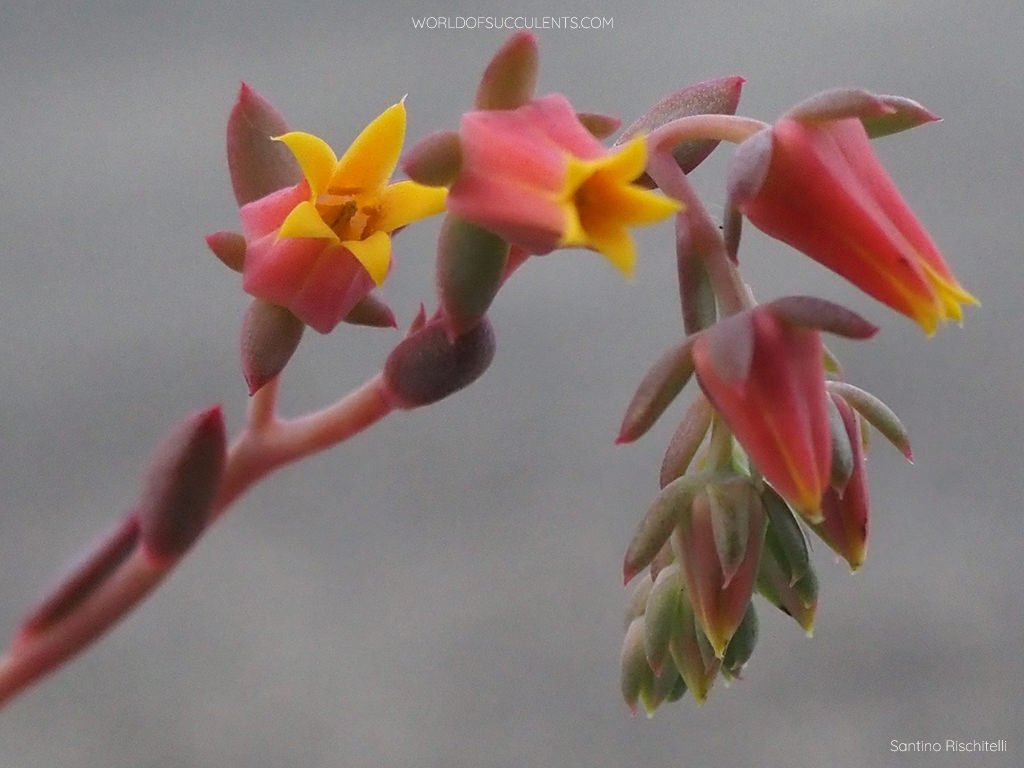
In spring and summer, Echeveria 'Sitifukumiama' produces red, bell-shaped flowers with red tips and a yellow interior. The flowers appear on long, arching stalks.
How to Grow and Care for Echeveria 'Sitifukumiama'
Light: Echeveria 'Sitifukumiama' grows best in full sun to partial shade. Therefore, place it near the brightest window in your home. In addition, if you plan to move the plant outside in the spring, do so gradually and avoid exposing it to intense afternoon sun.
Soil: Having soil that drains quickly is essential for growing healthy succulents. While many growers prefer to create their own soil mix, commercial soil mixes for succulents will work fine.
Temperature: High temperatures are not a problem as long as there is plenty of fresh air. However, Echeveria 'Sitifukumiama' is a tender succulent that must be brought indoors if there is a risk of freezing temperatures. It grows best in USDA Plant Hardiness Zones 10a to 11b, with average minimum winter temperatures ranging from 30°F to 50°F (-1.1°C to 10°C).
Watering: During the growing season, this plant prefers the "soak and dry" method. Water deeply and then let the soil dry out completely before watering again. Water sparingly during the winter, only enough to keep the plant from shriveling. Above all, if you have a saucer under the pot, do not forget to empty the excess water.
Fertilizing: Although it can grow well without fertilizer, Echeveria 'Sitifukumiama' may benefit from extra nutrients. Feed only during the growing season and use a water-soluble fertilizer diluted to half-strength.
Repotting: If growing in a container, repot as needed in spring or early summer. Ensure the soil is dry before starting. Also, always use a container with drainage holes.
Propagation: A simple way to propagate Echeveria 'Sitifukumiama' is by taking stem cuttings. It is best to take cuttings in the spring and summer. Although leaves can also be used for propagation, the resulting plants may not be crested.
Learn more at How to Grow and Care for Echeveria.
Toxicity of Echeveria 'Sitifukumiama'
Echeveria 'Sitifukumiama' has no reported toxic effects and is safe for growing around children and pets.
Photo Gallery
Click on a photo to see a larger version.
Internal Links
- Explore all plants within the genus Echeveria.
- Explore all plants within the family Crassulaceae.