

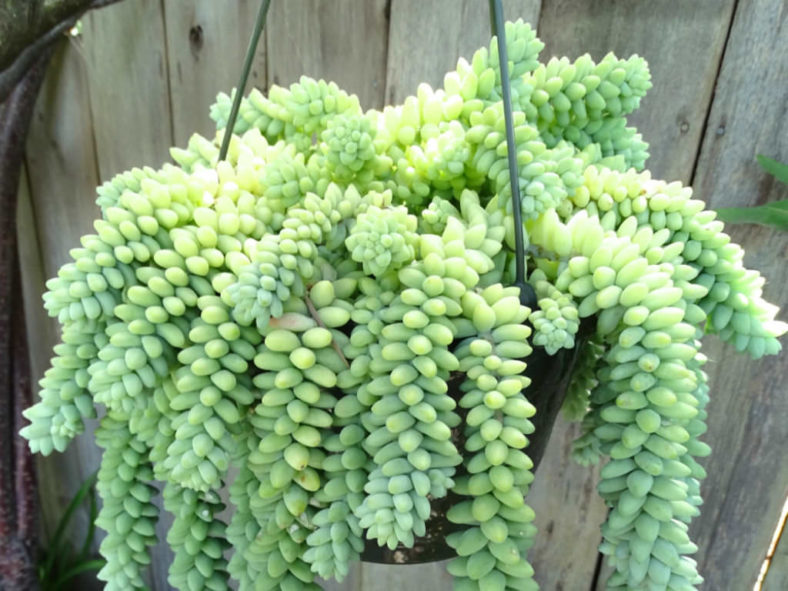
Sedum burrito, commonly known as Baby Burro's Tail, is a popular succulent prized for its long, trailing stems covered in plump, bead-like leaves that range in color from grey-green to blue-green. It is often confused with its close relative, Sedum morganianum. However, Sedum burrito is generally easier to care for because its leaves are less fragile and detach less easily than those of Sedum morganianum. Nevertheless, it still requires careful handling.
Taxonomy of Sedum burrito
Scientific Name
Sedum burrito Moran
Synonym(s)
Sedum 'Burrito'
Common Name(s)
Baby Burro's Tail, Baby Donkey's Tail
Scientific Classification
Family: Crassulaceae
Subfamily: Sempervivoideae
Tribe: Sedeae
Genus: Sedum
Etymology
The generic name "Sedum" (pronounced "SEE-dum") means "sitting" or "low-growing" and refers to the low-growing habit of the plants of this genus, which appear to "sit" and spread over rocks, slopes, and ground surfaces.
The specific epithet "burrito" (pronounced "bur-REE-toh") means "young donkey" in Spanish and refers to the stems of this species, which resemble a young donkey's tail.
Origin
This popular plant was first distributed from Paul Hutchinson's Tropic World Nursery in Escondido, California, United States, under the name "Burrito." Its origin is quite a mystery. Reid Moran formally described it in 1977 based on two specimens bought several years earlier at local nurseries: one in Guadalajara and another in a small town in Veracruz, Mexico. So, there is no known record of Sedum burrito in the wild.
Because of its similarities to Sedum morganianum, some have suggested that Sedum burrito is a vegetative sport or a natural hybrid of the latter. In 2017, Myron Kimnach wrote an article in the Journal of the Cactus and Succulent Society of America (V89 N.1), disagreeing with Moran's treatment of this plant. He pointed out that the differences between the two plants were primarily vegetative. However, because the two plants differ in floral characteristics, this argument has been rejected. As a result, the accepted name for this taxon remains Sedum burrito, and it is still listed as such in the Royal Botanic Garden, Kew's database.
Description
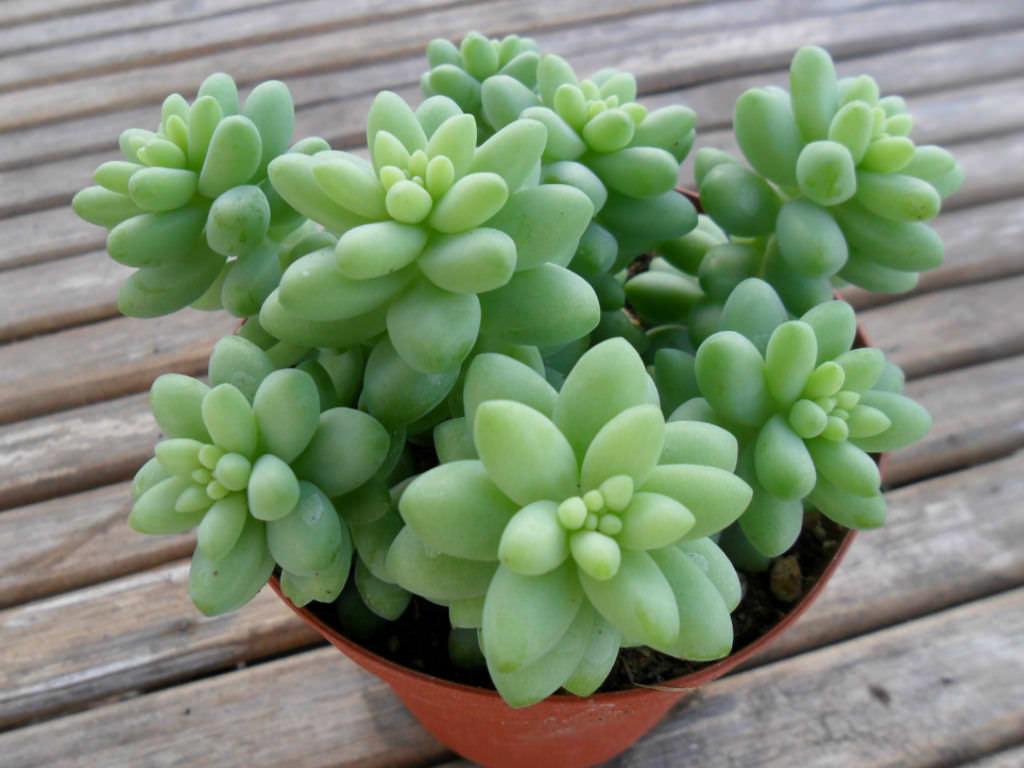
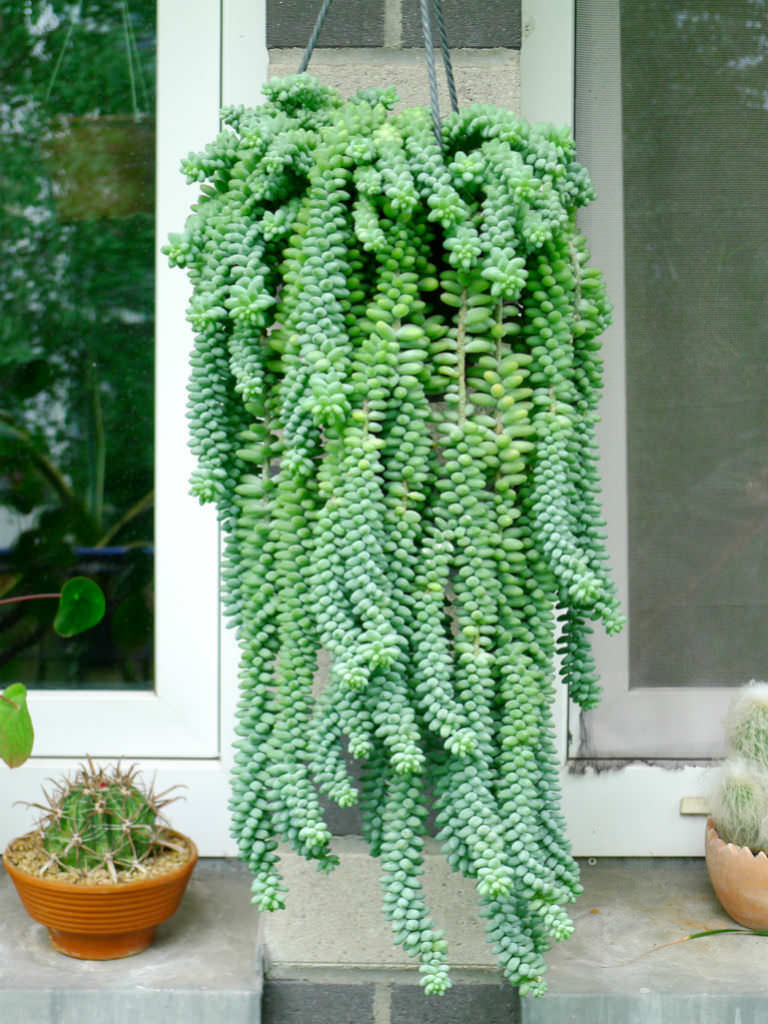
Sedum burrito is an attractive succulent with trailing stems bearing densely packed, grey-green to blue-green leaves covered with a powdery bloom. It is similar to Sedum morganianum but has much more compact growth, with blunter and bluer leaves that do not detach as easily. The stems can grow over 3 feet (90 cm) long, starting erect and becoming pendulous with age. The leaves are thick, fleshy, bean-shaped, measuring up to 0.6 inches (1.5 cm) long and about 0.3 inches (0.7 cm) wide.
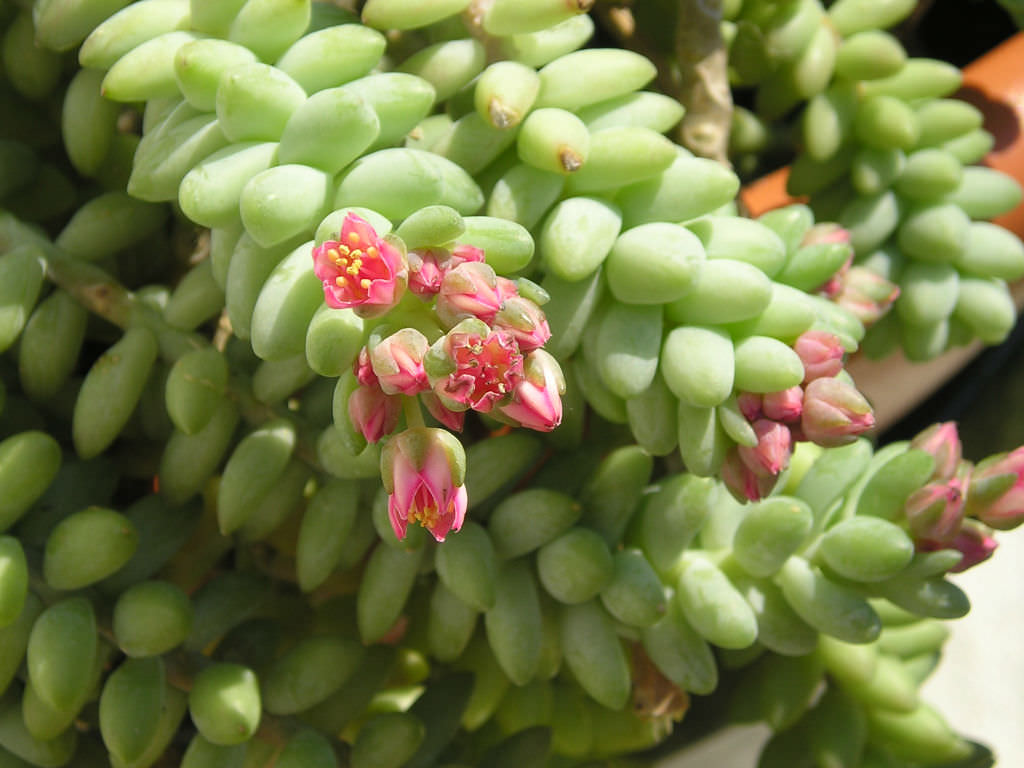
The flowers are small, star-shaped, and pink, with irregular, deeper pink lines and yellow anthers. They usually appear in spring in terminal clusters of up to 6.
Sedum burrito is often found in nursery catalogs or labeled with the invalid name Sedum morganianum 'Burrito'.
Hybrids of Sedum burrito
How to Grow and Care for Sedum burrito
Light: Sufficient light is most important for growing a healthy plant. Sedum burrito grows best in full sun for at least 6 hours a day, but will tolerate some shade. Place the plant near a sunny window or use artificial lights when growing indoors.
Soil: This plant does not tolerate waterlogged soil, so good drainage is essential to prevent root rot. Use a commercially available mix specifically designed for succulents, or create your own.
Temperature: Sedum burrito tolerates heat and low temperatures. It grows best in USDA Plant Hardiness Zones 10a to 11b, with average minimum winter temperatures ranging from 30°F to 50°F (-1.1°C to 10°C).
Watering: From spring to fall, water thoroughly and let the soil dry out before watering again. During the winter, water the plant just enough to keep it from shriveling. When watering, avoid getting the leaves, stems, and flowers wet.
Fertilizing: Feed a water-soluble fertilizer diluted to half-strength during the growing season. However, feeding is unnecessary if you provide the plant with fresh soil annually.
Repotting: When Sedum burrito outgrows its current pot, repot it into a larger pot in spring. Make sure the soil is dry before you begin repotting.
Propagation: Sedum burrito is easy to propagate by taking leaf or stem cuttings during the growing season or by sowing seeds in spring or summer.
Learn more at How to Grow and Care for Sedum.
Toxicity of Sedum burrito
Sedum burrito is not considered toxic to humans, but it can be mildly toxic to pets and children.
Photo Gallery
Click on a photo to see a larger version.
Internal Links
- Explore all plants within the genus Sedum.
- Explore all plants within the family Crassulaceae.