

Portulacaria afra, commonly known as Elephant Bush, is a versatile succulent that is native to South Africa, Eswatini, and Mozambique. It is valued as a hardy houseplant, a drought-tolerant landscape shrub, and a popular choice for beginner bonsai enthusiasts.
Taxonomy of Portulacaria afra
Scientific Name
Portulacaria afra Jacq.
Common Name(s)
Dwarf Jade, Elephant Bush, Elephant's Food, Miniature Jade, Porkbush, Small Leaf Jade, Spekboom (Afrikaans)
Synonym(s)
Claytonia portulacaria, Crassula portulacaria, Crassula portulacastrum, Haenkea crassifolia, Portulaca fruticosa
Scientific Classification
Family: Portulacaceae
Subfamily: Portulacarioideae
Genus: Portulacaria
Etymology
The specific epithet "afra" (pronounced "AF-ruh") means "African; from Africa" and refers to the origin of this species.
The common name "Elephant Bush" comes from the fact that elephants frequently eat the leaves of this species. Elephants have a symbiotic relationship with Portulacaria afra, as it makes up to 80% of their diet. While feeding, elephants break off branches, which can later take root and grow into new plants.
Forms and Cultivars of Portulacaria afra
Origin of Portulacaria afra
The native range of Portulacaria afra extends from the Eastern Cape northwards into KwaZulu-Natal, Mpumalanga, and the Limpopo provinces of South Africa, as well as Eswatini, and further north into Mozambique. It grows in warm situations on rocky outcrops and slopes.
Description of Portulacaria afra
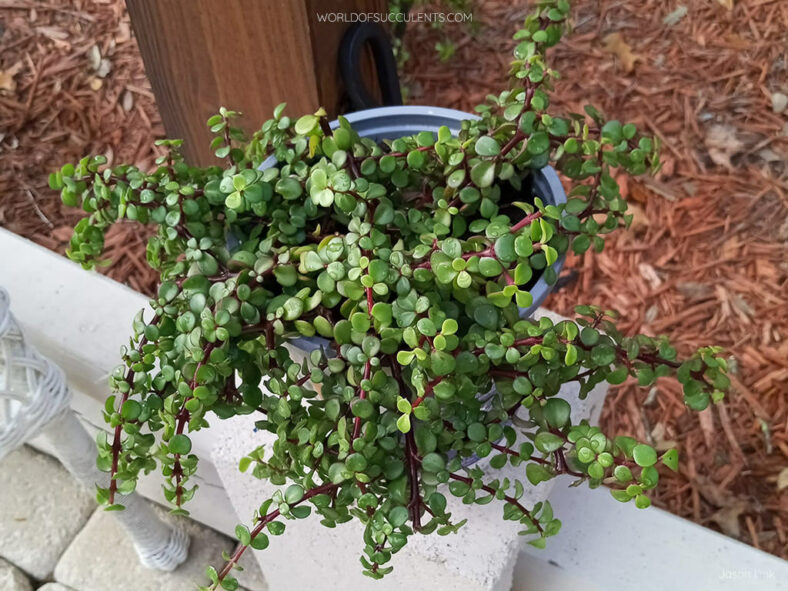
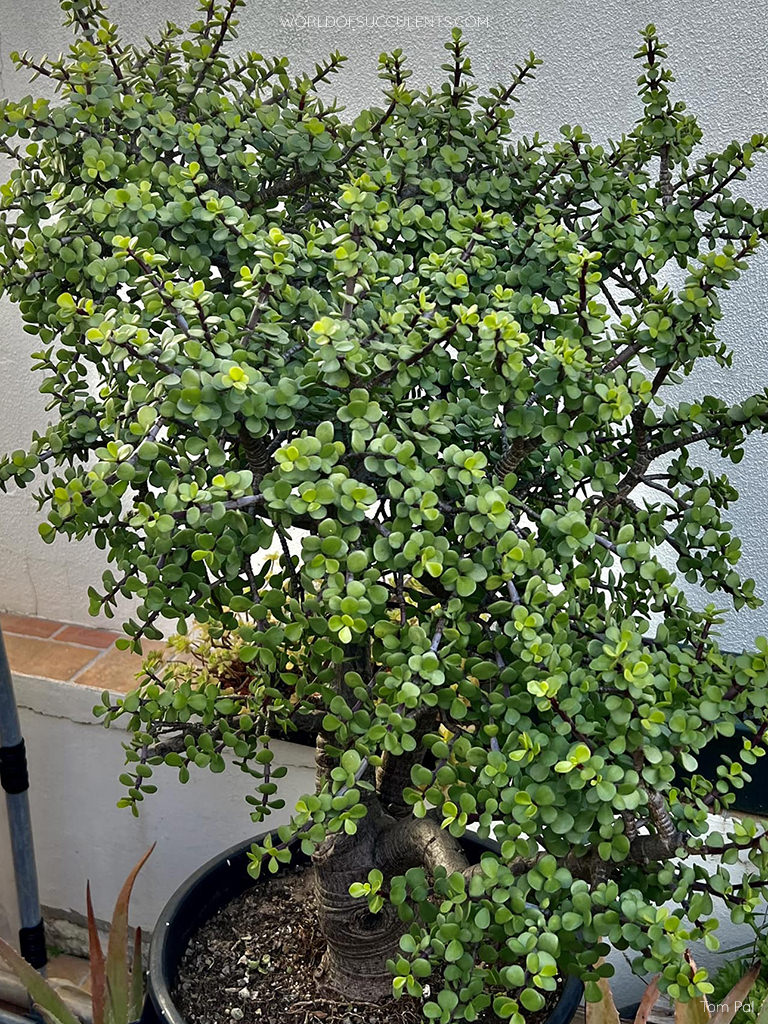
Portulacaria afra is a densely branched succulent shrub or small tree with glossy green, opposite leaves on brittle, reddish-brown branches that mature to a wood grey color. It can grow up to 16.4 feet (5 m) tall. Its branches are initially fleshy but become woody as they age. The succulent leaves are obovate, measuring up to 1 inch (2.5 cm) in length and 0.6 inches (1.5 cm) in width.
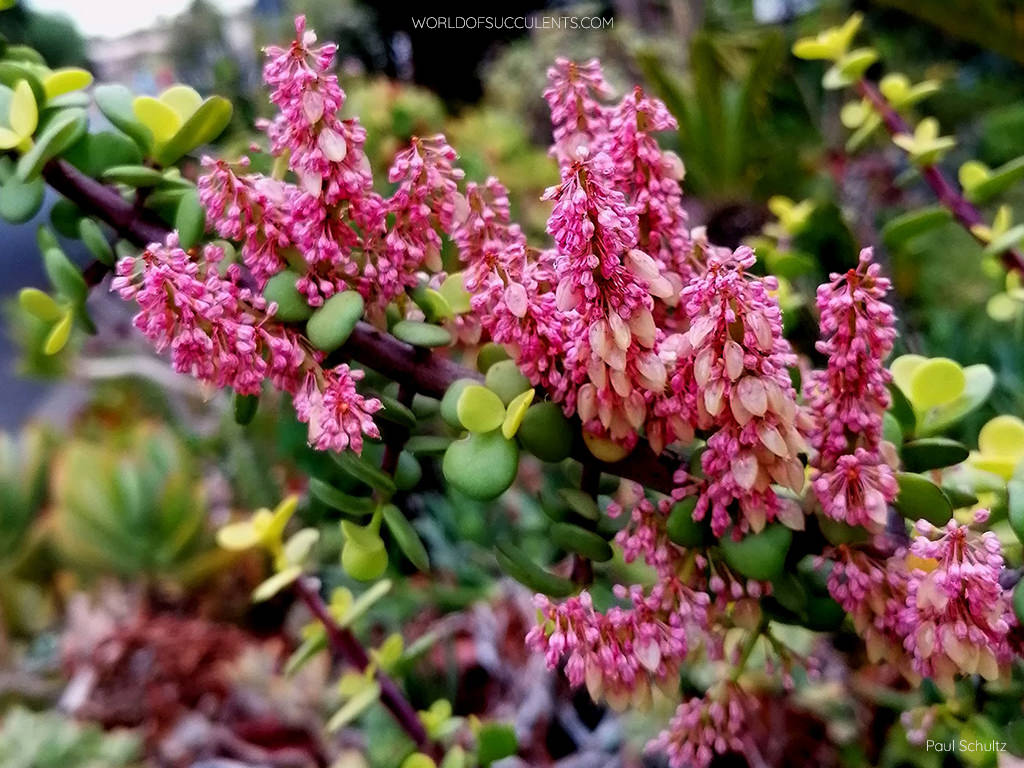
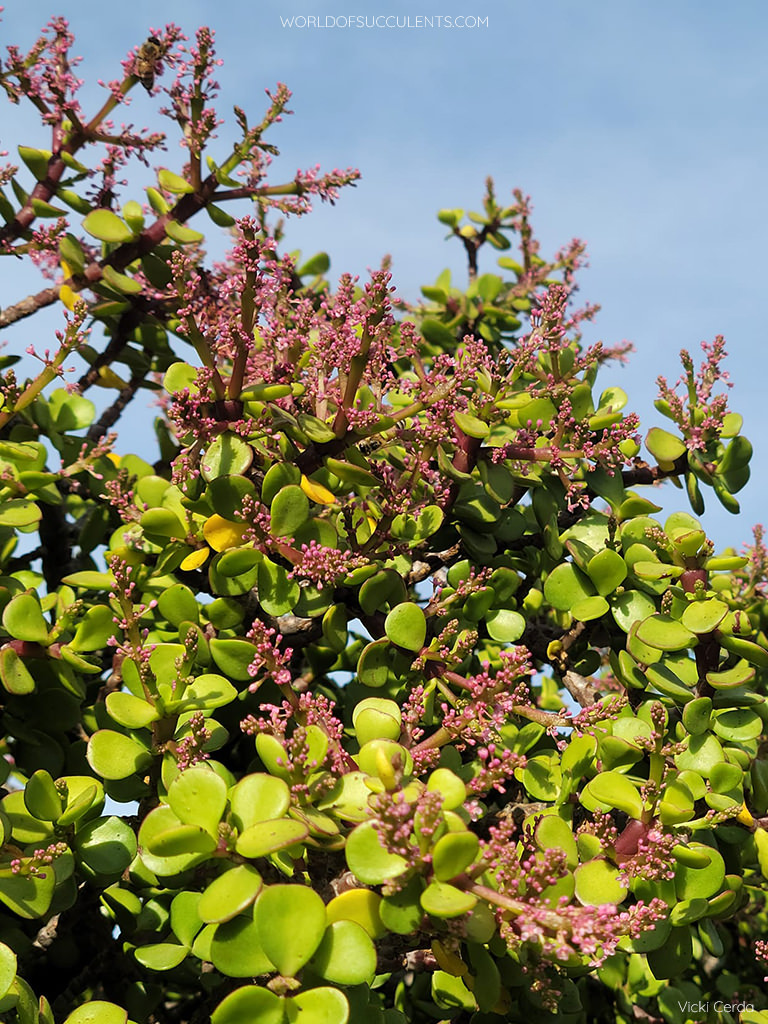
In its native habitat, the plant produces small, rosy pink to mauve flowers in dense clusters on terminal branches in late spring or early summer, but flowering is rare in cultivation. The fruits are translucent, glossy, pink, ellipsoid, 3-angled, and winged on the angles and can grow up to 0.2 inches (0.5 cm) long.
Although sometimes confused with Crassula ovata, the two plants are quite different. Portulacaria afra has smaller, rounder leaves and a more compact growth habit. Both plants are relatively popular subjects for bonsai.
How to Grow and Care for Portulacaria afra
Light: This plant requires at least 6 hours of direct sunlight per day but tolerates partial shade. If grown indoors, place it in a sunny window.
Soil: Well-draining soil is essential for a healthy plant. While many growers make their own soil mix, commercial succulent soil with extra perlite or another grit will also work well.
Hardiness: Portulacaria afra thrives in warm, sunny climates and can tolerate light frost. It grows best in USDA Plant Hardiness Zones 9b to 11b, with average minimum winter temperatures ranging from 25°F to 50°F (-3.9°C to 10°C).
Watering: In spring and fall, water thoroughly and wait until the topsoil dries before watering again. Water less during winter when growth slows down significantly. During the summer, when the plant is usually dormant, water it only enough to keep the leaves from shriveling.
Fertilizing: Portulacaria afra is a slow-growing plant that requires minimal feeding. However, it will benefit from a small amount of organic fertilizer during the growing season.
Repotting: It is best to repot this plant every 2 to 3 years, or when it becomes top-heavy, even though it tolerates root-bound conditions. Repotting is recommended during the summer.
Propagation: Although it can be grown from seeds, Portulacaria afra is usually started from stem cuttings. Always take cuttings when the plant is actively growing.
Toxicity of Portulacaria afra
Portulacaria afra is a non-toxic plant with edible leaves rich in vitamin C and a pleasant sour taste.
Photo Gallery
Click on a photo to see a larger version.
Internal Links
- Explore all plants within the genus Portulacaria.
- Explore all plants within the family Portulacaceae.