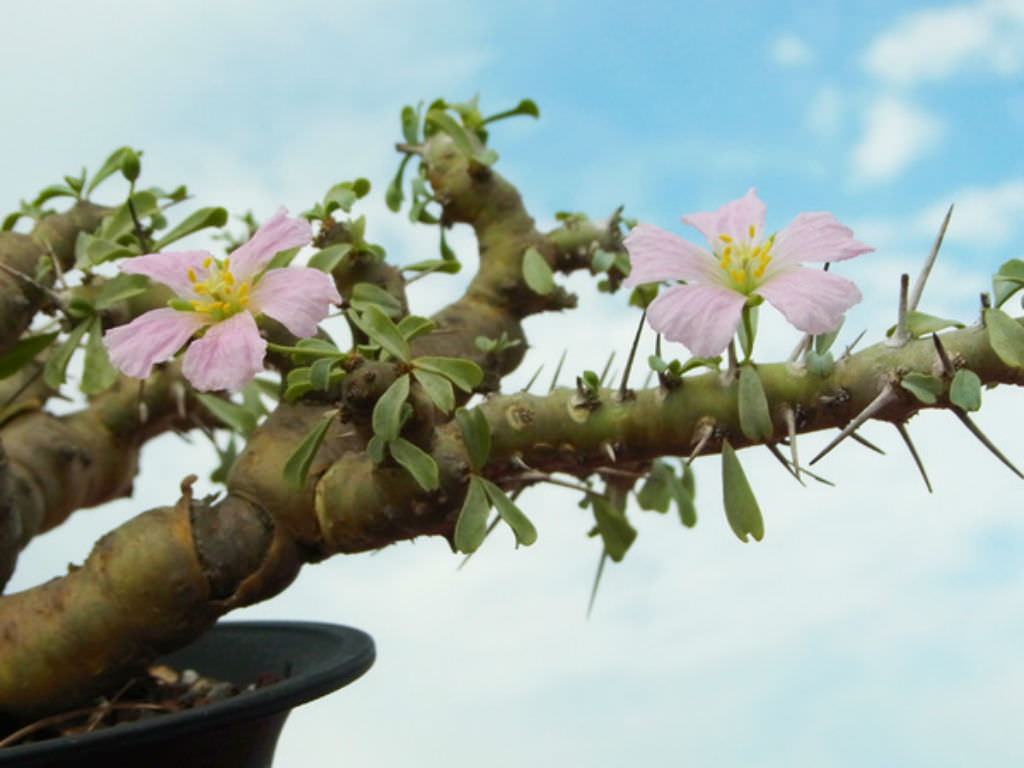
Scientific Name
Sarcocaulon patersonii (DC.) G.Don
Synonym(s)
Monsonia patersonii
Common Name(s)
Bushman's Candle, Candle Bush, Dwarf Bushcandle
Scientific Classification
Family: Geraniaceae
Genus: Sarcocaulon
Etymology
The specific epithet "patersonii" (pronounced "pat-er-SOH-nee-eye") honors William Paterson🡕 (1755–1810), a Scottish soldier, explorer, best known for his pioneering travels in Southern Africa between 1777 and 1780, during which he collected numerous botanical specimens, including this species.
Origin
The native range of Sarcocaulon patersonii extends from Port Nolloth in South Africa to Lüderitz in Namibia. It grows in sand and rock crevices.
Description
Sarcocaulon patersonii, also known as Monsonia patersonii, is a succulent shrublet with spiny, semi-erect to nearly prostrate branches with mostly straight spines often arranged in a few columns. It can grow up to 20 inches (50 cm) tall. The branches are yellow-brown or olive-green to quite dark, smooth, and covered in a waxy bark. They are usually more than 0.4 inches (1 cm) in diameter. The leaves are grey-green to blue-green, obovate, long and short petioled, measuring up to 1 inch (2.5 cm) long and 0.6 inches (1.5 cm) wide. The spines dry out soon after the leaves drop off, and old spines may also disappear. The young spines are red-brown, while the old ones are whitish or grey.
The flowers are rose, pale magenta, or purple, and appear in late fall and winter. They can reach up to 1 inch (2.5 cm) long and 1.3 inches (3.2 cm) in diameter.
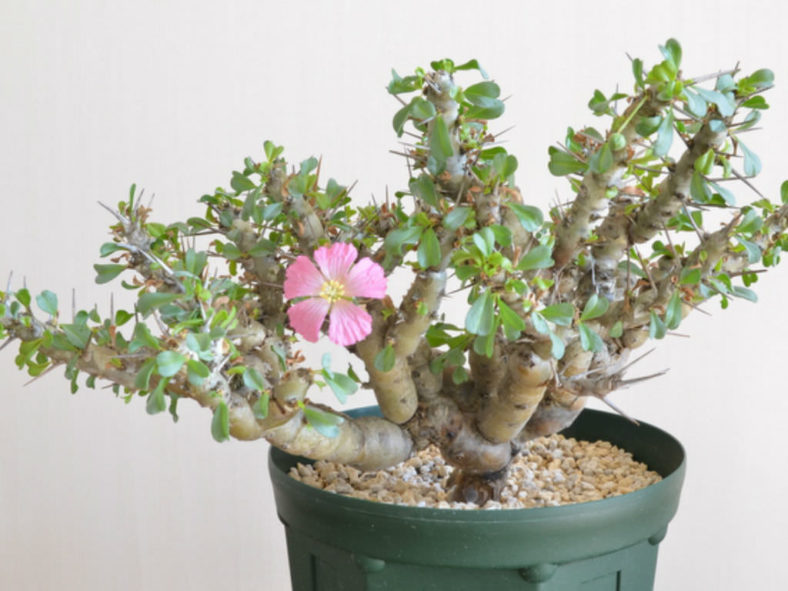
How to Grow and Care for Sarcocaulon patersonii
Hardiness: USDA hardiness zone 10b to 11b: from 35°F (1.7°C) to 50°F (10°C).
Monsonia species are generally easy to cultivate. Except for Monsonia camdeboensis and Monsonia vanderietiae, they rarely produce an extensive new root system once transplanted. Transplanted specimens flower sporadically in cultivation but survive for many years.
Seed-grown plants, in contrast, thrive and flower prolifically in cultivation. The ideal cultivation medium for most species is silt collected from the sides of road culverts, to which a small amount of bone meal and some ordinary, sandy garden soil has been added. Seeds should be sown just under the surface of the soil in large seed trays. They should be planted in individual containers when they are about two years old.
All Monsonia species require direct sunlight when in full growth. Seedlings need to be regularly watered during active growth and occasionally during dormancy.
Monsonia salmoniflora has considerable potential for the landscaping trade. The species is easily and relatively quickly grown from seed and is long-lived.
See more at How to Grow and Care for Monsonia.
Links
- Back to genus Sarcocaulon
- Succupedia: Browse succulents by Scientific Name, Common Name, Genus, Family, USDA Hardiness Zone, Origin, or cacti by Genus
Photo Gallery
Click on a photo to see a larger version.