Lithops ruschiorum, commonly known as Rusch's Living Stone, is a small succulent native to Namibia's extreme, rocky deserts. It was first described by Nicholas Edward Brown🡕 in 1926. This species varies significantly in size, color, and the presence or absence of markings on the upper surface of its body.
Taxonomy of Lithops ruschiorum
Scientific Name
Lithops ruschiorum (Dinter & Schwant.) N.E. Br.
Synonym(s)
Lithops ruschiana, Mesembryanthemum ruschii, Mesembryanthemum ruschiorum
Common Name(s)
Bushman's Buttocks, Hottentot's Buttocks, Rusch's Living Stone
Scientific Classification
Family: Aizoaceae
Subfamily: Ruschioideae
Tribe: Ruschieae
Genus: Lithops
Etymology
The specific epithet "ruschiorum" (pronounced "roos-kee-OR-um") honors Ernst J. Rusch (1867–1957), a German farmer and businessman in Namibia who first collected the species in 1923 near Khan Mine.
Description
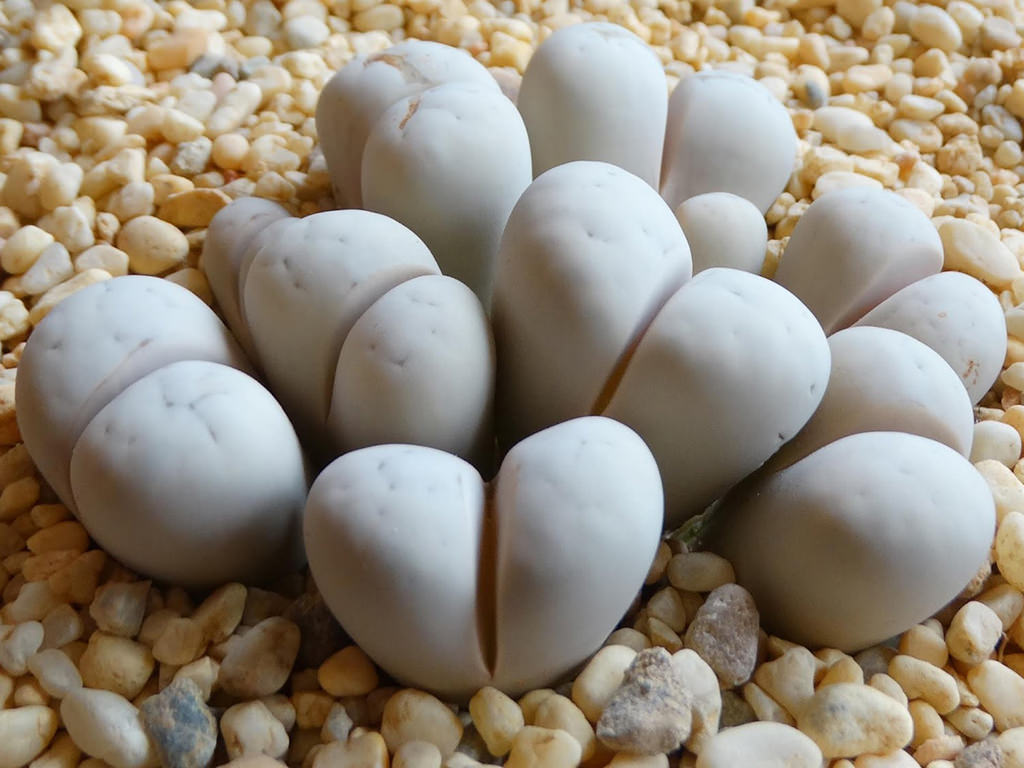
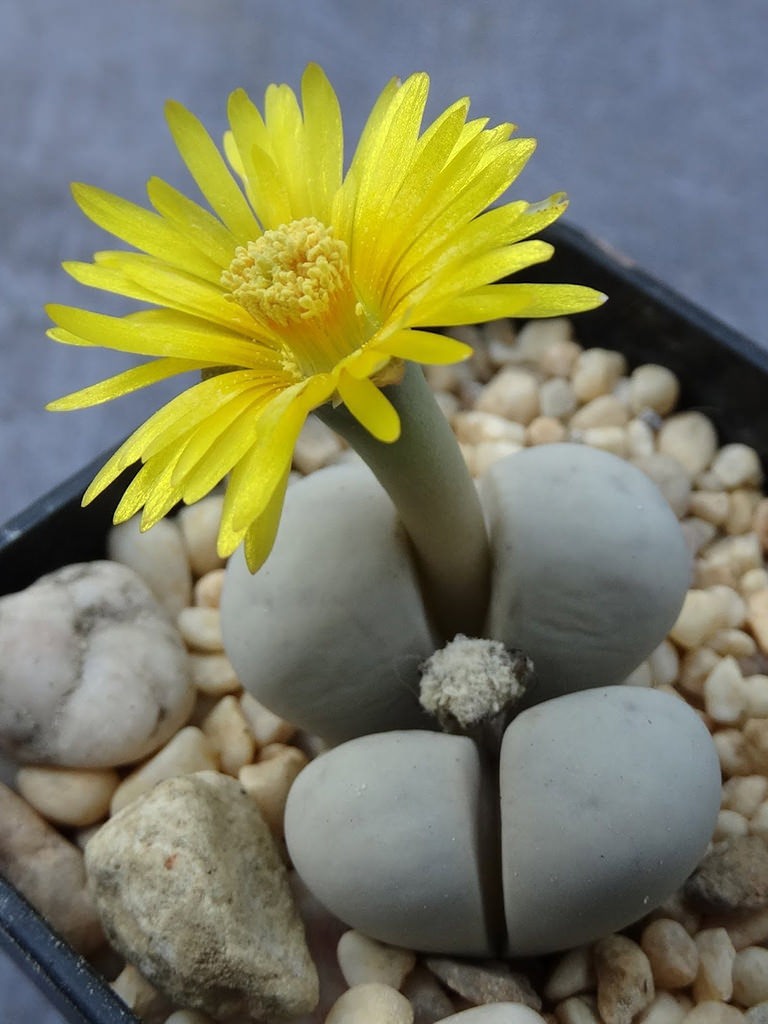
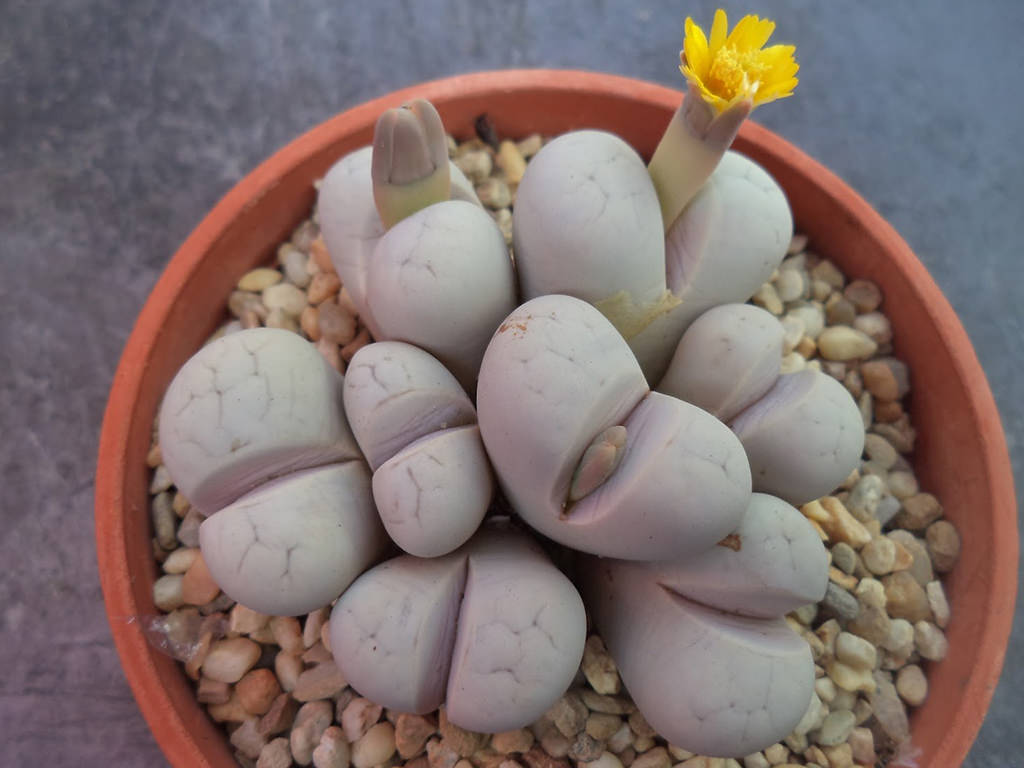
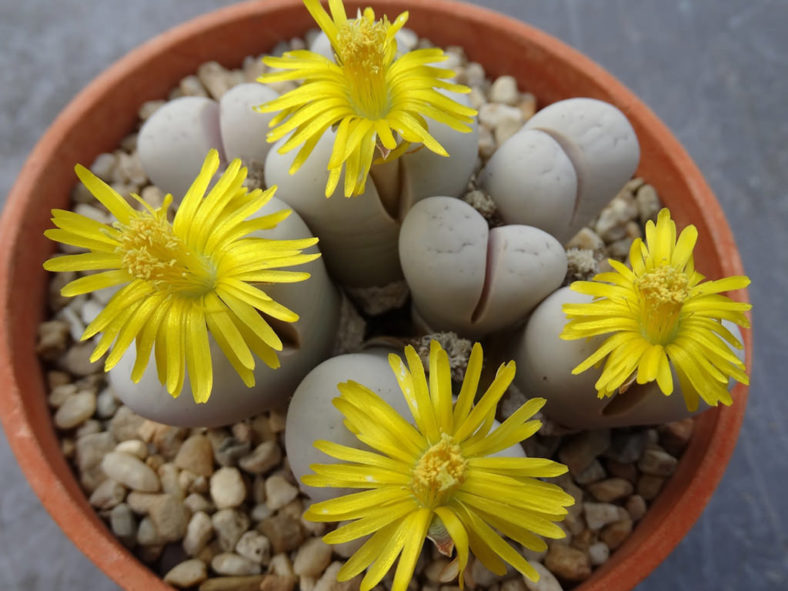
Lithops ruschiorum is a dwarf succulent that typically grows in clusters of 5 to 6 two-lobed bodies, although it can occasionally form larger clumps of up to 30 bodies. Each body consists of a pair of plump, fused leaves opposite each other, with a deep central fissure. The leaves are generally bluish-grey, but can also appear yellowish or brownish, with new growths distinctly brown. The bodies can grow up to 1.6 inches (4 cm) tall and 0.8 inches (2 cm) wide at the fissure. The lobes are convex on top and usually have a few faint red lines and spots, although these markings may sometimes be absent. Some bodies may also have faint bluish spots.
In the fall, Lithops ruschiorum produces solitary, yellow flowers that emerge from the fissure between the leaves and can reach a diameter of 1.2 inches (3 cm). The fruits are 5-locular capsules containing tiny, brown seeds.
Origin
Lithops ruschiorum is endemic to Namibia. It grows in rocky areas and cold deserts from Kaokoveld to Swakopmund.
Forms of Lithops ruschiorum
- Lithops ruschiorum var. lineata has more clearly visible markings on its bodies, and it occurs from Rocky Point to the Angolan border. It is not accepted as a separate variety and is treated as a synonym of Lithops ruschiorum.
- Lithops ruschiorum var. nelii occurs in a few locations near Cape Cross and has smoother and paler bodies, sometimes with few obscure or usually completely absent spots and lines. It is not accepted as a separate variety and is treated as a synonym of Lithops ruschiorum.
How to Grow and Care for Lithops ruschiorum
Light: A sunny windowsill that gets 4 to 5 hours of direct sunlight early in the day and partial shade in the afternoon is ideal. You may place the plant on the balcony or in the garden from spring to fall.
Soil: Lithops ruschiorum thrives in soil that drains quickly. Use a commercial succulent potting mix, or make your own.
Temperature: High temperatures are not a problem for this plant as long as there is plenty of fresh air, but it is not cold-hardy. It is hardy in USDA Plant Hardiness Zones 10a-11b, which have average annual extreme minimum winter temperatures ranging from 30°F to 50°F (-1.1°C to 10°C).
Watering: Because this plant has a specific yearly growth cycle, water only during certain stages, and keep the soil dry during others. How often you need to water Lithops ruschiorum depends on how quickly the soil dries out. Stop watering in winter to let the old leaf pair dry out and the new pair develop.
Fertilizing: As long as you repot this plant every two years, it doesn't need fertilizer.
Repotting: Although this plant can thrive in the same pot for decades, it is beneficial to repot it occasionally to provide more space. You can repot at any time during the growing season, but the best time is at the beginning of the season.
Propagation: Lithops ruschiorum is primarily propagated from seeds sown in summer. However, if you have a multi-headed plant, you can also easily propagate it by division.
Learn more in "How to Grow and Care for Lithops."
Toxicity of Lithops ruschiorum
Lithops ruschiorum is non-toxic and safe to have around children and pets.
Photo Gallery
Click on a photo to see a larger version.