

Agave desmetiana is a plant with a complex and somewhat confusing history. It is believed to grow naturally in Veracruz, Mexico, and possibly in the Caribbean as well. The plant was first described by Georg Albano von Jacobi in 1866, based on specimens from a garden, likely from Rancho El Mirador near the town of Huatusco in Veracruz.
The American botanist William Trelease used the name in his contribution to Part 2 of Paul Stanley's series "Trees and Shrubs of Mexico". He noted that it was presumed to originate from Rancho El Mirador, but also said it was "said to be from Brazil." Howard Scott Gentry followed Trelease's treatment in his book "Agaves of Continental North America," in which he described a neotype in 1952. However, this neotype also came from a garden, this time in the western state of Sinaloa, Mexico.
For a plant to be considered a valid species, it must be able to set seed. Agave desmetiana has not demonstrated this ability, leading some to speculate that it may be a natural pre-Columbian hybrid. A 2023 DNA study suggested that it is most closely related to Agave angustifolia and Agave attenuata, adding further intrigue to its classification. Interestingly, the current treatment of Agave desmetiana in the Royal Botanic Gardens, Kew database🡕, known as "Plant of the World Online," is either as an invalid name linked to Agave demeesteriana or as a synonym of the very different-looking Agave horrida.
Taxonomy of Agave desmetiana
Scientific Name
Agave desmetiana Jacobi
Accepted Scientific Name
Agave demeesteriana Jacobi
Synonym(s)
Agave desmettiana (misspelling)
Common Name(s)
Dwarf Century Plant, Smooth Agave, Spineless Jade Agave
Scientific Classification
Family: Asparagaceae
Subfamily: Agavoideae
Genus: Agave
Etymology
The specific epithet "desmetiana" (pronounced "de-smet-ee-AY-na"), often misspelled as "desmettiana," honors Louis De Smet🡕 (1813-1887), a Belgian horticulturist and owner of a nursery specialized in succulent plants in Ledeberg, Ghent.
Origin of Agave desmetiana
Agave desmetiana is most likely native to Mexico.
Description of Agave desmetiana
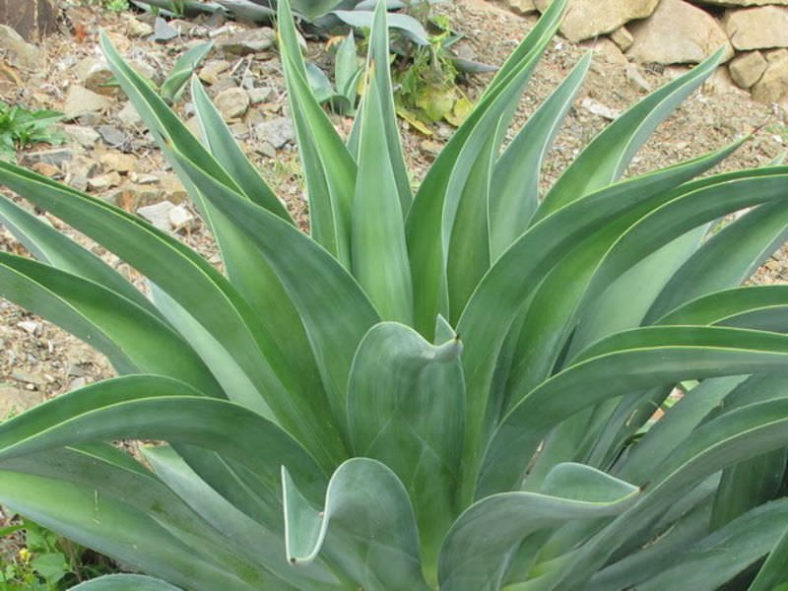
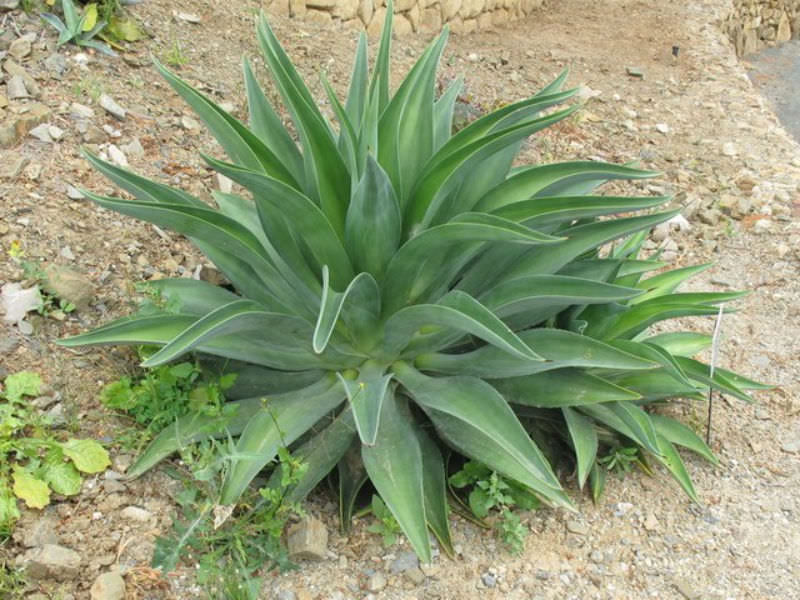
Agave desmetiana is a succulent plant that forms attractive rosettes of dark blue-green leaves with smooth margins and a sharp, reddish terminal spine. The rosettes can grow up to 5 feet (1.5 m) in diameter and produce offsets at the base, forming a colony over time. The leaves are fleshy, rigid, and usually recurved or reflexed, measuring up to 40 inches (1 m) long and 3.6 inches (9 cm) wide.
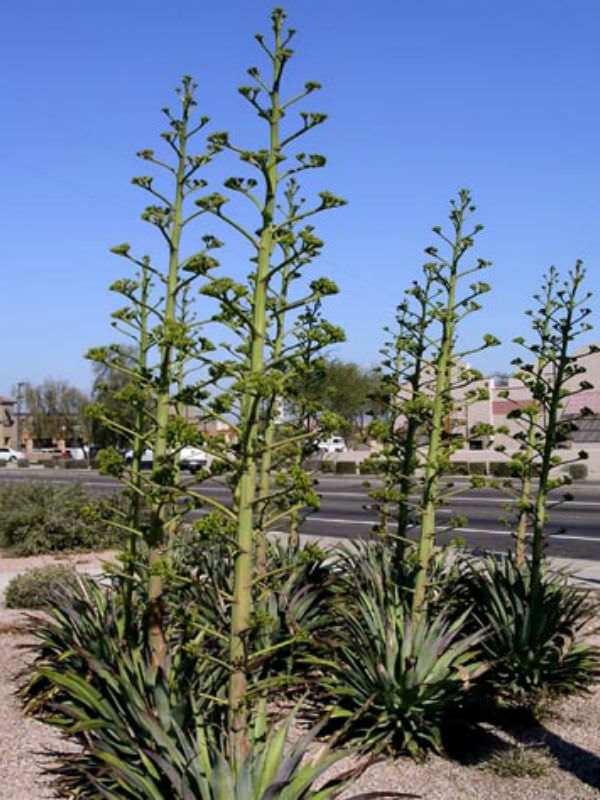
At some point between 8 and 10 years, a striking flower stalk with side branches emerges from the center of the rosette, reaching up to 8 feet (2.5 m) in height. The flowers are pale yellow, measuring up to 1.5 inches (3.8 cm) long, and appear in terminal clusters on side branches of the stalk. The rosette dies after flowering, but new rosettes formed by the offsets and bulbils on the flower stalk will remain. In Mexico, flowers typically bloom from spring to early summer.
Cultivars and Hybrids of Agave desmetiana
How to Grow and Care for Agave desmetiana
Light: Agave desmetiana grows well in full sun to partial shade. If you are keeping it indoors, place it near a sunny window. From spring to fall, it enjoys being outdoors.
Soil: This plant can tolerate most soils as long as they have good drainage. However, it thrives in sandy or rocky soil.
Temperature: During the growing season, Agave desmetiana prefers warm temperatures, but in winter, it rests in cooler conditions. It grows best in USDA Plant Hardiness Zones 9a to 11b, with average minimum winter temperatures ranging from 20°F to 50°F (-6.7°C to 10°C).
Watering: To keep this plant healthy, water it thoroughly when the top of the soil feels dry from spring to fall. In winter, water it sparingly, about once a month. A plant in a container will require more frequent watering than a plant in the ground.
Fertilizing: In the spring, during the first two years, apply a small amount of fertilizer to the plant. Once Agave desmetiana is established, it will take care of itself, and you no longer need to fertilize it.
Repotting: If you notice the plant is becoming pot-bound, repot it with fresh soil in a new pot slightly larger than the old one. After repotting, allow the plant a week or so to adjust before watering it again.
Propagation: Since it has a solitary growth habit, this plant can only be propagated by seeds.
Learn more at How to Grow and Care for Agave.
Toxicity of Agave desmetiana
Agave desmetiana is non-toxic to humans, but the sap of the leaves and inflorescence may be mildly poisonous to children and pets.
Photo Gallery
Click on a photo to see a larger version.

Internal Links
- Explore all plants within the genus Agave.
- Explore all plants within the family Asparagaceae.