Scientific Name
Adenium oleifolium Stapf
Synonym(s)
Adenium obesum subsp. oleifolium
Common Name(s)
Desert Rose
Scientific Classification
Family: Apocynaceae
Subfamily: Apocynoideae
Tribe: Nerieae
Subtribe: Neriinae
Genus: Adenium
Etymology
The specific epithet "oleifolium" (pronounced "oh-lee-ih-FOH-lee-um") means "olive tree-leafed; having leaves like an olive tree" and refers to leaves of this species, which resemble those of the olive tree.
Origin
Adenium oleifolium is native to Botswana, South Africa, and Namibia. It grows on stony ridges, limestone outcrops, or loose sand.
Description
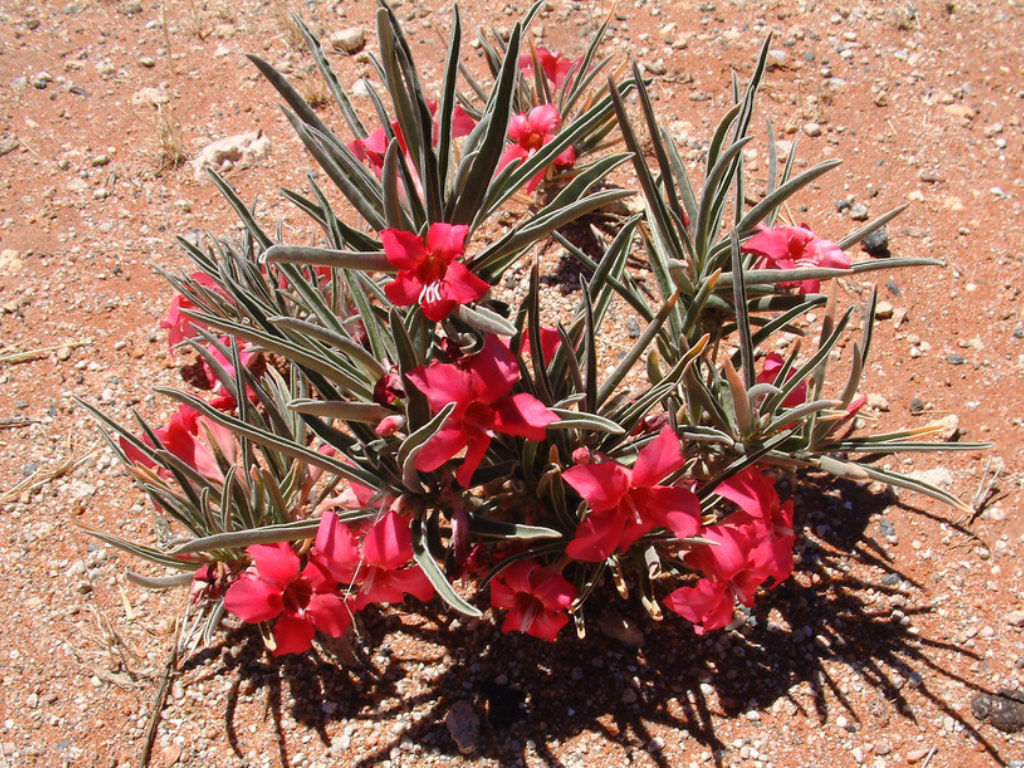
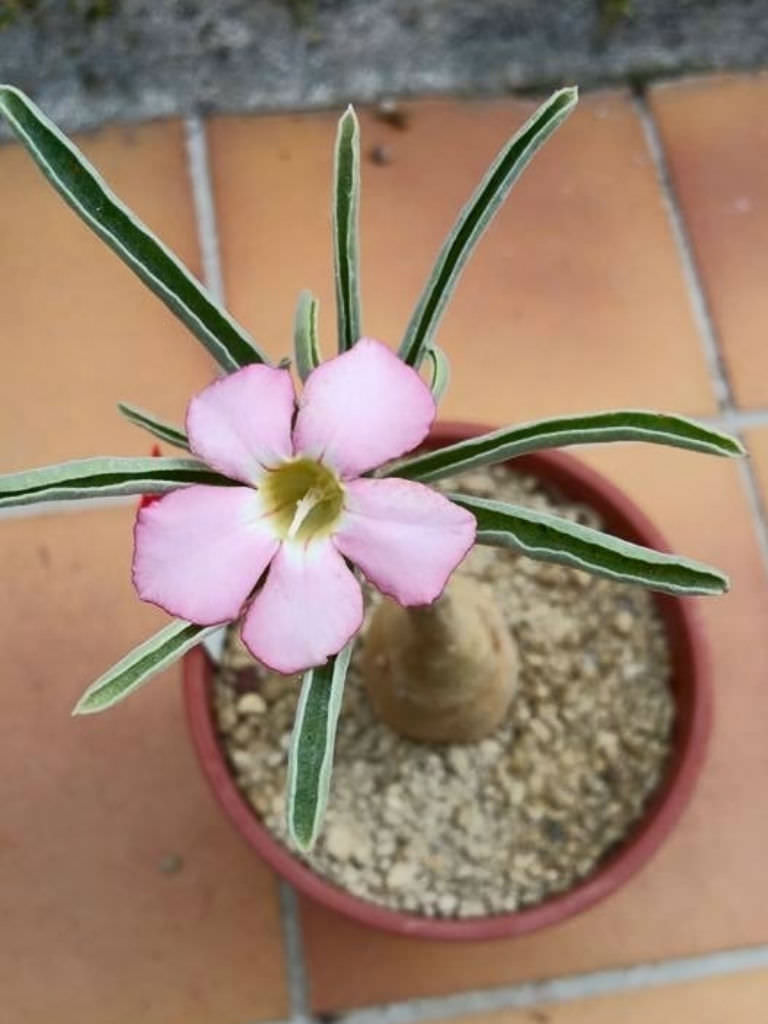
Adenium oleifolium, also known as Adenium obesum subsp. oleifolium, is a succulent shrublet with a swollen, tuberous, largely underground stem bearing one to several erect branches and leaves clustered at the ends of the branches. It can grow up to 16 inches (40 cm) tall. The carrot-like rootstock can reach a diameter of 4 inches (10 cm). The branches are pubescent when young, becoming glabrous with age. They have greyish-white bark that is sometimes corky or wrinkled. The leaves are above shiny, glaucous or pale green, and pubescent to glabrous, beneath dull, slightly paler green and pubescent. They are linear to very narrowly obovate, frequently folded along the midrib, measuring up to 4.4 inches (11 cm) long and 0.5 inches (1.3 cm) wide.
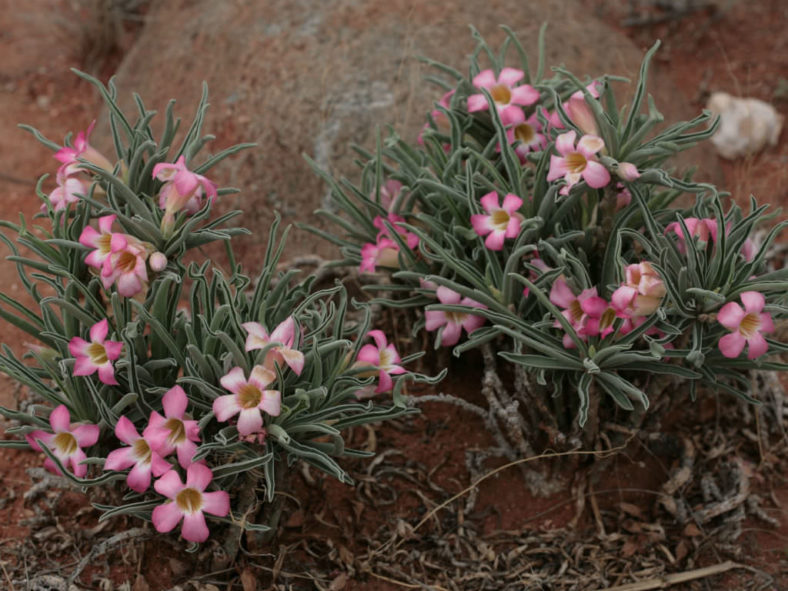
The terminal inflorescence carries a few pinkish, salmon, or pale pink to red flowers that appear with the leaves. The flowers are pale pink to red, more intense towards the margins, and appear with the leaves. The fruits are pale grey to pale grey-brown with pale brown seeds inside.
How to Grow and Care for Adenium oleifolium
Hardiness: USDA hardiness zone 10a to 11b: from 30°F (-1.1°C) to 50°F (10°C).
These are not difficult plants to grow well, provided they get enough sunlight and warmth. However, like all succulents, they cannot tolerate sitting in water, and if you err, do it on the side of too little water. Use a specialized soil mix designed for cacti and succulents.
Repot as needed, preferably during the warm season. To repot a Desert Rose, ensure the soil is dry before repotting, then gently remove the plant from the pot. Knock away the old soil from the roots and remove any rotted or dead roots. Treat any cuts with a fungicide and antibacterial solution. Next, place the plant in its new pot and backfill with potting soil, spreading the roots out as you repot. Leave the plant dry for a week or so, then begin to water lightly to reduce the risk of root rot.
The Desert Rose is typically propagated by seed. If your plant develops a seed pod, sow the seeds as soon as possible after the pod ripens to maximize the chances of germination. Desert Rose can also be propagated from stem cuttings, but this plant often fails to develop the characteristic (and highly desired) bulbous stem.
Links
- Back to genus Adenium
- Succupedia: Browse succulents by Scientific Name, Common Name, Genus, Family, USDA Hardiness Zone, Origin, or cacti by Genus
Photo Gallery
Click on a photo to see a larger version.