Scientific Name
Stapelia grandiflora Masson
Common Name(s)
Carrion Flower, Carrion Plant, Starfish Flower, Giant Toad Plant, Giant Zulu, Starfish Cactus
Synonym(s)
Ceropegia grandiflora, Gonostemon grandiflorus, Stisseria grandiflora
Scientific Classification
Family: Apocynaceae
Subfamily: Asclepiadoideae
Tribe: Stapeliae
Genus: Stapelia
Etymology
The specific epithet "grandiflora" (pronounced "gran-dih-FLOR-uh") means "having large flowers" and refers to the large, showy flowers of this species.
Origin
Stapelia grandiflora is native to South Africa (Northern Cape, Eastern Cape, and Free State).
Description
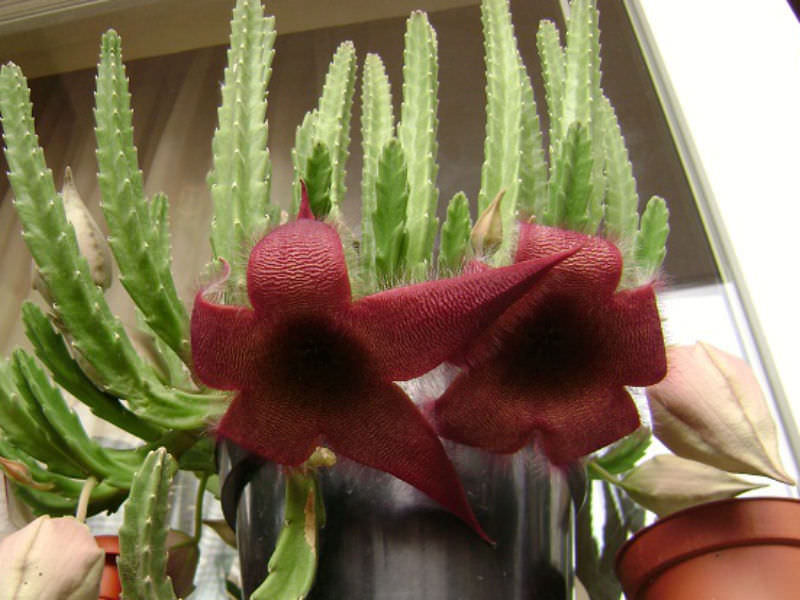
Stapelia grandiflora is a succulent plant with 4-angled, finely hairy, erect or decumbent stems with tubercles widely spaced along the ribs. It forms a large, compact clump as it matures. The stems are thick, fleshy, unusually gray-green, and can grow up to 12 inches (30 cm) long and 1.6 inches (4 cm) thick.
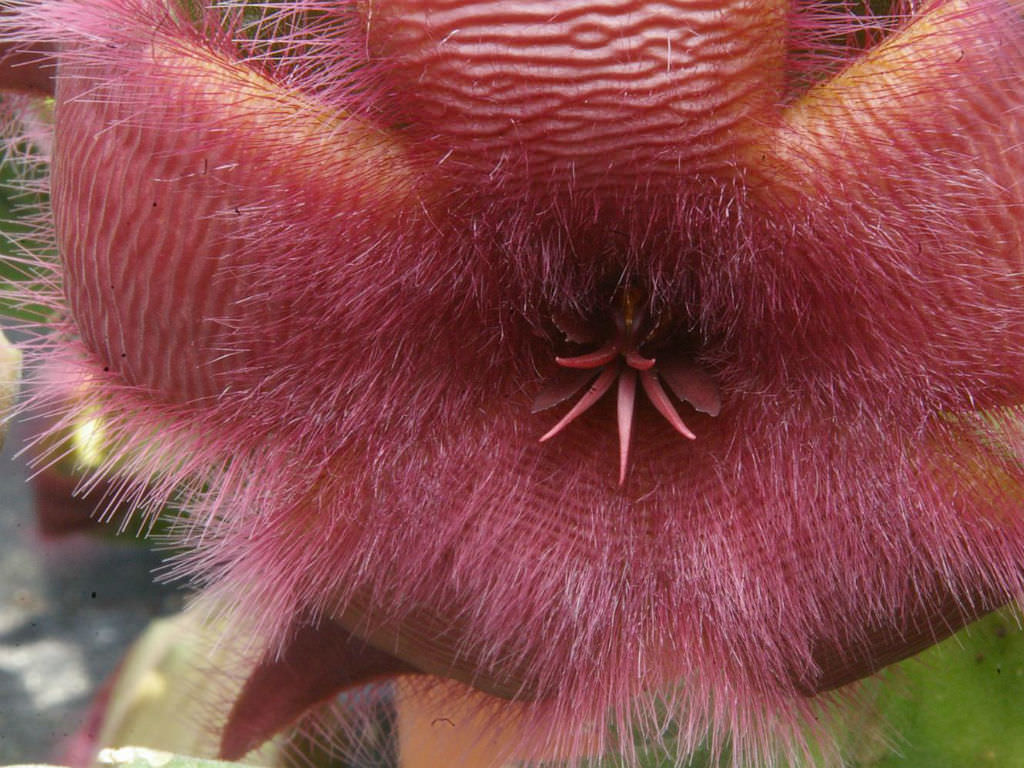
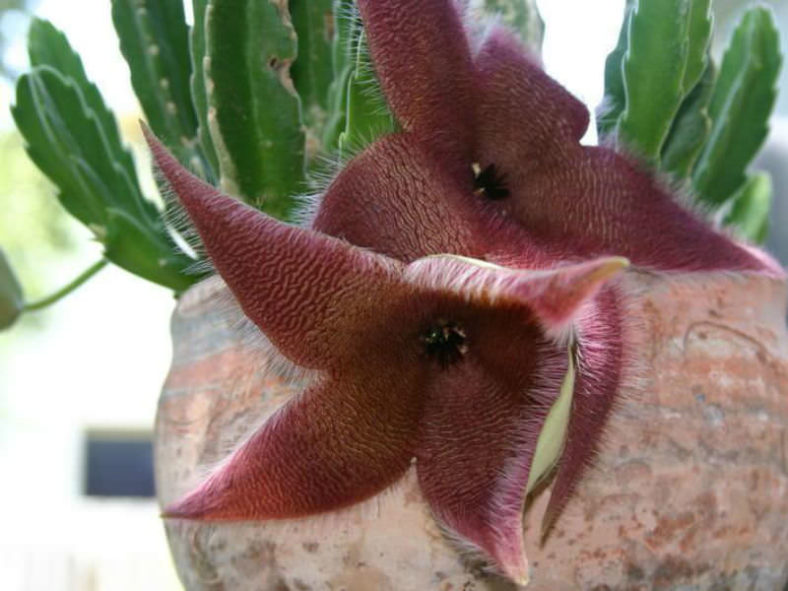
The starfish-shaped flowers usually have strongly recurved lobes and can reach a diameter of 8.8 inches (22 cm). They are intermittently produced throughout the late summer and fall. The corolla has transverse purplish-red ridges and yellow between them, changing to more or less uniformly purplish-red towards the tips of the lobes and near the margins. It is covered with soft, mostly white hairs, particularly towards the margins of the lobes. The corona is red to purple, becoming yellow towards the tips and base, and is raised on a stout, yellow, obtusely pentagonal stipe. The fruits are typical twin-seed horns and often do not appear until the following year.
Varieties and Forms of Stapelia grandiflora
- Stapelia grandiflora var. conformis
- Stapelia grandiflora var. grandiflora
- Stapelia grandiflora f. cristata
How to Grow and Care for Stapelia grandiflora
Hardiness: USDA hardiness zones 10a to 11b: from 30°F (-1.1°C) to 50°F (10°C).
Several species are relatively easy to grow. Others, often those with slightly hairy stems and the more unusual flowers, are more challenging and require careful watering (with some fertilizer) during the growing season and complete water withdrawal during the winter months. A minimum winter temperature of 10°C (50°F) is acceptable, provided plants are kept dry. A heated growing bench or incubator may help delicate plants get through the colder months. However, many species live under shrubs in their habitat and prefer light shade rather than full sun.
A gritty, succulent soil mix is essential, and clay pots are advisable for the more delicate species. Some growers prefer mineral-only soil to reduce the risk of fungal root attack. A layer of grit on the soil's surface prevents moisture from accumulating around the base of stems.
Keeping Stapelias and their roots free of pests such as mealybugs is key to success, as fungal attacks often result from insect-damaged stems.
Learn more at How to Grow and Care for Stapelia.
Links
- Back to genus Stapelia
- Succupedia: Browse succulents by Scientific Name, Common Name, Genus, Family, USDA Hardiness Zone, Origin, or cacti by Genus
Photo Gallery
Click on a photo to see a larger version.