

Sempervivum arachnoideum, commonly known as the Cobweb Houseleek, is a popular, hardy succulent that forms small rosettes of leaves adorned with fine, white, cobwebby hairs that crisscross the tips of its leaves. This species is highly variable in rosette size and hairiness. It has two subspecies, both of which have earned the Royal Horticultural Society's Award of Garden Merit🡕.
Taxonomy of Sempervivum arachnoideum
Scientific Name
Sempervivum arachnoideum L.
Synonym(s)
Sedum arachnoideum
Common Name(s)
Cobweb Hen and Chick, Cobweb Houseleek, Cobweb Sedum, Spider Web Hens and Chicks
Scientific Classification
Family: Crassulaceae
Subfamily: Sedoideae
Tribe: Sedeae
Subtribe: Sedinae
Genus: Sempervivum
Etymology
The generic name "Sempervivum" (pronounced "sem-per-VEE-vum") means "always alive" or "ever-living". It refers to the evergreen, resilient nature of plants in the genus Sempervivum.
The specific epithet "arachnoideum" (pronounced "a-rak-NOY-dee-um") means "spider-like" or "cobweb-like and refers to the cobwebby white hairs at the tips of the leaves of this species.
Description
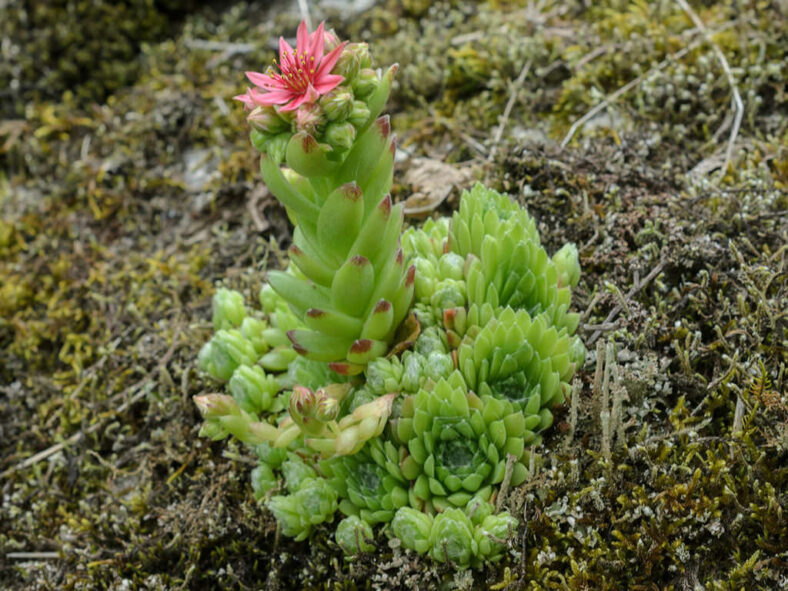
Sempervivum arachnoideum is a succulent plant that forms a mat of compact rosettes of green leaves tipped with white, cobwebby hairs. The subspherical rosettes can reach up to 1.4 inches (3.5 cm) in diameter. The leaves are oblanceolate to oblong-obovate, incurved, and usually have brown or red tips.
During the summer, Sempervivum arachnoideum produces clusters of 5 to 15 star-shaped flowers on an upright stalk with red-tipped leaves, each with an apical tuft of cobwebby hairs. The flowers have 8 to 10 bright reddish-pink petals with a greenish keel, and can reach a diameter of 0.6 inches (1.5 cm). The flower stalk can grow up to 5 inches (12.5 cm) tall. After flowering, the mother rosette dies, but it produces many offsets beforehand.
Origin
Sempervivum arachnoideum is native to the mountains of Europe, from the Pyrenees to the Carpathians.
Subspecies and Forms of Sempervivum arachnoideum
- Sempervivum arachnoideum subsp. arachnoideum: This subspecies is mainly distributed in the eastern part of the species' native range. Its rosette can reach a diameter of 0.6 inches (1.5 cm), and the quantity of cobwebby hairs can vary, sometimes being quite sparse.
- Sempervivum arachnoideum subsp. tomentosum: This subspecies is primarily found in the south-western part of the species' native range. It has larger rosettes, with diameters ranging from 0.6 to 1.4 inches (1.5-3.5 cm), and typically has abundant cobwebby hairs that disappear in the fall and winter. The leaves of this subspecies are broader towards the tip than those of the typical subspecies (subsp. arachnoideum).
- Sempervivum arachnoideum var. bryoides (not accepted as a separate variety and is treated as a synonym of Sempervivum arachnoideum subsp. arachnoideum)
Cultivars and Hybrids of Sempervivum arachnoideum
- Sempervivum arachnoideum 'Cebenese'
- Sempervivum arachnoideum 'Emily'
- Sempervivum arachnoideum 'Robin'
- Sempervivum arachnoideum 'Rubrum'
- Sempervivum arachnoideum 'Viridescens'
- Sempervivum ×barbulatum
How to Grow and Care for Sempervivum arachnoideum
Light: This plant prefers full sun but will appreciate some afternoon shade, especially in hot climates. It is not suitable for indoor growing, as it typically does not receive sufficient sunlight.
Soil: To help Sempervivum arachnoideum thrive, use a well-draining soil mix with 25 to 50% sand, gravel, and perlite or pumice. A commercial succulent soil mix should keep the roots dry and healthy when planted in a pot.
Temperature: Sempervivum arachnoideum is ideal for cold climates, as it can withstand freezing temperatures. It is also heat-tolerant but prefers average summer temperatures between 65°F and 75°F (18°C and 24°C). This plant grows best in USDA Plant Hardiness Zones 5a to 8b, with average minimum winter temperatures ranging from -20°F to 20°F (-28.9°C to -6.7°C).
Watering: Water thoroughly in spring and summer, letting the soil dry out between waterings. Reduce watering in the fall when Sempervivum arachnoideum enters dormancy. Mature rosettes planted in the ground can overwinter without additional water, whereas potted plants may require a little water to make it through the winter. Avoid letting water sit in the rosette or beneath the pot.
Fertilizing: This plant can thrive without feeding, but benefits from a controlled-release fertilizer at the beginning of the growing season. Alternatively, you can fertilize once a week with a diluted liquid solution.
Repotting: Container plants will benefit from repotting. It's best to repot them as needed, preferably in the spring.
Propagation: The easiest way to propagate Sempervivum arachnoideum is by dividing the offsets it produces each season. The best time to divide the offsets is in spring or summer when they are at least a quarter of the size of the mother rosette. You can also propagate by seed; sow the seeds in the fall so seedlings are ready for transplanting in the spring.
Learn more at How to Grow and Care for Sempervivum.
Uses of Sempervivum arachnoideum
Crushed leaves or their juice can be applied externally to treat boils, wounds, and similar issues. They are also effective in stopping nosebleeds. When slightly warmed, the juice can relieve ear inflammation, and chewing the leaves can ease toothaches. Additionally, when macerated and infused in vinegar, the plant can help remove warts and corns.
Harvest the leaves in summer and use them fresh, as they are difficult to dry properly. You can use the leaves' pulp to make a cooling face mask for reddened or sunburned skin.
Toxicity of Sempervivum arachnoideum
Sempervivum arachnoideum is not known to contain toxic compounds, making it a safe plant for pets and children.
Photo Gallery
Click on a photo to see a larger version.


Internal Links
- Explore all plants within the genus Sempervivum.
- Explore all plants within the family Crassulaceae.