

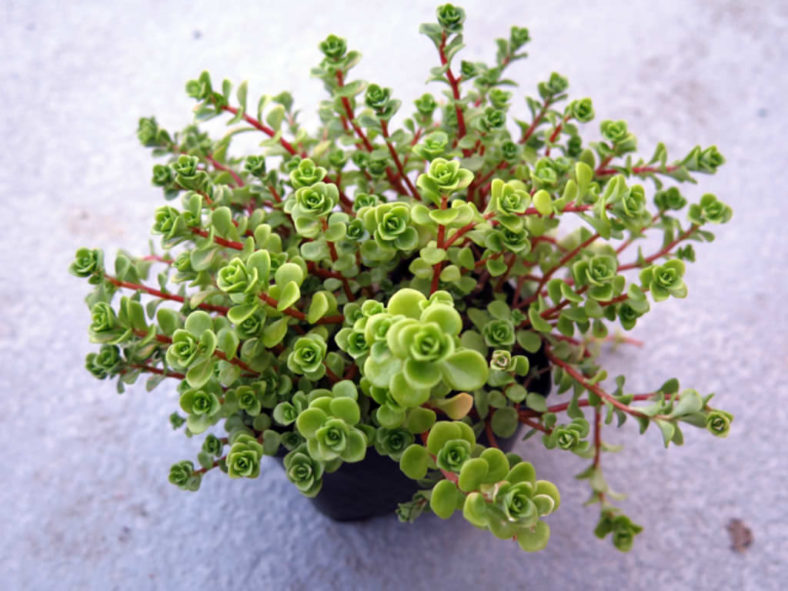
Sedum makinoi 'Limelight', commonly known as Japanese Stonecrop, is a fast-growing, mat-forming succulent prized for its bright chartreuse-to-lime-green foliage. It works well as a low-maintenance groundcover, in rock gardens, or spilling over container edges.
Taxonomy of Sedum makinoi 'Limelight'
Scientific Name
Sedum makinoi 'Limelight'
Common Name(s)
Japanese Sedum, Japanese Stonecrop, Limelight Stonecrop
Scientific Classification
Family: Crassulaceae
Subfamily: Sempervivoideae
Tribe: Sedeae
Genus: Sedum
Etymology
The generic name "Sedum" (pronounced "SEE-dum") means "sitting" or "low-growing" and refers to the low-growing habit of this genus, whose plants appear to "sit" and spread over rocks, slopes, and ground surfaces.
The specific epithet "makinoi" (pronounced "MACK-kin-oy") honors Tomitaro Makino🡕 (1862–1957), a pioneering Japanese botanist noted for his taxonomic work.
The cultivar epithet 'Limelight' refers to the plant's lime-green foliage.
Description
Sedum makinoi 'Limelight' is a mat-forming succulent with slender, creeping stems and striking chartreuse-to-lime-green leaves. It can grow up to 4 inches (10 cm) tall.
The flowers are yellow, star-shaped, and appear in summer.
Origin
Sedum makinoi 'Limelight' is a Japanese cultivar of Sedum makinoi.
How to Grow and Care for Sedum makinoi 'Limelight'
Light: Sedum makinoi 'Limelight' thrives in full sun to partial shade. Full sun promotes compact growth and enhances its bright lime-green foliage, while some afternoon shade is beneficial in particularly hot climates. When grown indoors, place it near a bright window that receives several hours of direct sunlight, or use supplemental grow lights if natural light is insufficient.
Soil: This plant requires well-draining soil and does not tolerate prolonged waterlogging. A commercial cactus and succulent potting mix is suitable; however, adding perlite, pumice, or coarse sand can further improve drainage. When grown outdoors, it can also thrive in ordinary garden soil as long as it drains well.
Temperature: Sedum makinoi 'Limelight' is a relatively cold-hardy succulent that tolerates both summer heat and low winter temperatures, provided the soil is well-drained. It is generally considered suitable for USDA hardiness zones 6b–9b, which have average annual extreme minimum temperatures ranging from -5°F to 30°F (-20.6°C to -1.1°C). When grown in containers, protect the roots from prolonged freezing and avoid excessive winter moisture.
Watering: During the active growing season, water thoroughly and allow the soil to dry out before watering again. Established plants are relatively drought-tolerant, but benefit from occasional watering during prolonged hot, dry periods. Reduce watering during winter, especially when the plant is growing slowly. Avoid keeping the soil continuously moist, as this can lead to root rot.
Fertilizing: Sedum makinoi 'Limelight' has modest nutritional needs and generally doesn't require frequent feeding. If desired, apply a balanced, water-soluble fertilizer diluted to half strength once or twice during the growing season. Avoid excessive fertilization, as it can promote weak growth.
Repotting: Repot when the plant outgrows its container or when the soil needs refreshing, preferably in spring. Choose a slightly larger pot with drainage holes. Allow the soil to dry before repotting.
Propagation: You can easily propagate Sedum makinoi 'Limelight' with stem or leaf cuttings. Stem cuttings are generally the quickest and most reliable method. Leaf cuttings can also produce new plants when you remove healthy leaves cleanly. Spring and early summer are ideal times for propagation.
Learn more at How to Grow and Care for Sedum.
Toxicity of Sedum makinoi 'Limelight'
Sedum makinoi 'Limelight' is generally considered non-toxic to cats and dogs. However, avoid ingestion, as eating plant material may cause mild gastrointestinal upset.
Photo Gallery
Click on a photo to see a larger version.


Internal Links
- Explore all plants within the genus Sedum.
- Explore all plants within the family Crassulaceae.