Scientific Name
Orbea decaisneana (Lem.) Bruyns
Synonym(s)
Angolluma decaisneana, Boucerosia decaisneana, Caralluma decaisneana, Desmidorchis decaisneana, Pachycymbium decaisneanum, Stapelia decaisneana
Common Name(s)
Carrion Plant
Scientific Classification
Family: Apocynaceae
Subfamily: Asclepiadoideae
Tribe: Ceropegieae
Subtribe: Stapeliinae
Genus: Orbea
Etymology
The specific epithet "decaisneana" (pronounced "de-kane-ee-AY-na") honors Joseph Decaisne🡕 (1807–1882), a French botanist and agronomist.
Description
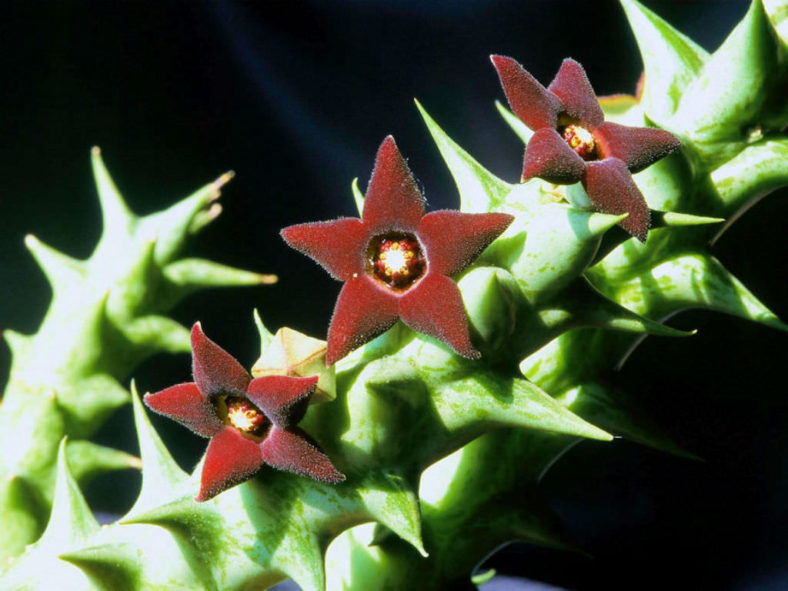
Orbea decaisneana is a much-branched succulent with cylindrical, slightly angled stems with long, conical tubercles. The stems are erect to decumbent and can grow up to 16 inches (40 cm) long and 0.6 inches (1.5 cm) in diameter, excluding tubercles, and root freely in contact with the soil, forming diffuse mats. They are whitish-green to grey-green and mottled with brown to purple. The tubercles can measure up to 0.6 inches (1.5 cm) in length.
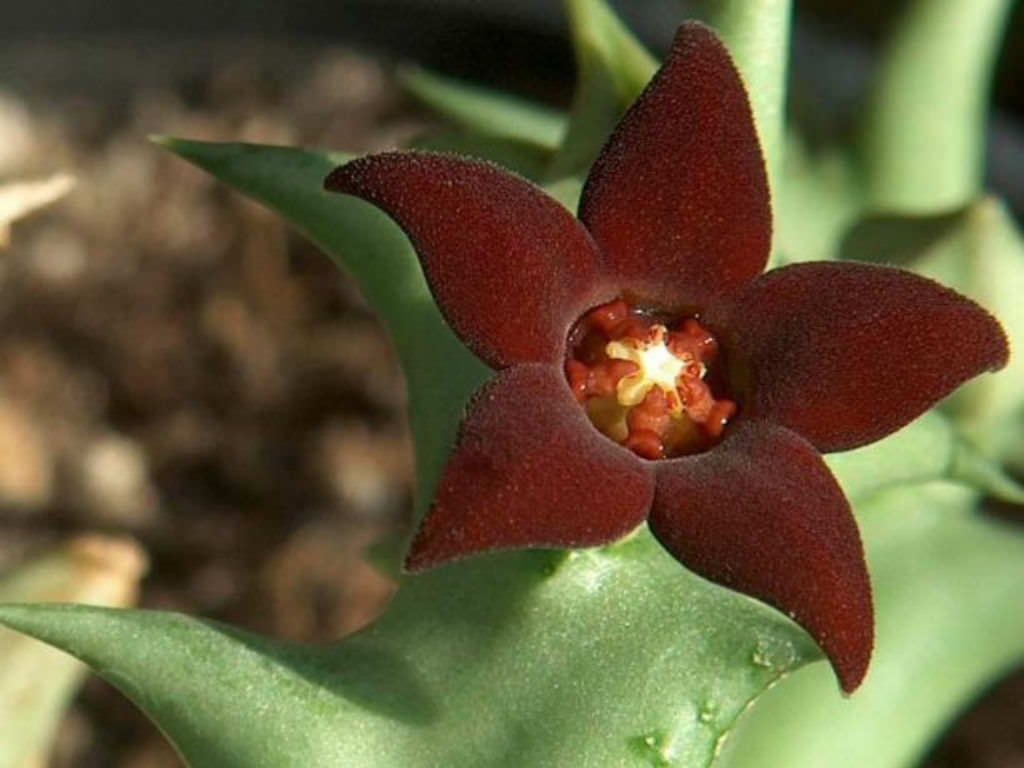
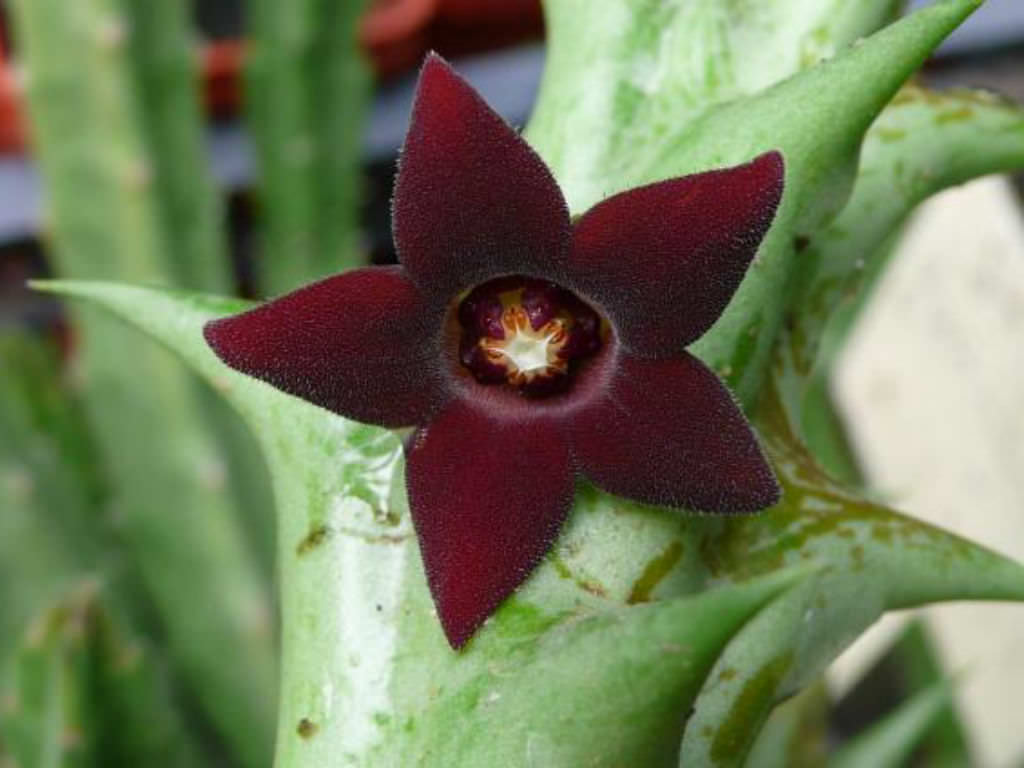
The flowers are dark purple or reddish-brown, frosted with minute white papillae, and appear from summer to fall. They are star-shaped and can reach a diameter of 1 inch (2.5 cm). The fruits are typical horn-shaped follicles.
Origin
Orbea decaisneana is native to Senegal, Mali, Morocco, Burkina Faso, and Sudan. It grows on desert margins and in dry grasslands, among stones on the slopes of granite and limestone outcrops, at elevations from sea level up to 6,560 feet (2,000 m).
Forms
- Orbea decaisneana subsp. hesperidum (not accepted as a separate subspecies and is treated as a synonym of Orbea decaisneana.)
How to Grow and Care for Orbea decaisneana
Hardiness: USDA hardiness zones 10a to 11b: from 30°F (-1.1°C) to 50°F (10°C).
Several species are fairly easy to grow. Others, often those with slightly hairy stems and the more unusual flowers, are more challenging and require careful watering (with some fertilizer) during the growing season and complete water withdrawal during the winter months. A minimum winter temperature of 50°F (10°C) is acceptable, provided plants are kept dry. A heated growing bench or incubator may help delicate plants get through the colder months. However, many species live under shrubs and prefer light shade rather than full sun.
A gritty compost is essential, and clay pots are advisable for the more delicate species. Some growers prefer mineral-only compost to minimize the chance of a fungal attack on the roots. A layer of grit on the compost surface prevents moisture from accumulating around the base of the stems.
Keeping Stapelias and their roots free of pests such as mealybugs is key to success, as fungal attack often results from insect-caused stem damage.
Learn more at How to Grow and Care for Stapelia.
Links
- Back to genus Orbea
- Succupedia: Browse succulents by Scientific Name, Common Name, Genus, Family, USDA Hardiness Zone, Origin, or cacti by Genus
Photo Gallery
Click on a photo to see a larger version.