

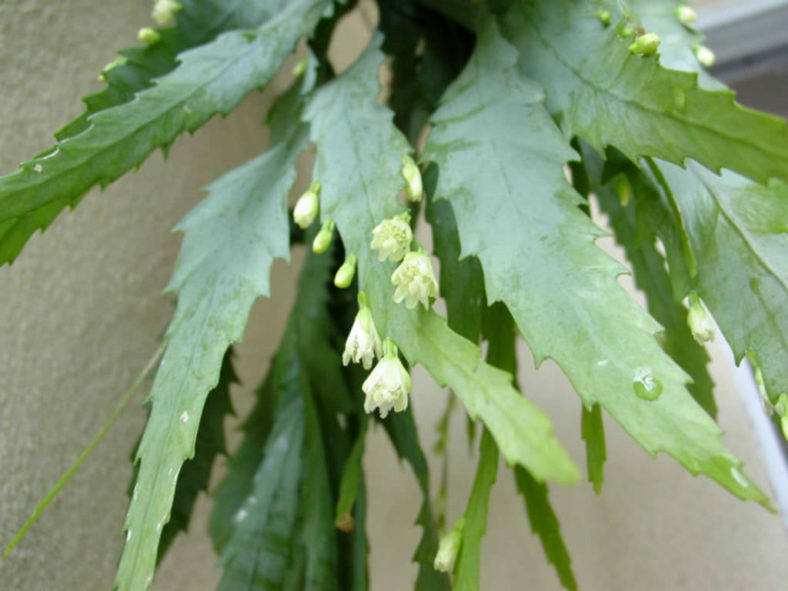
Lepismium houlletianum, commonly known as the Snowdrop Cactus, is a jungle cactus native to the humid rainforests of Brazil, Argentina, and possibly Bolivia. Unlike desert cacti, this cactus lacks sharp spines and is adapted to life in tree canopies. It features highly sculptural, flat, leaf-like trailing stems with prominent serrated edges. When healthy, it produces profuse, delicate, bell-shaped cream or white flowers that dangle gracefully like snowdrops. After flowering, it produces small, translucent dark red or black decorative berries.
Taxonomy of Lepismium houlletianum
Scientific Name
Lepismium houlletianum (Lem.) Barthlott
Common Name(s)
Snowdrop Cactus
Synonym(s)
Rhipsalis houlletiana, Hariota houlletiana, Acanthorhipsalis houlletiana, Nothorhipsalis houlletiana
Scientific Classification
Family: Cactaceae
Subfamily: Cactoideae
Tribe: Rhipsalideae
Genus: Lepismium
Etymology
The generic name "Lepismium" (pronounced "le-PIS-mee-um") means "scaly" and refers to the small, scale-like leaf rudiments surrounding the areoles of the plants in this genus.
The specific epithet "houlletianum" (pronounced "hoo-let-ee-AH-num") honors the discoverer M. Houlletia (1811–1890), a French physician and botanist, who discovered this species and imported it from eastern Brazil.
Description
Lepismium houlletianum is a highly branched cactus with cylindrical primary stems and flattened secondary stem segments with serrated margins. The stems are green and can grow up to 6 feet (1.8 m) long.
The creamy-yellow, funnel-shaped flowers appear at the edges of the stems almost year-round. The spherical, translucent fruits are dark red or black and contain black seeds. They can reach a diameter of 0.4 inches (1 cm).
Origin
Lepismium houlletianum is native to Brazil, Argentina, and possibly Bolivia. It grows as an epiphyte or lithophyte in subtropical or tropical moist forests.
How to Grow and Care for Lepismium houlletianum
Light: Lepismium houlletianum thrives in bright, indirect light or partial shade. Gentle morning or late-afternoon sunlight is beneficial, but protect the plant from strong midday and afternoon sun, as it can scorch its flattened stems. If the light is insufficient, the plant may exhibit weak, elongated growth and produce fewer flowers. An ideal indoor location features bright, filtered light.
Soil: This cactus requires a loose, airy, well-draining potting mix that retains some moisture without becoming waterlogged. A suitable mix includes regular potting soil combined with orchid bark, perlite, and pumice. Unlike desert cacti, Lepismium houlletianum benefits from a more organic and moisture-retentive growing medium.
Temperature: Lepismium houlletianum prefers warm conditions, ideally between 64°F and 81°F (18°C and 27°C ). It is sensitive to frost, so protect it from temperatures below 41°F (5°C). In colder climates, grow it in a container and bring it indoors to a bright, frost-free location during the winter. This plant is generally considered suitable for USDA hardiness zones 10a–11b, which have average annual extreme minimum temperatures ranging from 30°F to 50°F (-1.1°C to 10°C).
Watering: Water regularly during the active growing season, allowing the top layer of the soil to dry slightly between waterings. Unlike desert cacti, Lepismium houlletianum should not be kept completely dry for extended periods. Reduce watering during winter, but avoid letting the substrate dry out completely. Be cautious about overwatering, as excess moisture can cause root and stem rot.
Fertilizing: Feed with a balanced, water-soluble fertilizer diluted to half strength every 4 to 6 weeks during the active growing season. A fertilizer formulated for cacti, orchids, or epiphytic plants is suitable. Stop or significantly reduce fertilizing during the winter months.
Repotting: Repot Lepismium houlletianum every 2 to 3 years or when it outgrows its container. Spring is an ideal time to repot. Choose a pot with drainage holes; hanging baskets are particularly well-suited for showcasing its trailing stems.
Propagation: Lepismium houlletianum can be easily propagated by stem cuttings. Take healthy stem segments and allow the cut ends to dry for a day or two before planting. Keep the cuttings in a warm spot with bright, indirect light until roots develop. You can also propagate it from seeds, although this method is less commonly used.
Learn more in "How to Grow and Care for Rhipsalis."
Toxicity of Lepismium houlletianum
Lepismium houlletianum is generally considered non-toxic to cats and dogs; however, ingestion should be avoided.
Photo Gallery
Click on a photo to see a larger version.


