

Kleinia petraea, commonly known as Trailing Jade, Creeping Jade, or Weeping Jade, is a fast-growing, trailing succulent native to dry, rocky areas of Kenya, Tanzania, and possibly Uganda. Although the currently accepted botanical name is Kleinia petraea, it is still widely sold under its former name, Senecio jacobsenii.
Taxonomy of Kleinia petraea
Scientific Name
Kleinia petraea (R.E.Fr.) C.Jeffrey
Synonym(s)
Notonia petraea, Notoniopsis petraea, Senecio jacobsenii, Senecio petraeus
Common Name(s)
Creeping Jade, Trailing Jade, Vining Jade, Weeping Jade
Scientific Classification
Family: Asteraceae
Subfamily: Asteroideae
Tribe: Senecioneae
Subtribe: Senecioninae
Genus: Kleinia
Etymology
The generic name "Kleinia" (pronounced "KLINE-ee-uh") honors Jacob Theodor Klein🡕 (1685–1759), also known as Plinius Gedanensium, a German jurist, historian, botanist, zoologist, mathematician, and diplomat who served Polish King August II the Strong.
The specific epithet "petraea" (pronounced "pet-RAY-uh") means "growing in rocky places" and refers to the species' natural habitat.
Description
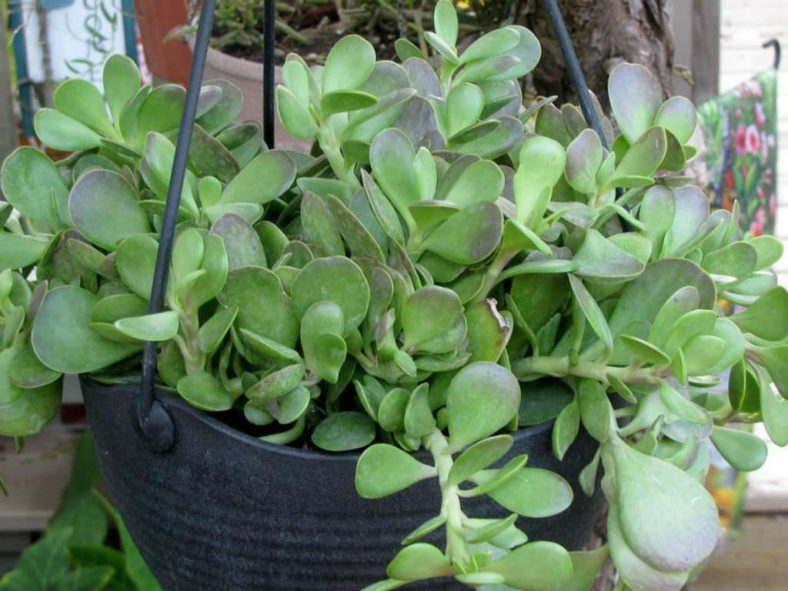
Kleinia petraea, also known as Senecio jacobsenii, is a highly branched succulent with fleshy stems that grow along the soil or hang over the container edges. The stems bear green leaves, often with a purple, mauve, or brown tinge. They can grow up to 20 inches (50 cm) long and about 0.3 inches (0.8 cm) in diameter. The leaves are erect or spreading and more or less egg-shaped, measuring up to 2.6 inches (6.5 cm) long and 1.3 inches (3.2 cm) wide.
The bright orange, rayless composite flowers usually appear in fall or winter on erect stalks that can grow up to 16 inches (40 cm) tall.
Origin
Kleinia petraea is native to the highlands from Kenya to Tanzania. It occurs at elevations ranging from 4,265 to 8,040 feet (1,300 to 2,450 m) above sea level.
Cultivars of Kleinia petraea
How to Grow and Care for Kleinia petraea
Light: Kleinia petraea thrives in bright light, ranging from partial shade to full sun. It benefits from several hours of direct morning sunlight, but some protection from intense midday and afternoon sun is recommended during hot summer weather. When grown indoors, place it near a bright window where it can receive plenty of natural light.
Soil: This plant requires a well-draining, porous soil. A commercial succulent mix amended with pumice, perlite, or coarse sand works well. Good drainage is essential to prevent root and stem rot.
Temperature: Kleinia petraea prefers warm conditions and is sensitive to frost. Protect it from prolonged cold and move container-grown plants to a bright, frost-free location during winter. It is generally listed as suitable for USDA hardiness zones 10a–11b, which have average annual extreme minimum temperatures ranging from 30°F to 50°F (-1.1°C to 10°C).
Watering: During the active growing season, water thoroughly and allow the soil to dry out completely before watering again. Reduce watering during winter when growth slows, and avoid keeping the soil continuously moist. Always ensure that excess water drains freely from the container.
Fertilizing: This plant has modest nutritional requirements. During the active growing season, apply a balanced, water-soluble fertilizer diluted to half strength once a month. Avoid excessive fertilization, as it can encourage weak, leggy growth.
Repotting: Repot every 2 to 3 years or when the plant outgrows its container. Choose a pot with drainage holes. It is best to repot at the beginning of the active growing season.
Propagation: Kleinia petraea can be propagated by stem cuttings or seeds. Stem cuttings are the easiest and fastest method. Take cuttings during the active growing season, and let the cut ends dry and callus for several days before planting. Seed propagation is also possible, though it is generally slower.
Learn more in "How to Grow and Care for Senecio."
Toxicity of Kleinia petraea
The toxicity of Kleinia plants varies among species. While some species, such as Kleinia stapeliiformis, are considered non-toxic, certain members of the genus contain pyrrolizidine alkaloids, which can pose health risks. The toxicity of Kleinia petraea has not been clearly established. As a precaution, keep the plant out of reach of pets and small children.
Photo Gallery
Click on a photo to see a larger version.


