Scientific Name
Hylotelephium sieboldii 'Misebaya-nakafu'
Common Name(s)
Variegated October Daphne
Synonym(s)
Hylotelephium sieboldii 'Mediovariegatum', Sedum sieboldii 'Mediovariegatum'
Scientific Classification
Family: Crassulaceae
Subfamily: Sempervivoideae
Tribe: Telephieae
Genus: Hylotelephium
Origin
Hylotelephium sieboldii 'Misebaya-nakafu' is a Japanese variegated cultivar of Hylotelephium sieboldii.
According to Julian Shaw, as published in Sedum Society Newsletter 130 (2019), there has been only one known clone of this cultivar in Japan, and that remains the case today. There is no doubt that the 'Mediovariegatum' in Japanese and Western cultivation today is identical to the plant introduced from Japan by Siebold and described by Lemaire in 1863, and that this is the same as Samurai Mizuno's 'Misebaya-nakafu'. Based on priority and because of its unambiguous application, it is argued that the Japanese cultivar epithet should be adopted. Hence, the 'Misebaya-nakafu', as published by Samurai Mizuno in 1829, is the correct cultivar epithet for this variegated clone of Hylotelephium sieboldii.
Description
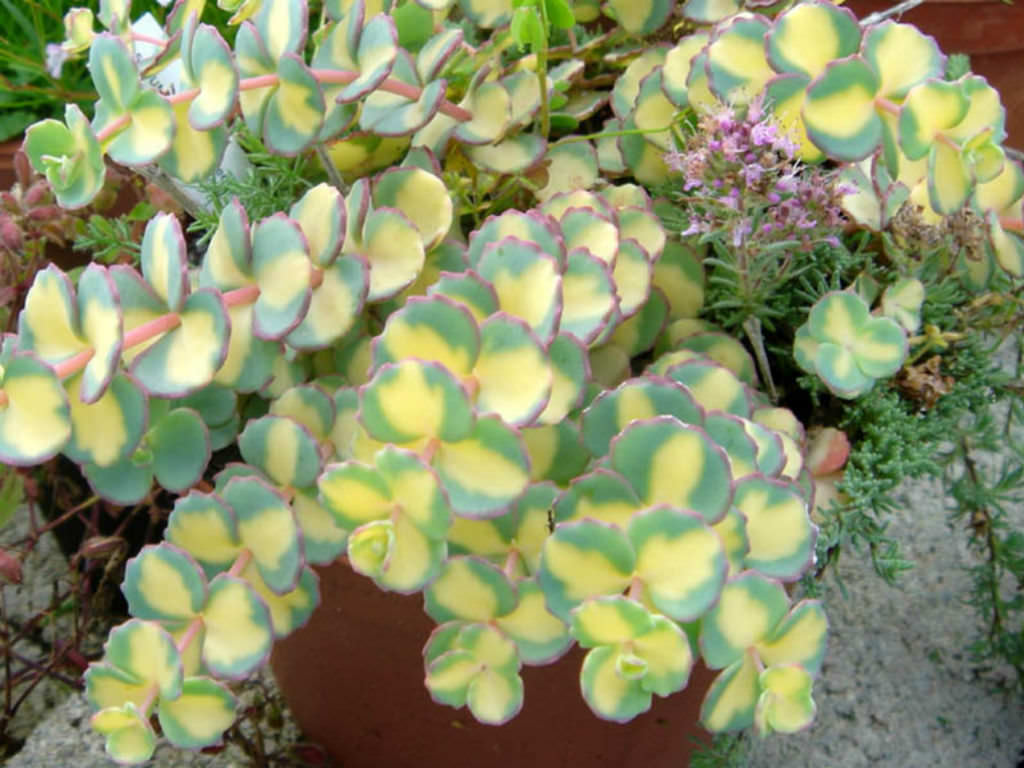
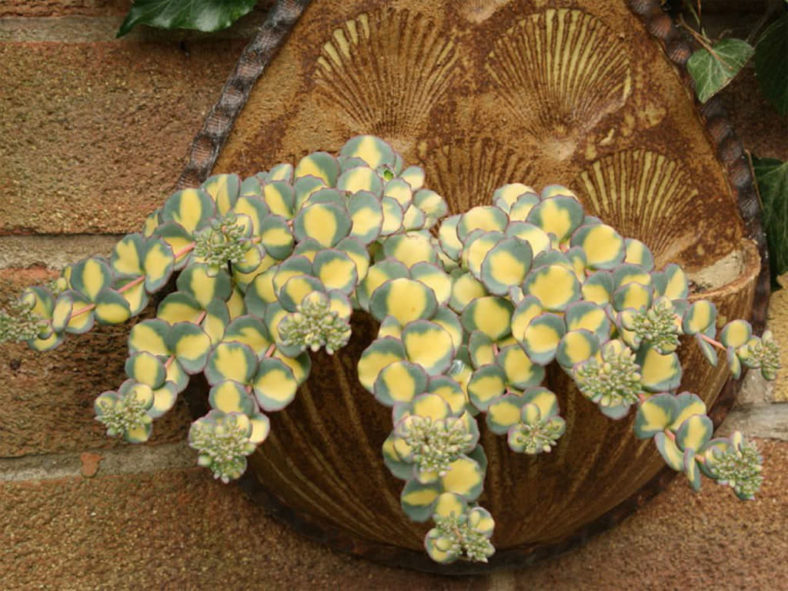
Hylotelephium sieboldii 'Misebaya-nakafu', better known as Hylotelephium sieboldii 'Mediovariegatum' or Sedum sieboldii 'Mediovariegatum', is an attractive succulent that forms a rounded mound, sending out unbranched stems from the central crown. It can grow up to 8 inches (20 cm) tall and 20 inches (50 cm) in diameter. The leaves are blue-green with broad, irregular, creamy-white to yellow markings down the center. They are disc-shaped, borne in whorls of 3 around the stems, and can reach up to 0.8 inches (2 cm) in diameter.
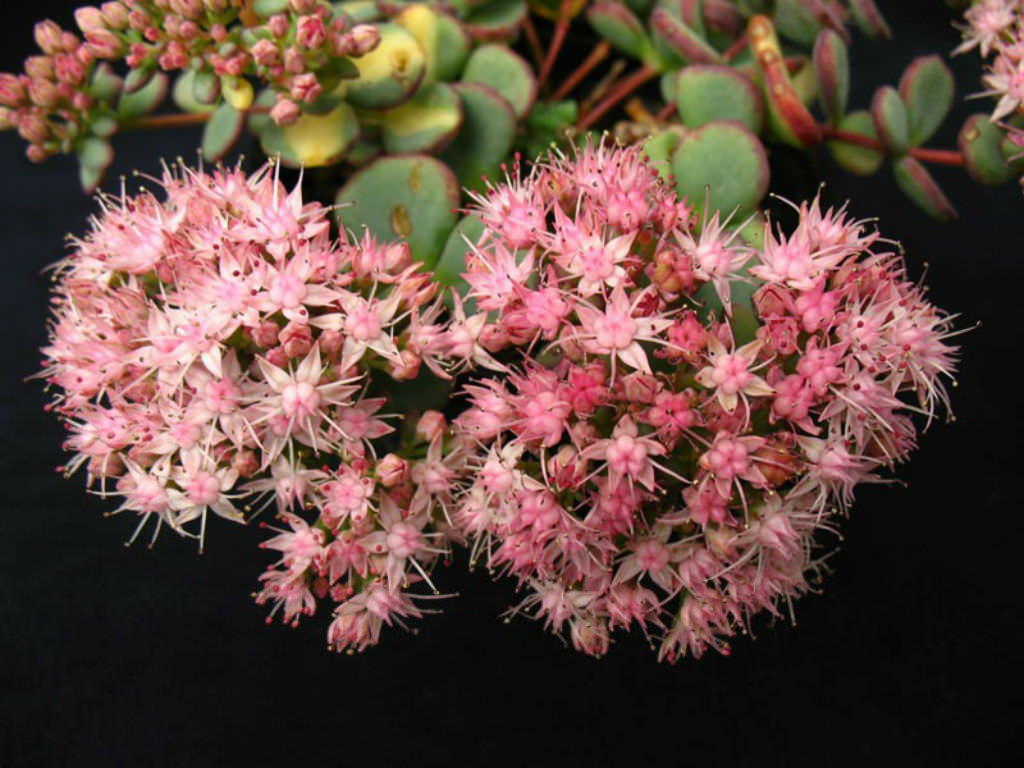
The bright pink, star-shaped flowers appear in small clusters at the ends of the stems in fall. The plant goes dormant in winter when its foliage dies down, but new growth appears in spring.
How to Grow and Care for Hylotelephium sieboldii 'Misebaya-nakafu'
Light: This succulent prefers full sun. It tolerates light to partial shade in hot summer climates but will produce weak, floppy growth when grown in too much shade. Plant your H. sieboldii 'Mediovariegatum' in an area of your garden that gets 6 hours of sunlight a day.
Soil: Hylotelephium sieboldii 'Misebaya-nakafu' does not need rich soil but requires excellent drainage. You can choose a commercial potting mix for succulents or make one yourself.
Hardiness: This plant is tolerant of heat and drought and is cold-hardy, making it a popular outdoor succulent. Hylotelephium sieboldii 'Misebaya-nakafu' can withstand temperatures from -40°F to 30°F (-40°C to -1.1°C) and is hardy to USDA hardiness zones 3a to 9b.
Watering: The best way to water Hylotelephium sieboldii 'Misebaya-nakafu' is to use the "soak and dry" method. Get the soil completely wet, and then wait until it is dry before watering again.
Fertilizing: Feed annually with a balanced fertilizer. According to package directions, apply the fertilizer to the soil in spring as new growth appears.
Repotting: Plants in containers require little more care than those in gardens. When your H. sieboldii 'Mediovariegatum' outgrows its current pot, move it to a larger pot that will better hold the plant. Spring is the best time to repot this plant. Make sure the soil is dry before you begin repotting.
Propagation: This succulent can be grown from seeds, division, or stem cuttings. Sow seeds in spring. Dividing your Hylotelephium sieboldii 'Misebaya-nakafu' is easy and can be carried out almost any time in the growing season. However, it is probably best done in spring or early summer. Propagate by stem cuttings in summer.
Learn more at How to Grow and Care for Hylotelephium.
Toxicity of Hylotelephium sieboldii 'Misebaya-nakafu'
Hylotelephium sieboldii 'Misebaya-nakafu' can be mildly toxic to humans and animals.
Links
- Back to genus Hylotelephium
- Succupedia: Browse succulents by Scientific Name, Common Name, Genus, Family, USDA Hardiness Zone, Origin, or cacti by Genus
Photo Gallery
Click on a photo to see a larger version.