Scientific Name
Graptopetalum rusbyi (Greene) Rose
Synonym(s)
Cotyledon rusbyi, Dudleya rusbyi, Echeveria rusbyi
Common Name(s)
Leather Petals, San Francisco River Leatherpetal
Scientific Classification
Family: Crassulaceae
Subfamily: Sedoideae
Tribe: Sedeae
Subtribe: Sedinae
Genus: Graptopetalum
Origin
Graptopetalum rusbyi is native to the United States (Arizona) and Mexico (Sonora, Chihuahua, and Sinaloa). It grows on north-exposed shaded slopes and cliffs at elevations of up to 5,250 feet (1,600 m).
Description
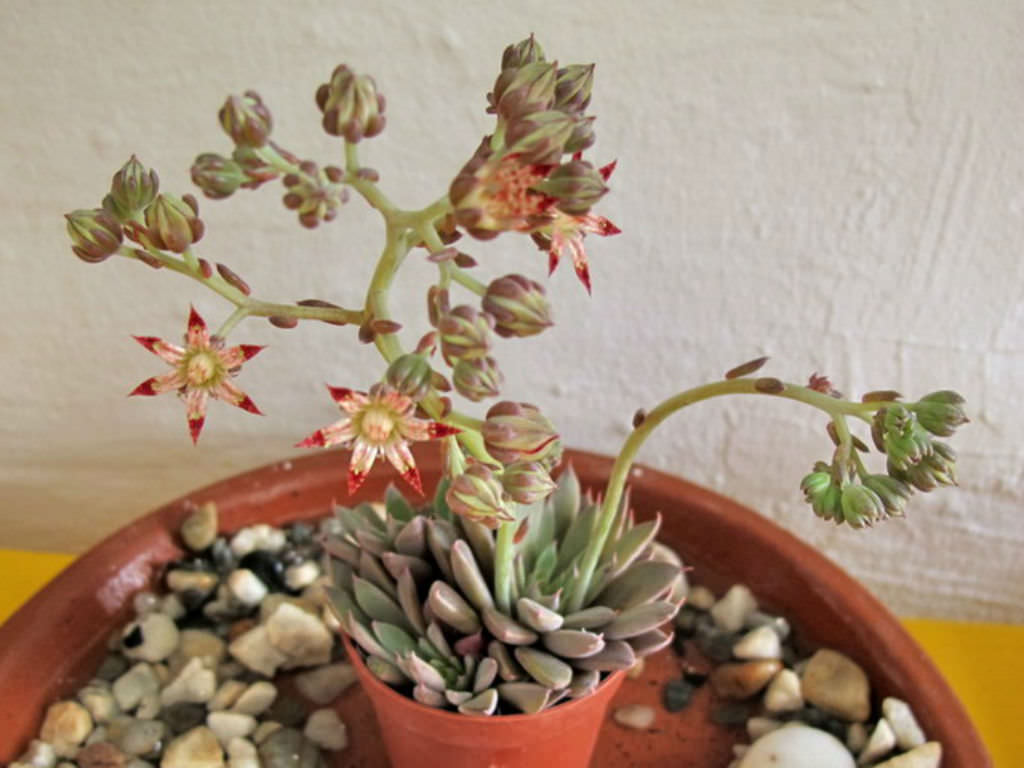
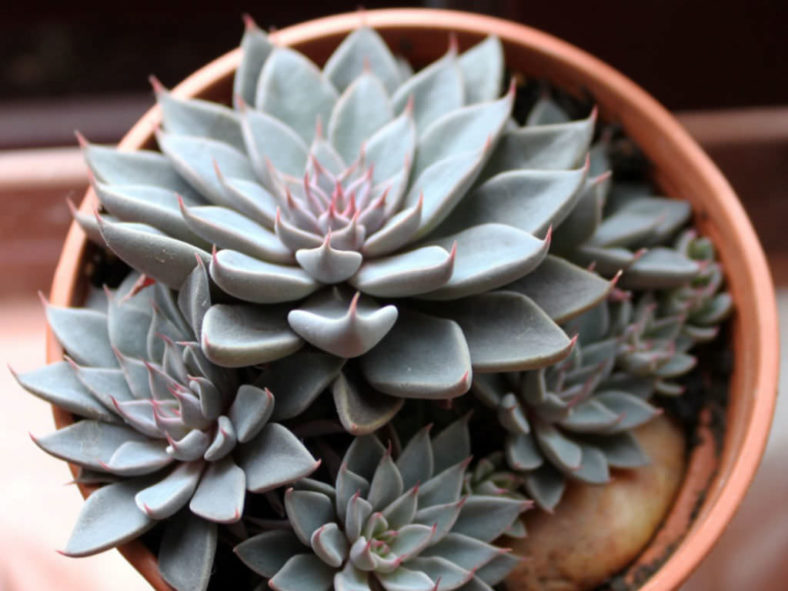
Graptopetalum rusbyi is a small succulent that forms dense rosettes on short, erect stems with ascending, slender branches. The stems branch from below the rosettes. The rosettes have 10 to 50 leaves and can reach a diameter of 4 inches (10 cm). The leaves are fleshy, rhombic to obovate or oblanceolate, with a short, slender, flexible point, and can measure up to 2 inches (5 cm) long and 0.6 inches (1.5 cm) wide. They are pale green, reddish, or violet.
The flowers have a bowl-shaped tube and narrowly triangular, white or greenish petals with 6 to 8 dark red cross-stripes, more conspicuous and denser in the upper half. They appear in late spring, usually in flat-topped clusters on upright stalks that can grow up to 7.2 inches (18 cm) tall.
How to Grow and Care for Graptopetalum rusbyi
Hardiness: USDA hardiness zone 9b to 11b: from 25°F (-3.9°C) to 50°F (10°C).
The rules for Graptopetalums care are similar to those for most succulents. All require lots of sunlight to look their best. They require gritty porous soil with excellent drainage. Water the plants regularly over the summer months, letting the soil dry out between waterings. Minimal water is required over winter. Overwatering is a cause of root rots, and the plant can get several pest infestations. Fertilize once during the growing season with a balanced fertilizer diluted to ¼ strength.
The Graptopetalums are generally easy to propagate by seeds, leaf cuttings, or offsets. Any rosette that breaks off has the potential to root and start a new plant. Even a leaf that drops off will quickly root below the parent plant and produce a new rosette. The new plant feeds off the leaf until it shrivels up and falls off. By then, the new little ghost plant had rooted and sprouted new leaves.
See more at How to Grow and Care for Graptopetalum
Links
- Back to genus Graptopetalum
- Succupedia: Browse succulents by Scientific Name, Common Name, Genus, Family, USDA Hardiness Zone, Origin, or cacti by Genus
Photo Gallery
Click on a photo to see a larger version.