Scientific Name
Crassothonna capensis (L.H.Bailey) B.Nord.
Common Name(s)
Little Pickles
Synonym(s)
Othonna capensis, Othonna crassifolia
Scientific Classification
Family: Asteraceae
Subfamily: Asteroideae
Tribe: Senecioneae
Genus: Othonna
Etymology
The specific epithet "capensis" (pronounced "ka-PEN-sis") means "of, belonging to, or from the Cape Province, South Africa, previously known as Cape Colony or Cape of Good Hope" and refers to the origin of this species.
Origin
Crassothonna capensis is native to South Africa. It occurs in semi-arid Karoo scrub and dry, rocky flats, often in the partial protection of surrounding vegetation or rocks in the Eastern Cape province.
Description
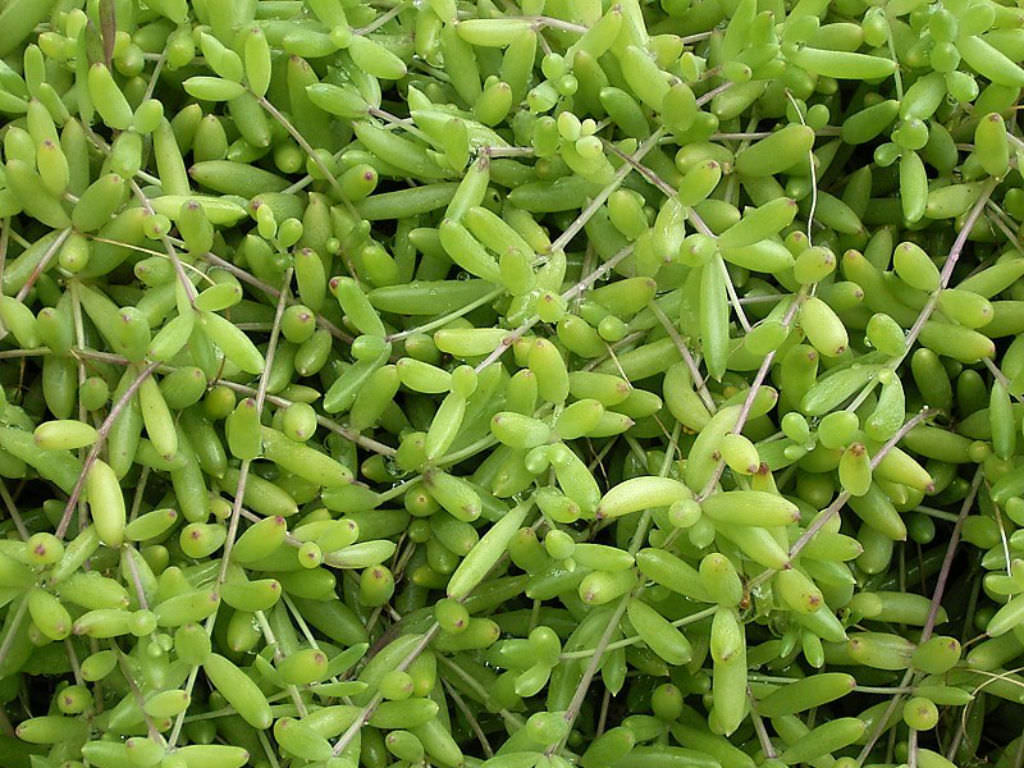
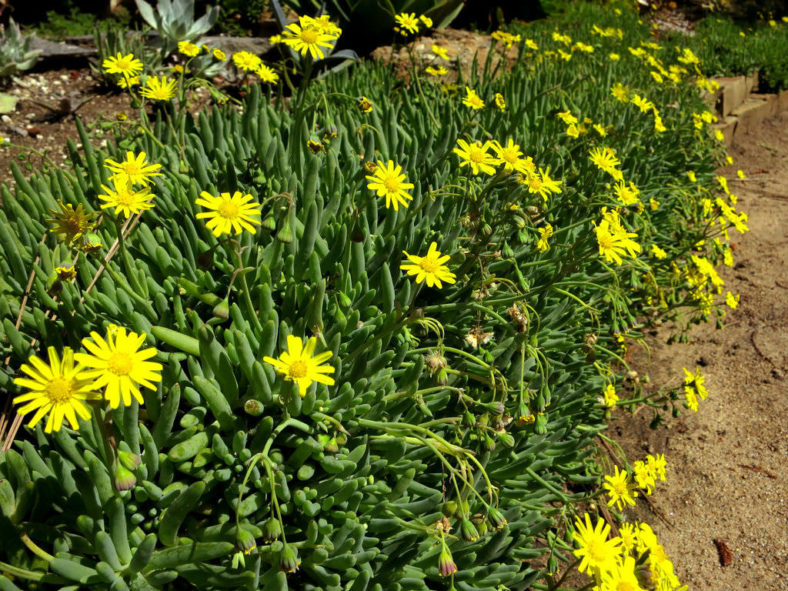
Crassothonna capensis, formerly known as Othonna capensis, is a low-growing succulent with a spreading habit. It can reach a height of up to 4 inches (10 cm) and spread up to 1 foot (30 cm). The leaves are upright, arranged spirally, pickle-shaped, and can grow up to 1 inch (2.5 cm) long. They are bluish-green but can take on yellow, lavender, and red hues when stressed.
The flowers are yellow, daisy-like, and can reach a diameter of 0.5 inches (1.3 cm). They appear from mid-spring through fall and sometimes even year-round. The flowers emerge from pea-shaped, violet-hued buds and rise to 2 inches (5 cm) above the foliage.
Cultivars of Crassothonna capensis
Hardiness: USDA hardiness zone 8a to 10b: from 10°F (-12.2°C) to 50°F (4.4°C).
How to Grow and Care for Crassothonna capensis
Othonna's fleshy leaves and daisy-like flowers make them excellent in a desert or rock garden (where hardy) or indoors as houseplants or greenhouse specimens.
Othonnas tend to be pretty hardy, but some of them, such as Othonna cacalioides, can be extremely difficult to cultivate if you do not give them the right conditions: space to develop a radicular system, and better to keep them in flat pots. In summer, protect plants from direct sunlight. During the growing season, they like to be moist, fresh, and well-lit. They do not like temperatures below 50°F (10°C).
In the warmer months, Othonnas enter their dormant period. Stop watering them and place them in a shaded, cooler, relatively dry area, away from direct sunlight, with good air circulation. In the fall, when nights cool down, the plants may start growing on their own, but a good soaking will help them to leaf out.
A typical succulent soil mix should be suitable for growing Othonnas, but additional drainage material would be recommended.
See more at How to Grow and Care for Othonna.
Links
- Back to genus Othonna
- Succupedia: Browse succulents by Scientific Name, Common Name, Genus, Family, USDA Hardiness Zone, Origin, or cacti by Genus
Photo Gallery
Click on a photo to see a larger version.