

Scientific Name
Austrocylindropuntia subulata f. monstrosa (informal name)
Accepted Scientific Name
Austrocylindropuntia subulata (Muehlenpf.) Backeb.
Common Name(s)
Christmas Tree Cactus, Eve's Needle, Eve's Needle Cactus
Scientific Classification
Family: Cactaceae
Subfamily: Opuntioideae
Tribe: Austrocylindropuntieae
Genus: Austrocylindropuntia
Etymology
The generic name "Austrocylindropuntia" (pronounced "oss-troh-sil-in-droh-PUN-tee-uh") means "Southern Cylindropuntia". It refers to the genus's South American distribution and its relationship to the North American genus Cylindropuntia.
The specific epithet "subulata" (pronounced "sub-yoo-LAH-tuh") means "awl-shaped" and refers to the shape of this species' rudimentary leaves.
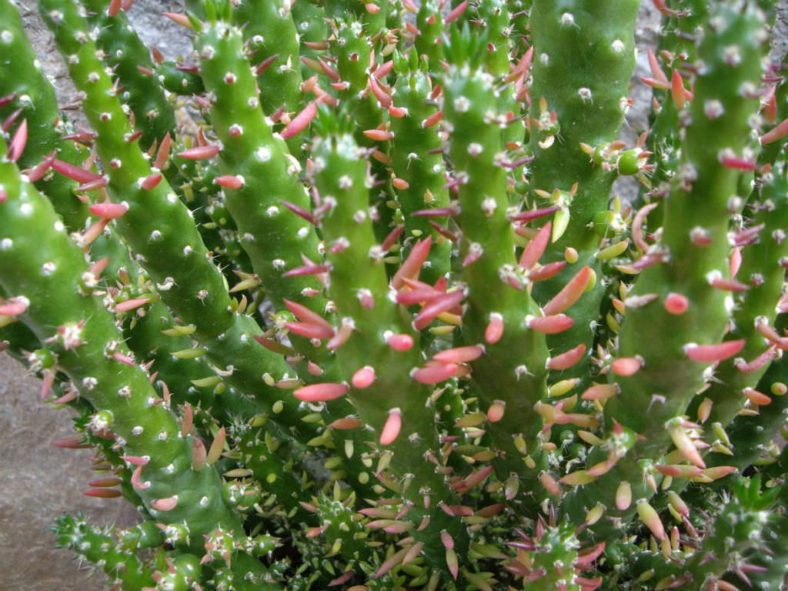
The formal epithet "monstrosa" (pronounced "mon-stru-OH-sa") means "monstrous; strange or abnormally formed" and refers to the plant's monstrous growth.
Description
Austrocylindropuntia subulata f. monstrosa is a densely branched cactus with a main stem and many upright, green, cylindrical shoots. It is smaller than the typical form and can reach up to 3.3 feet (1 m) tall. Its branches can grow up to 1.6 feet (50 cm) long and 1 inch (2.5 cm) in diameter. The leaves are green and nearly cylindrical, measuring up to 0.4 inches (1 cm) in length. The spines are white, very thin, irregular in number, and can measure up to 0.4 inches (1 cm) in length.
The flowers are red and appear in spring and summer.
Origin
Austrocylindropuntia subulata f. monstrosa is a monstrose form of Austrocylindropuntia subulata.
How to Grow and Care for Austrocylindropuntia subulata f. monstrosa
Hardiness: USDA hardiness zones 9a to 11b: from 20°F (-6.7°C) to 50°F (10°C).
Though the large variety of species within the Opuntia genus means different types of prickly pears may need slightly different care, all are desert cacti that require lots of sun, lots of light, and very little water. So, if you live in a hot, arid area, you can generally plant these plants outside, leave them alone, and enjoy them.
As desert cacti, Prickly Pears require maximum sunlight to thrive and should be kept in direct sunlight whenever possible. Very little water is needed. These drought-resistant plants grow best in hot, dry areas, and too much water can cause rot. They prefer hot temperatures but will tolerate a wide range. The most important soil requirement for Opuntia is drainage. Otherwise, basic potting soil is fine, and these cacti also grow well in rock gardens.
Opuntia can grow just fine in a garden, but it can also be grown in pots. To repot, ensure the soil is dry, remove the plant from the pot, and remove the old soil. After treating any cuts with fungicide, place the prickly pear in a new pot and backfill it with potting soil. As with a new cutting, avoid watering a newly repotted prickly pear, as it can rot its roots.
See more at How to Grow and Care for Opuntia.
Links
- Back to genus Austrocylindropuntia
- Succupedia: Browse succulents by Scientific Name, Common Name, Genus, Family, USDA Hardiness Zone, Origin, or cacti by Genus
Photo Gallery
Click on a photo to see a larger version.

