Scientific Name
Aloiampelos tenuior (Haw.) Klopper & Gideon F.Sm.
Synonym(s)
Aloe tenuior
Common Name(s)
Fence Aloe
Scientific Classification
Family: Asphodelaceae
Subfamily: Asphodeloideae
Genus: Aloiampelos
Etymology
The specific epithet "tenuior" (pronounced "ten-YOO-ee-or") means "thinner," "more slender," or "more delicate" and refers to the slender stems of this species.
Origin
Aloiampelos tenuior is native to South Africa. It usually grows in open grassland, shrubland, wooded areas, thicket, coastal scrub, and forest margins in Western Cape, Eastern Cape, KwaZulu-Natal, and Mpumalanga.
Description
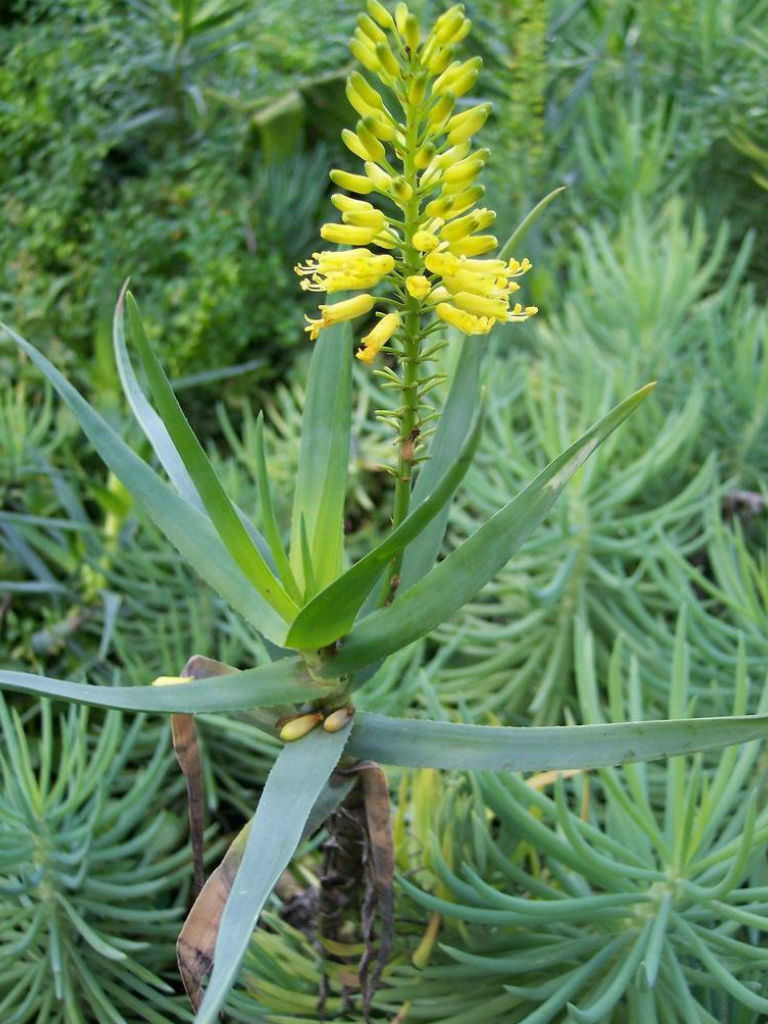
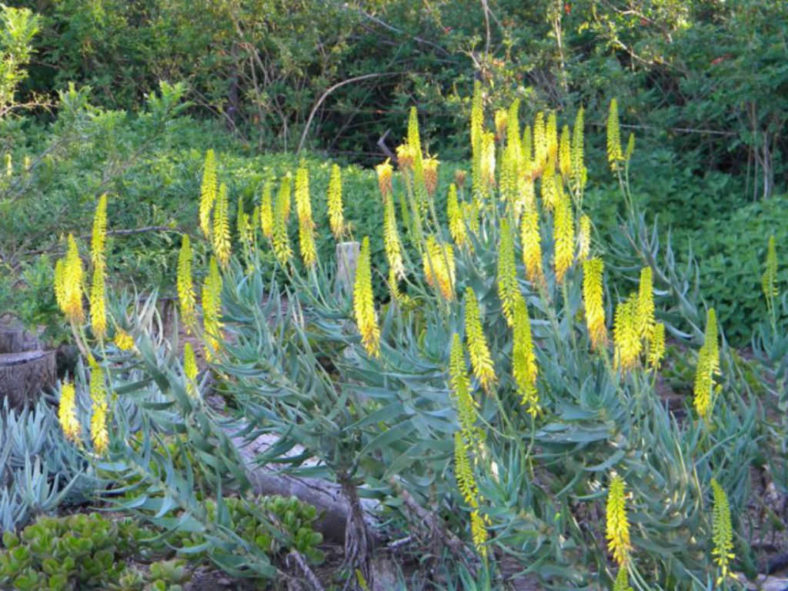
Aloiampelos tenuior, formerly known as Aloe tenuior, is a bushy succulent with numerous slender stems that grow from a large woody rootstock and narrow, lance-shaped leaves crowded in lax rosettes at the end of the stems. It can grow up to 5 feet (1.5 m) tall with support and spread up to 6 feet (1.8 m). The stems are irregularly branched, semi-woody, and have prominent leaf scars. They grow up to 10 feet (3 m) long and take root along nodes upon contact with the ground. The leaves are grayish-green with tiny, white teeth along the margins, measuring up to 6 inches (15 cm) long and 0.75 inches (1.9 cm) wide.
The flowers are bright yellow and appear arranged in slender racemes throughout the year, mainly in winter. They are tubular, reaching a length of 0.8 inches (2 cm) and a diameter of 0.15 inches (0.4 cm). The fruits are small, papery, dehiscent capsules, each with a few tiny seeds.
Subspecies of Aloiampelos tenuior
- Aloiampelos tenuior var. decidua
- Aloiampelos tenuior var. densiflora
- Aloiampelos tenuior var. ernstii
- Aloiampelos tenuior var. rubriflora
- Aloiampelos tenuior var. tenuior
- Aloiampelos tenuior var. viridifolia
How to Grow and Care for Aloiampelos tenuior
Hardiness: USDA hardiness zone 9b to 11b: from 25°F (-3.9°C) to 50°F (10°C).
Due to their hardiness and the wide range of flower colors, these slender succulents have become popular ornamental plants in South African gardens. The commoner species (such as the more widespread Aloes of the Eastern Cape) are also increasingly grown in gardens overseas.
Climbing Aloes require a sunny, well-drained position and are particularly suitable for rockeries. The taller, climbing species are commonly planted along fences and boundaries, growing through the surrounding foliage. However, the lower, rambling species are better suited for rockeries, slopes, or terraces, which they will naturally cascade down over.
See more at How to Grow and Care for Climbing Aloes.
Links
- Back to genus Aloiampelos
- Succupedia: Browse succulents by Scientific Name, Common Name, Genus, Family, USDA Hardiness Zone, Origin, or cacti by Genus
Photo Gallery
Click on a photo to see a larger version.