Scientific Name
Agave parryi var. truncata 'Huntington'
Common Name(s)
Artichoke Agave
Scientific Classification
Family: Asparagaceae
Subfamily: Agavoideae
Genus: Agave
Origin
Agave parryi var. truncata 'Huntington' is a clone of Agave parryi var. truncata.
Description
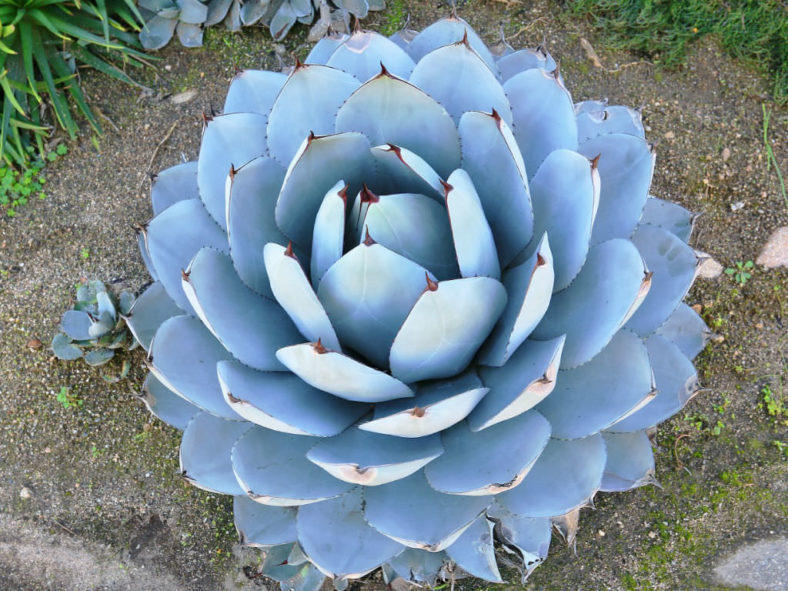
Agave parryi var. truncata 'Huntington' is an attractive succulent that forms tight rosettes of thick, broad, pale blue-gray leaves with small, widely spaced teeth and a curved terminal spine. The spines are dark reddish-brown on the new leaves and fade to gray on the older leaves. The leaves carry distinct imprints of the thorny leaf margins of the previous outer leaf bud on their lower surfaces.
Over ten years, mature rosettes are topped with a magnificent flower spike. Tinged orange in the bud, the flowers open yellow, resulting in a bicolored inflorescence. The rosette dies after flowering, but new rosettes formed by offsets will slowly root at the base of the mother rosette.
How to Grow and Care for Agave parryi var. truncata 'Huntington'
Hardiness: USDA hardiness zone 8a to 11b: from 10°F (-12.2°C) to 50°F (10°C).
Agaves are not difficult plants to grow. They're slow-growing and dramatic and will even thrive on a bit of neglect. If you're the type of person who likes to fuss with houseplants and water a lot, Agave is probably not the plant for you. If, however, you're the type of person who likes to set it and forget it, and you have a sunny window, Agave might be the way to go. Be aware that some large varieties will eventually outgrow your room (unless you have a large greenhouse), and Agave can be aggressive. They have irritating sap and sometimes sharp thorns that can injure small children and pets.
In general, Agaves do not need to be repotted every year. Most species commonly found in cultivation grow slowly and take a long time to outgrow their pot. It's also best to handle your Agave as little as possible, since they do not like being disturbed.
See more at How to Grow and Care for Agave.
Links
- Back to genus Agave
- Succupedia: Browse succulents by Scientific Name, Common Name, Genus, Family, USDA Hardiness Zone, Origin, or cacti by Genus
Photo Gallery
Click on a photo to see a larger version.