

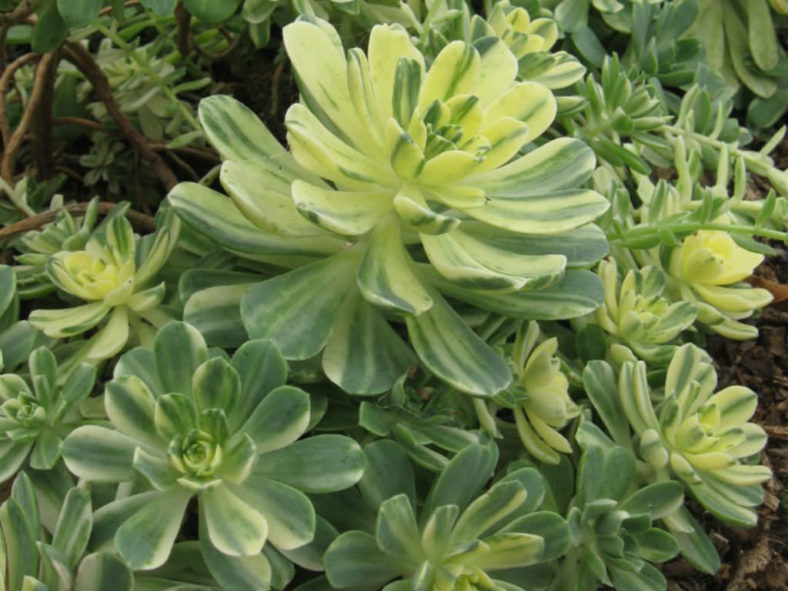
Aeonium castello-paivae 'Harry Mak' is a compact, branching succulent shrub with variegated leaves in shades of green, cream, and yellow. In bright light, the leaf edges can develop a pink hue. This cultivar is more commonly sold as Aeonium castello-paivae 'Suncup'. However, the name "Harry Mak" was first published in Gordon Rowley's book Teratopia in 2006, and therefore has priority over the name "Suncup", published in 2007.
Taxonomy of Aeonium castello-paivae 'Harry Mak'
Scientific Name
Aeonium castello-paivae 'Harry Mak'
Synonym(s)
Aeonium castello-paivae f. variegatum, Aeonium castello-paivae 'Suncup', Aeonium castello-paivae 'Variegatum', Aeonium 'Suncup'
Scientific Classification
Family: Crassulaceae
Subfamily: Sempervivoideae
Tribe: Aeonieae
Genus: Aeonium
Etymology
The generic name "Aeonium" (pronounced "ee-OH-nee-um") means "long-lasting" and refers to the enduring, perennial nature of the plants in this genus.
The specific epithet "castello-paivae" (pronounced "kas-TEL-oh PAY-vee") honors António da Costa Paiva🡕, Baron of Castelo de Paiva (1806–1879), a Portuguese botanist, naturalist, doctor, teacher, and nobleman.
The cultivar epithet 'Harry Mak' honors Chi-King Harry Mak (also cited as Harry C. K. Mak or simply Harry Mak), a succulent enthusiast and author of Photo Album of Succulents in Color.
Description
Aeonium castello-paivae 'Harry Mak', also known as Aeonium castello-paivae 'Suncup', is a lovely, densely branched succulent shrub that forms rosettes on ascending or pendent branches covered with fine, soft hairs. The rosettes can grow up to 2.8 inches (7 cm) in diameter. The leaves are fleshy, irregularly striped with green and cream or yellow, and have pink margins in full sun.
The greenish-white flowers are 7- to 9-merous and appear in lax, semi-globular clusters in summer.
Origin
Aeonium castello-paivae 'Harry Mak' is a form of Aeonium castello-paivae selected for its variegated foliage.
How to Grow and Care for Aeonium castello-paivae 'Harry Mak'
Light: Aeonium castello-paivae 'Harry Mak' thrives in bright light, ranging from partial shade to full sun. However, protect it from intense midday and afternoon sunlight, especially during hot summer weather, to prevent leaf scorch. If grown indoors, place it near a bright window that receives several hours of sunlight, and gradually acclimate it to direct sunlight.
Soil: Unlike many desert succulents, this plant prefers slightly more moisture-retentive soil but still well-draining. A sandy loam or a regular potting mix amended with perlite, pumice, or coarse sand works well. Avoid heavy, waterlogged soils, as excessive moisture can lead to root rot.
Temperature: Aeonium castello-paivae 'Harry Mak' prefers mild temperatures and may enter dormancy during hot, dry summer weather. It grows most actively during the cooler months and should be protected from prolonged frost. It is generally considered suitable for USDA hardiness zones 9b–11b, which have average annual extreme minimum temperatures ranging from 25°F to 50°F (-3.9°C to 10°C).
Watering: Water thoroughly during the active growing season, mainly from fall through spring, allowing the soil to dry partially between waterings. Reduce watering during winter if growth slows or conditions are cool and damp. During its summer dormancy, water very sparingly, only as needed to prevent excessive shriveling. Avoid keeping the soil continuously wet.
Fertilizing: During the active growing season, apply a balanced, water-soluble fertilizer diluted to half strength about once a month. Avoid fertilizing during summer dormancy.
Repotting: Repot every 2 to 3 years or when the plant outgrows its container. Choose a pot with drainage holes. Repotting is best done at the beginning of the active growing season in the fall.
Propagation: Aeonium castello-paivae 'Harry Mak' is most reliably propagated by stem cuttings. Take cuttings during the active growing season, and let the cut ends dry and callus for several days before planting. Leaf propagation is also possible, but it is slow and unreliable. Furthermore, plants grown from leaf cuttings may not retain the parent plant's characteristic variegated foliage.
Learn more at How to Grow and Care for Aeonium.
Toxicity of Aeonium castello-paivae 'Harry Mak'
Aeoniums are generally considered non-toxic to humans and pets. However, specific information on Aeonium castello-paivae 'Harry Mak' is limited. As a precaution, keep the plant out of reach of pets and small children.
Photo Gallery
Click on a photo to see a larger version.


Internal Links
- Explore all plants within the genus Aeonium.
- Explore all plants within the family Crassulaceae.