

Scientific Name
Dorstenia foetida Schweinf.
Synonym(s)
Kosaria foetida, Kosaria forskaohlii
Common Name(s)
Foetid Dorstenia, Grendelion, Shield Flower
Scientific Classification
Family: Moraceae
Tribe: Dorstenieae
Genus: Dorstenia
Etymology
The specific epithet "foetida" (pronounced "FET-uh-duh") means "stinking" or "foul-smelling". It refers to the sometimes unpleasant odor emitted by the flowers of this species to attract specific pollinators. However, this scent is not always strong or noticeable.
Origin
The native range of Dorstenia foetida extends from Eastern Africa (Tanzania, Kenya, Somalia, and Ethiopia) to Arabia (Yemen, Oman, and Saudi Arabia). It occurs in deciduous and succulent bushland, open places, and rock outcrops.
Description
Dorstenia foetida is a small succulent with a thick, erect stem, unbranched or with several branches, each with pronounced scars of leaves, stipules, and inflorescences. It is a highly variable species, especially in leaf shape and size, petiole length, and stipule size. The stem is dark green to mahogany-colored with peeling bark in older plants and can grow up to 16 inches (40 cm) tall and 6 inches (15 cm) in diameter. The leaves are light green to grayish green and crowded at the tops of stems and branches. They are oblong to narrowly lanceolate or elliptic, measuring up to 5.6 inches (14 cm) long and 0.8 inches (2 cm) wide.
The flowers are small, grayish or green, and can reach a diameter of 0.8 inches (2 cm). The solitary, disc-shaped flower-like structures are actually fruiting bodies called hypanthodiums, consisting of many minuscule flowers. They are usually grayish or green or sometimes orange or pinkish and can measure up to 0.6 inches (1.5 cm) in diameter, excluding appendages.
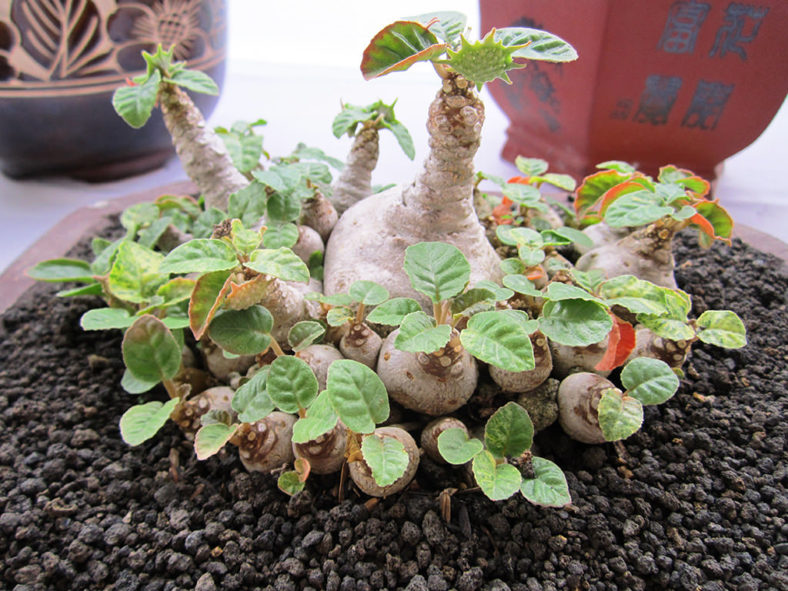
Subspecies of Dorstenia foetida
- Dorstenia foetida subsp. foetida
- Dorstenia foetida subsp. lancifolia
How to Grow and Care for Dorstenia foetida
Hardiness: USDA hardiness zones 10b to 11b: from 35°F (1.7°C) to 50°F (10°C).
Dorstenias are warm-loving plants that need a bit more water than regular succulents. They need a well-drained potting mix, and their watering needs vary by season. Water your Dorstenias regularly and abundantly from spring to fall. Allow the soil to dry slightly between waterings, but ensure it never dries out completely. These plants tend to go at least partially dormant during the winter months. During this period, water them very little. Giving plants a warm, sunny position can result in beautiful, compact growing plants. It is recommended to fertilize plants occasionally during their growing period with a high-potash, high-phosphorus fertilizer.
The spring weather, characterized by a high-temperature swing between day and night, along with frequent rain, can favor the development of fungal diseases, which should be treated preemptively with a systemic fungicide.
Dorstenias are generally propagated by seed. Many species are self-fertile. Their seeds are expelled explosively from the mature seed heads and are liable to populate pots several feet away. They can also be propagated by cuttings.
Learn more in "How to Grow and Care for Dorstenia."
Links
- Back to genus Dorstenia
- Succupedia: Browse succulents by Scientific Name, Common Name, Genus, Family, USDA Hardiness Zone, Origin, or cacti by Genus
Photo Gallery
Click on a photo to see a larger version.

