Scientific Name
Cyphostemma currorii (Hook.f.) Desc.
Synonym(s)
Cissus currorii, Vitis currorii
Common Name(s)
Butter Tree, Cobas Tree
Scientific Classification
Family: Vitaceae
Subfamily: Vitoideae
Genus: Cyphostemma
Etymology
The specific epithet "currorii" (pronounced "KUR-or-ee-eye") honors Andrew Beveridge Curror (1811–1844), a British-born surgeon who served as surgeon on different ships of the British Royal Navy and plant collector in Angola from 1839 to 1843.
Origin
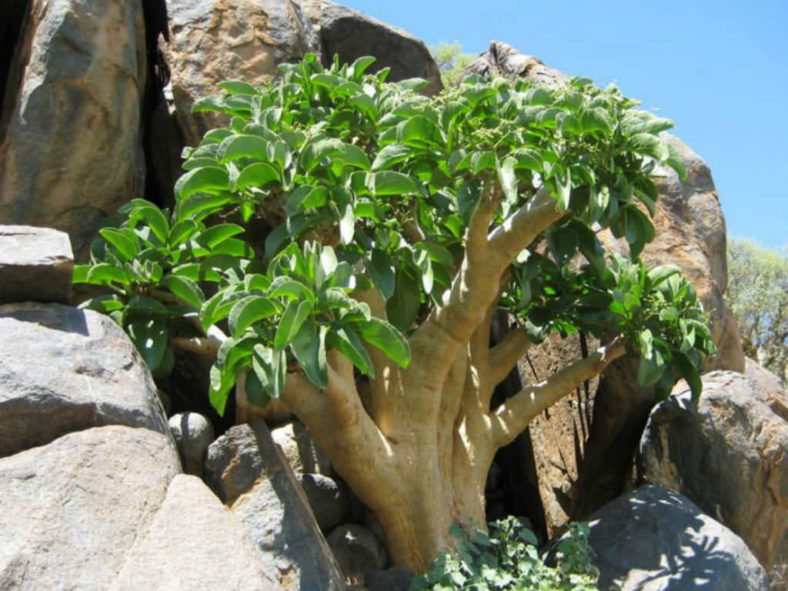
The native range of this species is from southern Angola to northwestern and west-central Namibia. It grows in hot, arid rocky outcrops, often growing on steep slopes.
Description
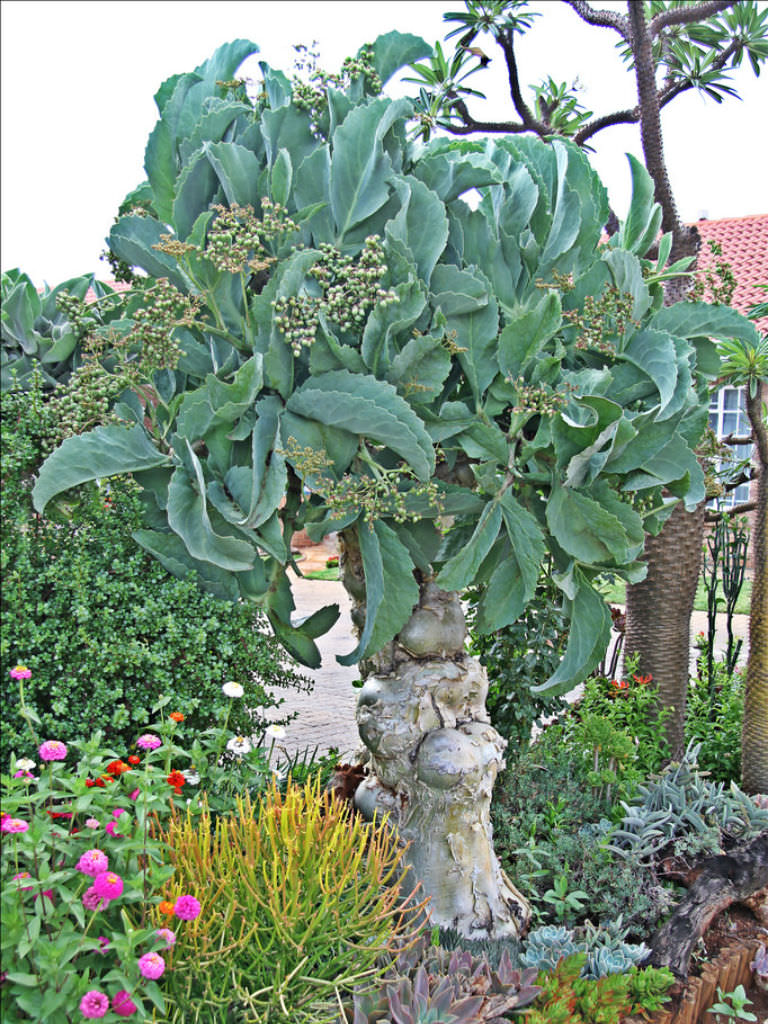
Cyphostemma currorii is a slow-growing, deciduous succulent shrub or small tree that has a thick trunk with a yellowish to orange bark, peeling off in paper-like flakes to expose a greenish underbark. It resembles a dwarf Baobab and most often reaches about 10 feet (3 m) in height, but can grow up to 20 feet (6 meters) tall. The leaves are large, fleshy, and arranged in groups of three at the tips of the branches. The plant goes dormant in the winter and loses its leaves.
The small, cream-colored flowers and bright-green fruits are borne on long stalks in summer.
How to Grow and Care for Cyphostemma currorii
Hardiness: USDA hardiness zones 10b to 11b: from 35°F (1.7°C) to 45°F (7.2°C).
Wild Grape is a very sought-after plant for the garden, as are other caudiciform plants such as Baobabs, Adeniums, and Tylecodons. They make superb container or open garden subjects in and around the garden, especially around swimming pools and courtyards. Because this species grows mainly in the summer, plants must be kept dry during the colder winter months. They are ideal accent plants for a rockery or for planting in a large container on a sunny, protected patio.
The Wild Grape fares best in loamy or sandy soil with optimal drainage. Plenty of river sand and general compost will greatly improve drainage in heavy clay soils. Soil quality can also be dramatically improved by lightly incorporating bone meal into the soil. Although smelly, the effect on soils is quite remarkable. As a rule of thumb, use only organic products, such as those based on seaweed extract, especially if plants are fed regularly. Organic products won't burn or damage plants.
See more at How to Grow and Care for Wild Grape (Cyphostemma juttae).
Links
- Back to genus Cyphostemma
- Succupedia: Browse succulents by Scientific Name, Common Name, Genus, Family, USDA Hardiness Zone, Origin, or cacti by Genus
Photo Gallery
Click on a photo to see a larger version.