

Sempervivum tectorum, commonly known as Common Houseleek, is a hardy succulent native to the mountainous regions of Western, Central, and Southern Europe. It forms low-growing rosettes of thick, fleshy leaves that store water and are often tipped with reddish-purple margins.
Taxonomy of Sempervivum tectorum
Scientific Name
Sempervivum tectorum L.
Synonym(s)
Sedum tectorum
Common Name(s)
Houseleek, Liveforever, Common Houseleek, Hen and Chickens, Old Man and Woman, Roof Houseleek, Hens and Chicks, Bullock's Beard, Bullock's Eye, Devil's Beard, Earwort, Fuet, Healing Blade, Homewort, Imbroke, Jove's Beard, Jupiter's Beard, Jupiter's Eye, Poor Jan's Leaf, Roof Foil, Sengreen, St Patrick's Cabbage, Thunder Plant, Welcome-home-husband-however-drunk-you-be
Scientific Classification
Family: Crassulaceae
Subfamily: Sedoideae
Tribe: Sedeae
Subtribe: Sedinae
Genus: Sempervivum
Etymology
The generic name "Sempervivum" (pronounced "sem-per-VEE-vum") means "always alive" or "ever-living". It refers to the evergreen, resilient nature of plants in the genus Sempervivum.
The specific epithet "tectorum" (pronounced "tek-TOR-um") means "of the roofs" and refers to the traditional practice of growing this species on rooftops, thought to protect against thunderstorms.

Description
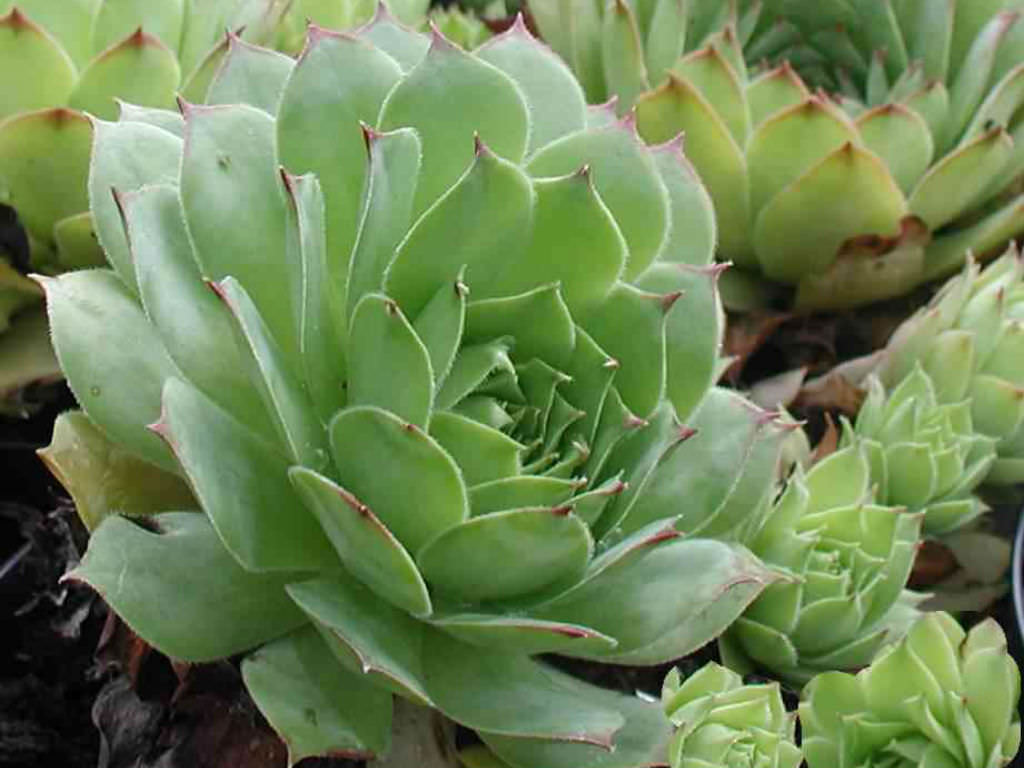
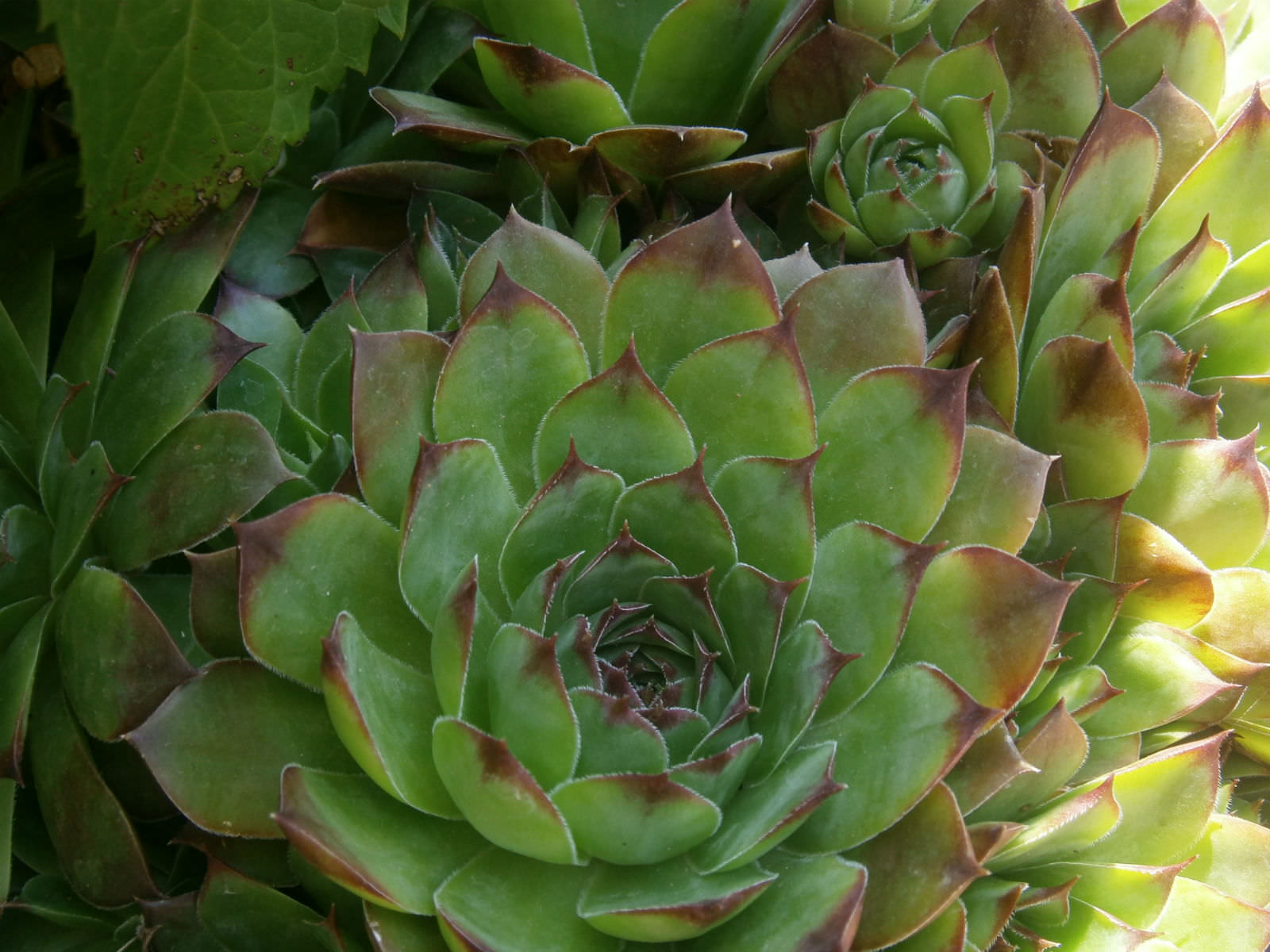
Sempervivum tectorum is a mat-forming succulent that forms rosettes of fleshy, green leaves variably tinged with red and usually with a purple tip. The rosettes typically grow about 4 inches (10 cm) in diameter and produce offsets attached to the mother rosette by stout stolons that can grow up to 1.6 inches (4 cm) long. The leaves are oblong-lanceolate to obovate, glabrous or shortly glandular-pubescent, with conspicuously white cilia along the margins. They can measure up to 2.4 inches (6cm) long and 0.6 inches (1.5 cm) wide.
In summer, an upright, leafy, pubescent flower stalk rises from the mother rosette and is topped with cymes of red-purple flowers. The flower stalk can grow up to 12 inches (30 cm) tall.
Origin
Sempervivum tectorum is native to the Mountains of Western, Central, and Southern Europe, from the Pyrenees to the Alps, Apennines, and Dinarides.
Subspecies of Sempervivum tectorum
- Sempervivum tectorum subsp. arvernense
- Sempervivum tectorum subsp. tectorum
- Sempervivum royanum (not accepted as a separate species and is synonymized with Sempervivum tectorum subsp. tectorum)
Hybrids of Sempervivum tectorum
How to Grow and Care for Sempervivum tectorum
Light: This plant prefers full sun but will appreciate some afternoon shade, especially in hot climates. It is not suitable for indoor growing, as it typically does not receive sufficient sunlight.
Soil: To help Sempervivum tectorum thrive, use a well-draining soil mix with 25 to 50% sand, gravel, and perlite or pumice. A commercial succulent soil mix should keep the roots dry and healthy when planted in a pot.
Temperature: Sempervivum arachnoideum is ideal for cold climates, as it can withstand freezing temperatures. It is also heat-tolerant but prefers average summer temperatures between 65°F and 75°F (18°C and 24°C). This plant grows best in USDA Plant Hardiness Zones 3b to 11b, with average minimum winter temperatures ranging from -20°F to 20°F (-28.9°C to -6.7°C).
Watering: Water thoroughly in spring and summer, letting the soil dry out between waterings. Reduce watering in the fall when Sempervivum tectorum enters dormancy. Mature rosettes planted in the ground can overwinter without additional water, whereas potted plants may require a little water to make it through the winter. Avoid letting water sit in the rosette or beneath the pot.
Fertilizing: This plant can thrive without feeding, but benefits from a controlled-release fertilizer at the beginning of the growing season. Alternatively, you can fertilize once a week with a diluted liquid solution.
Repotting: Container plants will benefit from repotting. It's best to repot them as needed, preferably in the spring.
Propagation: The easiest way to propagate Sempervivum tectorum is by dividing the offsets it produces each season. The best time to divide the offsets is in spring or summer when they are at least a quarter of the size of the mother rosette. You can also propagate by seed; sow the seeds in the fall so seedlings are ready for transplanting in the spring.
Learn more at How to Grow and Care for Sempervivum.
Uses of Sempervivum tectorum
For centuries, people have used the juice and leaves in folk remedies for their cooling, anti-inflammatory, astringent, and diuretic properties. Bruised leaves or juice can be used as poultices for burns, scalds, ulcers, and other inflammation, as they quickly reduce pain. Honey, mixed with the juice, helps relieve mouth ulcer pain.
Learn more at Houseleek: Superstitions, History, and Medicinal Benefits.
Toxicity of Sempervivum tectorum
Sempervivum tectorum is not known to contain toxic compounds, making it a safe plant for pets and children.
Photo Gallery
Click on a photo to see a larger version.

Internal Links
- Explore all plants within the genus Sempervivum.
- Explore all plants within the family Crassulaceae.