

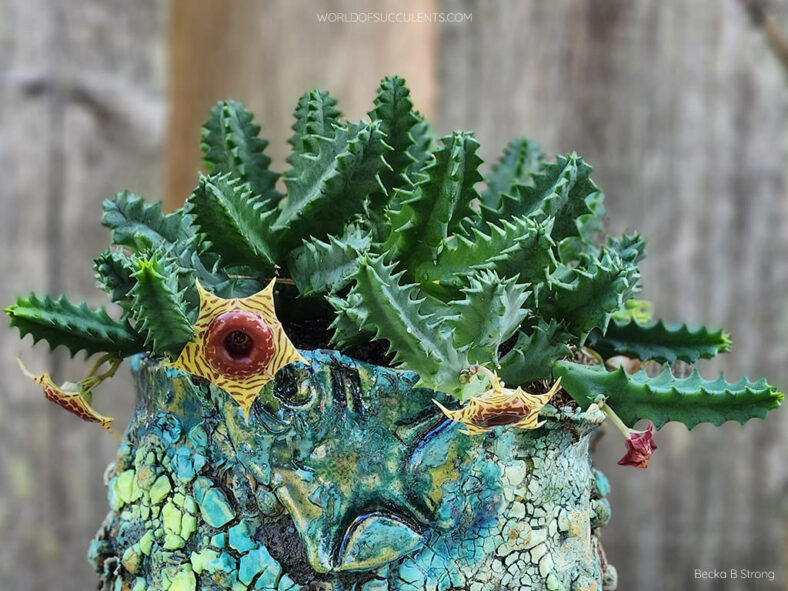
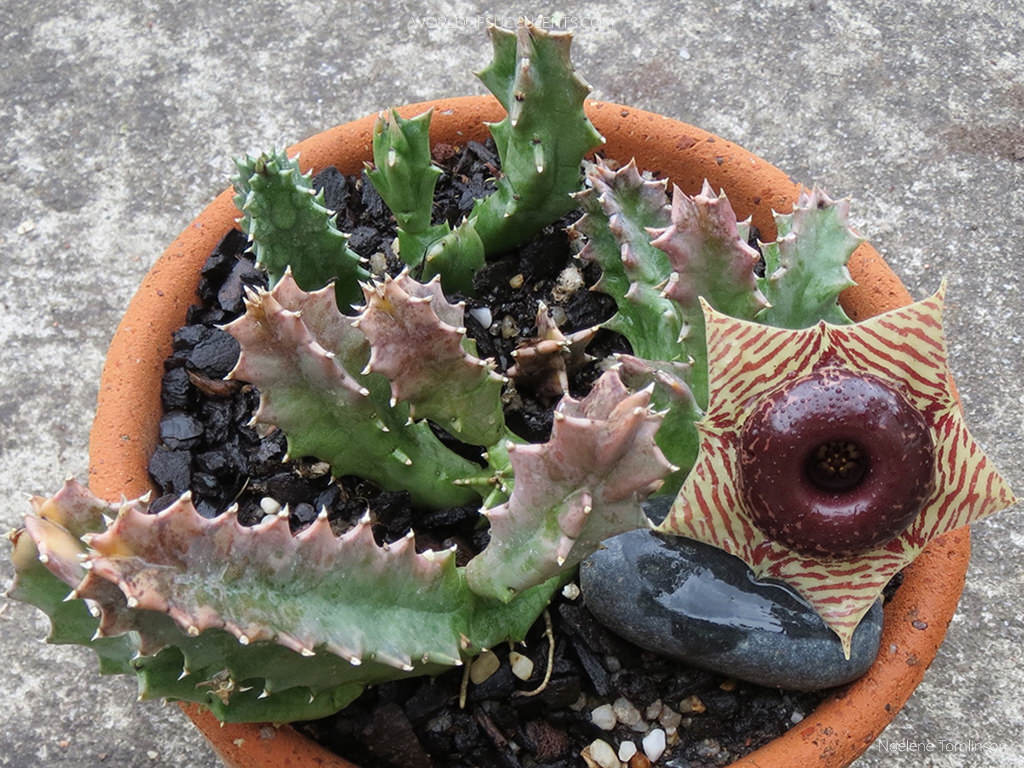
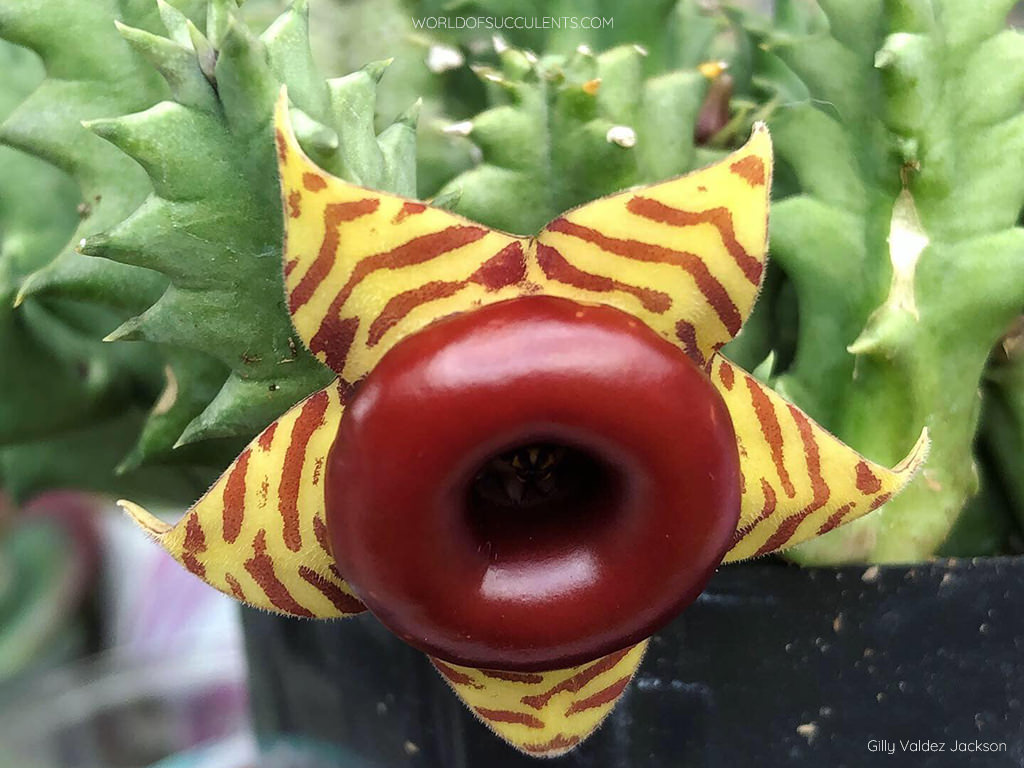
Huernia zebrina, commonly known as Little Owl Eyes, is a low-growing succulent native to southern Africa. It is admired for its unique, star-shaped flowers, which have a prominent, shiny, red-to-maroon ring (called an annulus) at the center, resembling a lifesaver candy. Huernia zebrina has also received the prestigious Award of Garden Merit🡕 from the British Royal Horticultural Society🡕.
Taxonomy of Huernia zebrina
Scientific Name
Huernia zebrina N. E. Br.
Synonym(s)
Ceropegia zebrina
Common Name(s)
Carrion Flower, Lifesaver Plant, Little Owl, Little Owl Eyes, Owl Eyes, Zebra-stripped Huernia
Scientific Classification
Family: Apocynaceae
Subfamily: Asclepiadoideae
Tribe: Stapeliae
Genus: Huernia
Etymology
The generic name "Huernia" (pronounced "HOY-a") honors Justus Van Heurn, Van Heurne, or Heurnius (1587–c.1653), a Dutch doctor, missionary, translator, and botanist, who is reputed to have been the first European to document and collect South Africa's Cape plants.
The specific epithet "zebrina" (pronounced "zeb-REE-nuh") means "zebra-striped" or "zebra-marked" and refers to the bold, zebra-striped patterns on the flowers of this species.
Description
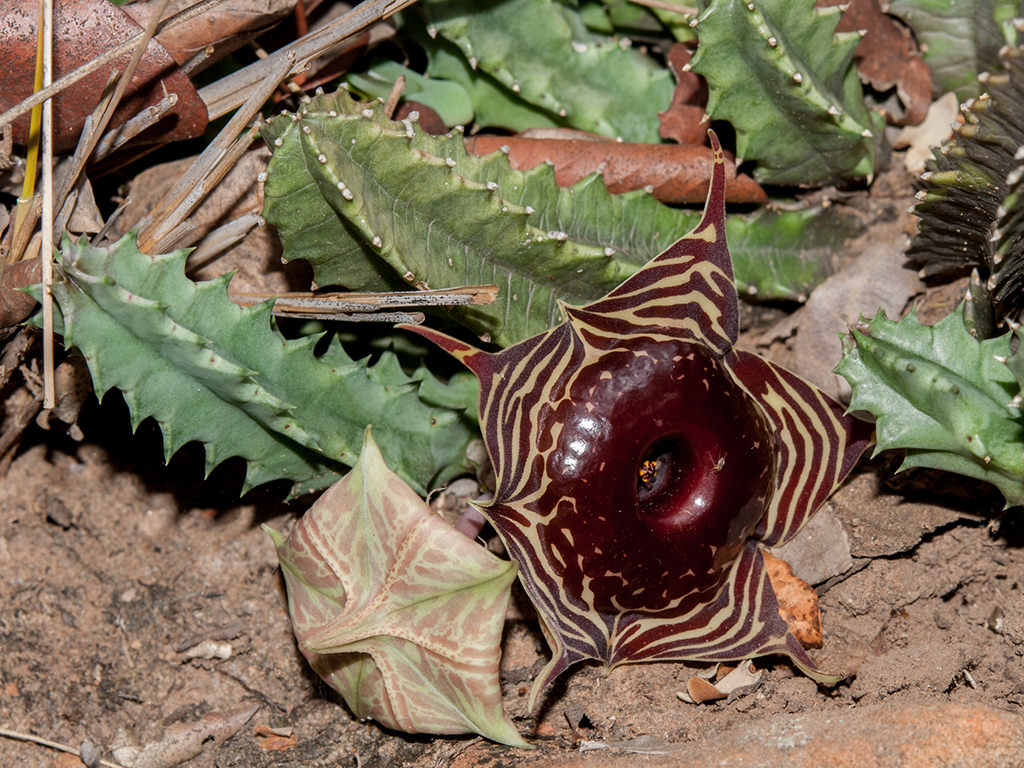
Huernia zebrina is a small succulent with erect to decumbent stems with deltoid tubercles joined into 4 to 6 angles along the stem. This plant can form a clump reaching up to 20 inches (50 cm) in diameter. The stems are grey-green and usually mottled with purple. They are fleshy, irregularly branched, and can grow up to 4.8 inches (12 cm) long and 0.8 inches (2 cm) thick (excluding teeth). The tubercles can grow up to 0.3 inches (0.7 cm) long and narrow abruptly into a slender tooth.
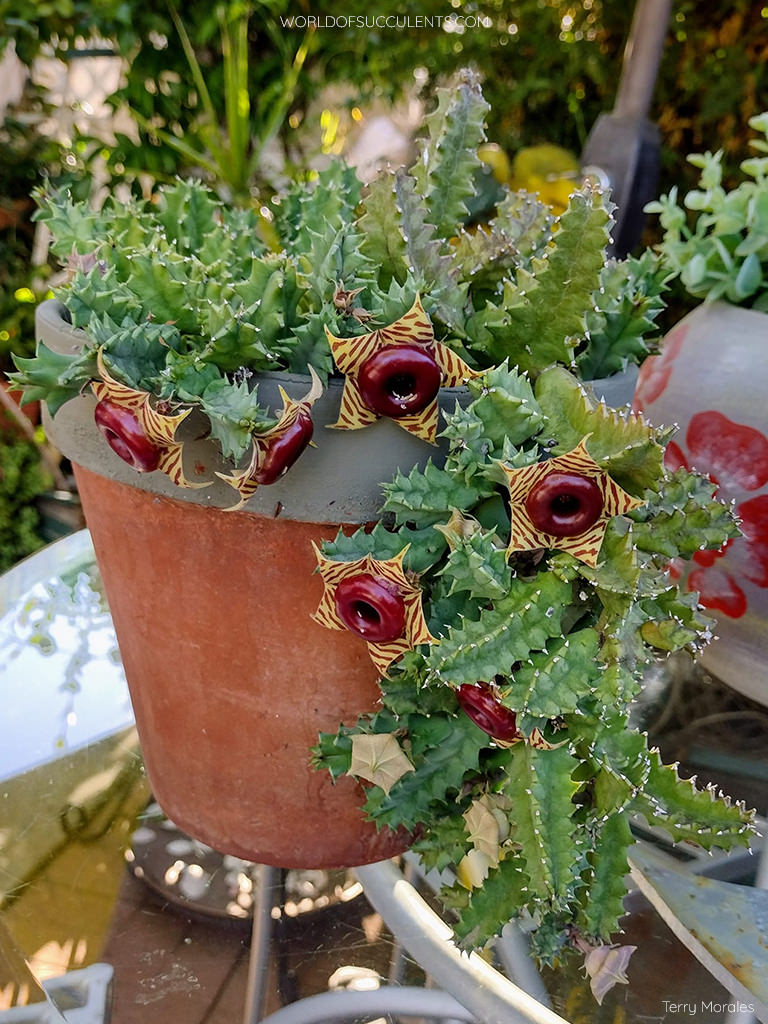
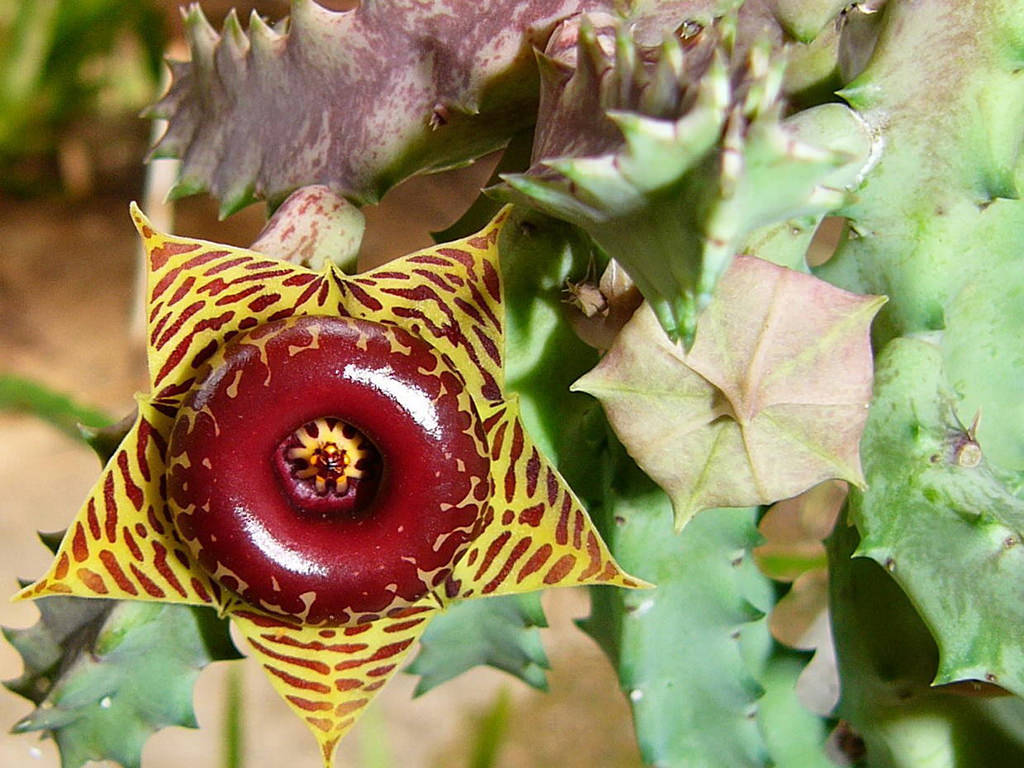
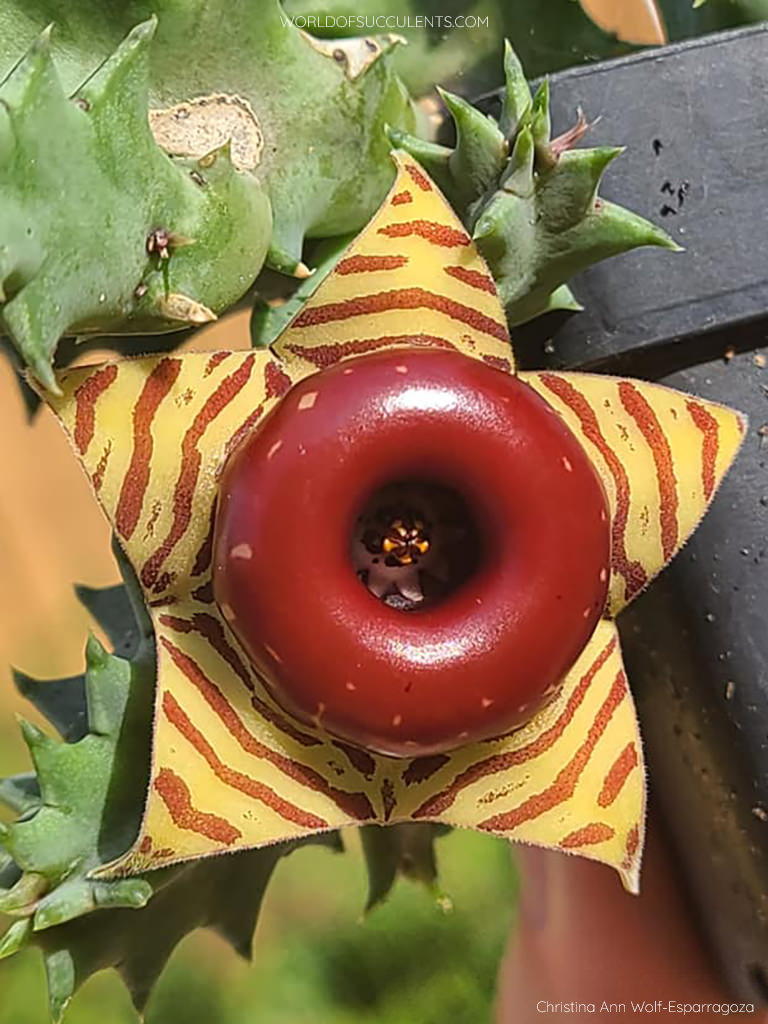
From late spring to early fall, Huernia zebrina produces inflorescences of 1 to 3 star-shaped flowers on short stalks. The flowers can reach up to 2 inches (5 cm) in diameter and develop in gradual succession. The corolla is cream to greenish-yellow, with irregular red-to-maroon transverse lines on the lobes, which change to dots on the shiny annulus, often coalescing there, and is uniformly red to maroon in the tube. On the outside, the corolla is cream-colored, often mottled reddish behind the annulus and on lobes, and with one heavy, raised longitudinal vein running down the center of each lobe. The corona is about 0.25 inches (0.6 cm) wide, with cream outer lobes with red-to-maroon margins and red-to-maroon inner lobes with bright yellow dorsal gibbosity.
Origin
Huernia zebrina is native to Mozambique, Zimbabwe, Namibia, South Africa (Limpopo, Mpumalanga, and KwaZulu-Natal), and Eswatini. It grows in open dry scrubland, in stony areas, often in calcrete or hard loamy soils.
Subspecies and Forms of Huernia zebrina
How to Grow and Care for Huernia zebrina
Light: Huernia zebrina prefers bright light or partial shade during the hottest summer days. Too much sun can cause the stems to develop a protective pigmentation or get sunburned. Too little light leads to weak, thin stems and decreased flower production. When grown indoors, place the plant near the brightest window of your home.
Soil: The right soil is crucial to successful growing. Use a commercial potting soil mix for succulents, or prepare your own with 50-70% mineral grit, such as coarse sand, pumice, or perlite.
Temperature: Huernia zebrina thrives in warm outdoor environments with low to moderate humidity, but does not like winter cold and should remain fairly dry and warm during its winter dormancy. It grows best in USDA Plant Hardiness Zones 10a to 11b, with average minimum winter temperatures ranging from 30°F to 50°F (-1.1°C to 10°C).
Watering: This plant has typical succulent watering needs. During the growing season, water it thoroughly and allow the soil to dry between waterings. It goes dormant in winter and needs almost no water, about once a month.
Fertilizing: To keep it healthy and thriving, fertilize during the growing season. Feed with water-soluble fertilizer diluted to half-strength.
Repotting: The plant will benefit from fresh potting soil every 2-3 years. Repot it in spring, just before the growing season. Pick a container with drainage holes.
Propagation: The best way to propagate Huernia zebrina is by stem cuttings. Take cuttings during the growing season to ensure good rooting. It is also easy to start from seeds in the spring.
Learn more at How to Grow and Care for Huernia.
Toxicity of Huernia zebrina
Huernia zebrina has no reported toxic effects, so it is safe around pets and humans.
Photo Gallery
Click on a photo to see a larger version.
Internal Links
- Explore all plants within the genus Huernia.
- Explore all plants within the family Apocynaceae.