

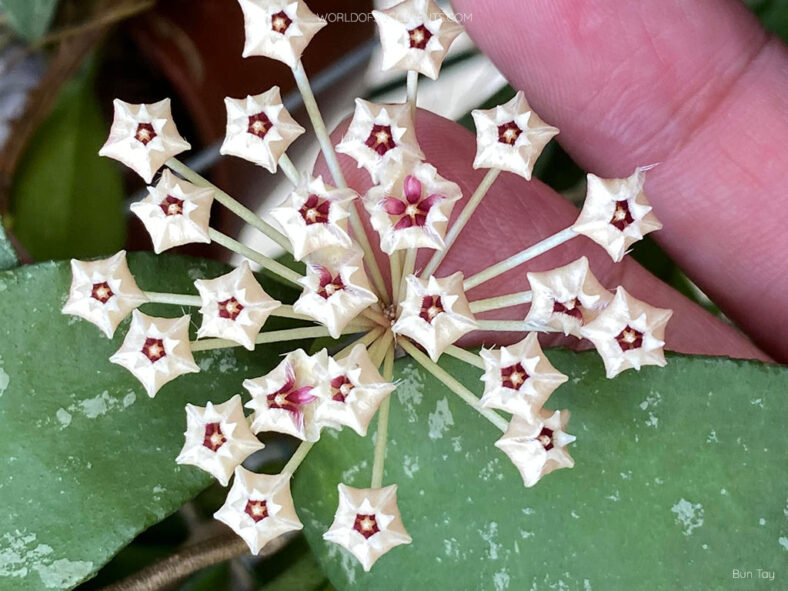
Hoya phuwuaensis is a climbing epiphyte that originates from the mixed deciduous forest of northeastern Thailand. It is similar to Hoya caudata, but can be easily distinguished by its elliptical leaves, whereas Hoya caudata has ovate leaves. Additionally, Hoya phuwuaensis blooms at night, while the flowers of Hoya caudata remain open both day and night. Its flowers are also similar to those of Hoya flagellata, which is another night-blooming species.
Taxonomy of Hoya phuwuaensis
Scientific Name
Hoya phuwuaensis Kidyoo
Scientific Classification
Family: Apocynaceae
Subfamily: Asclepiadoideae
Tribe: Marsdenieae
Genus: Hoya
Etymology
The generic name "Hoya" (pronounced "HOY-a") honors Thomas Hoy🡕 (c.1750-1822), an English gardener and botanist who worked for 40 years for the Duke of Northumberland at Syon House in Middlesex, United Kingdom.
The specific epithet "phuwuaensis" (pronounced "foo-WOO-uh-EN-sis") means "of or from Phu Wua" and refers to the Phu Wua Wildlife Sanctuary🡕 in Bueng Kan Province, Thailand, where this species was first discovered in 2008.
Origin of Hoya phuwuaensis
Hoya phuwuaensis is native to northeastern Thailand, specifically Bueng Kan Province. It grows as a climbing epiphyte in sun-exposed areas in mixed deciduous forest at an elevation of about 665 feet (200 m).
Description of Hoya phuwuaensis
Hoya phuwuaensis, formerly known as Hoya sp. Phu Wua, is a striking climbing plant with slender, cylindrical stems and thick, elliptical leaves. The stems can grow 6.6 feet (2 meters) long, while the leaves can measure up to 4.4 inches (11 cm) in length and 1.5 inches (3.7 cm) in width. Each leaf is attached to the stem by a stout petiole that can reach up to 0.25 inches (0.6 cm) in length. The upper surface of the leaves is dark green with irregular white blotches, while the lower surface is pale green. Both surfaces of the leaves are covered with scattered strigose hairs, and the midrib and lateral veins are inconspicuous.
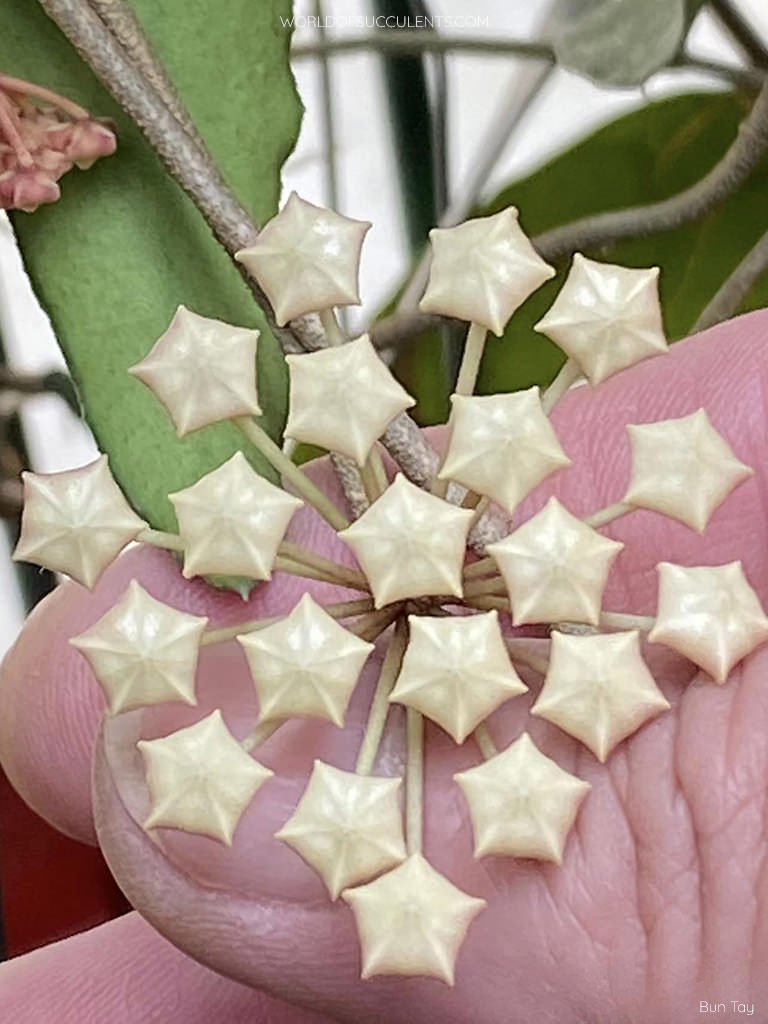
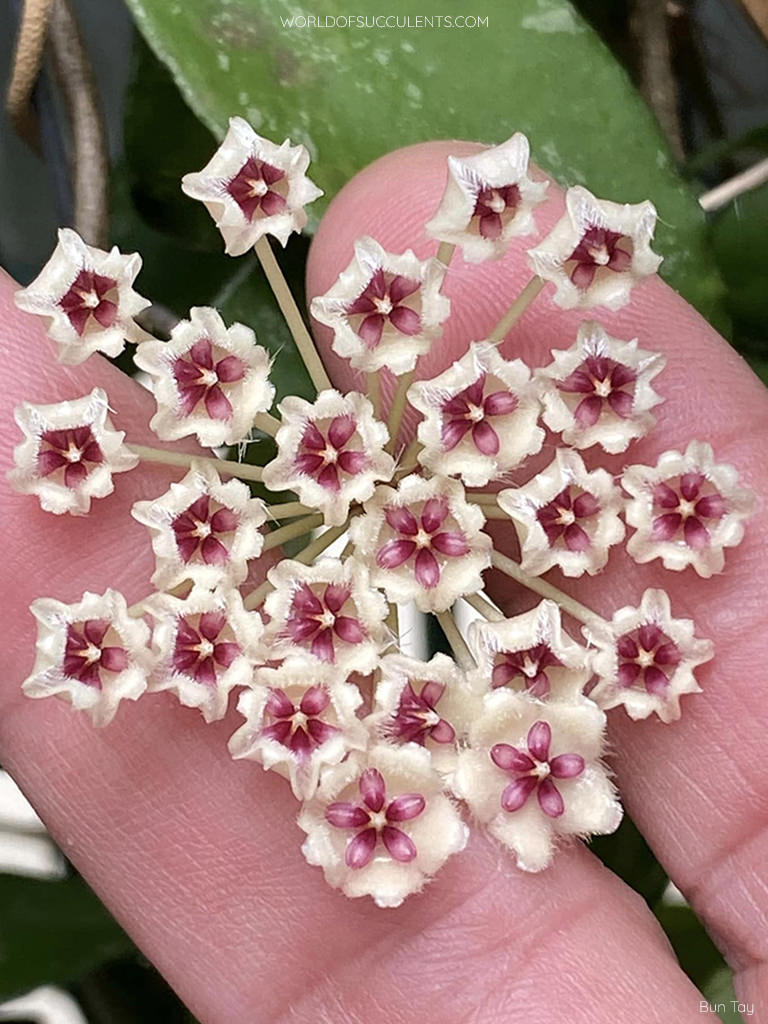
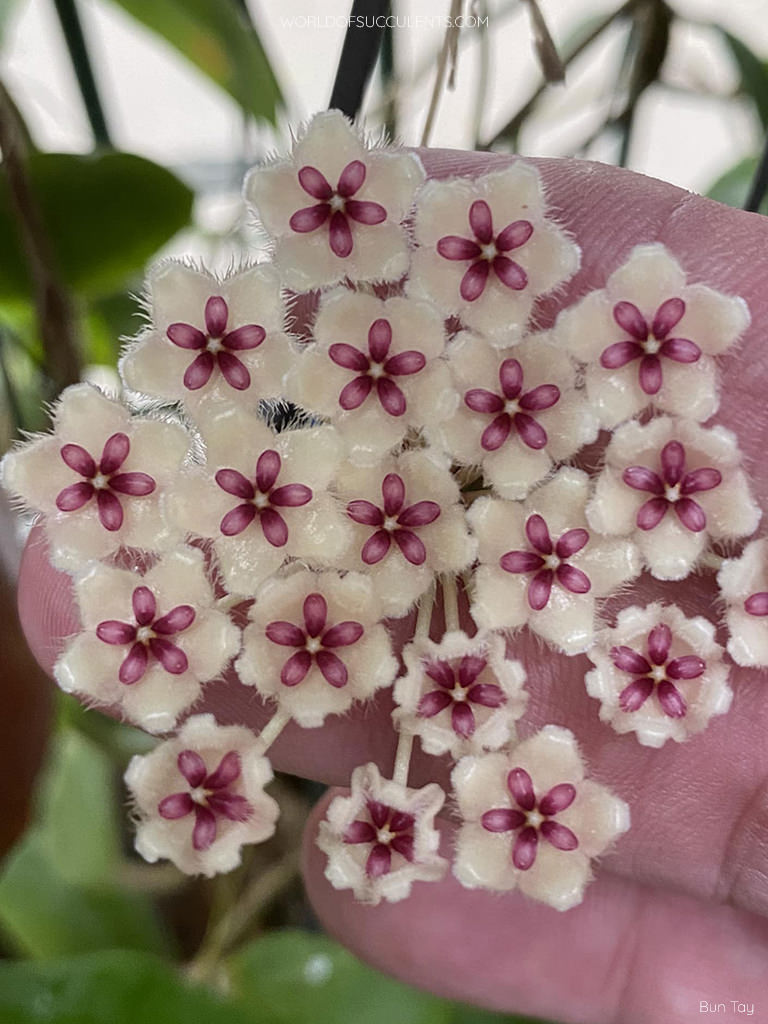
Under ideal conditions, Hoya phuwuaensis produces clusters of up to 25 stunning flowers that can bloom year-round, with peak flowering typically occurring in summer. The flowers last at least two days, opening at night and reclosing the following morning. Each flower can reach a diameter of 0.45 inches (1.1 cm). The corolla is creamy to yellowish-white and has long, straight hairs along the margins of the lobes. The corona is purple-red, measuring about 0.2 inches (0.5 cm) in diameter. The fruits are pale green follicles with scattered reddish-brown. They are spindle-shaped and can grow up to 4.8 inches (12 cm) long and 0.2 inches (0.5 cm) in diameter.
How to Grow and Care for Hoya phuwuaensis
Light: This plant prefers bright, indirect sunlight indoors. Although it tolerates low light, it may become weak and leggy when light levels are too low, producing fewer leaves and flowers.
Soil: Well-draining soil that provides excellent aeration and does not retain excessive water is essential for growing a healthy plant.
Temperature: Hoya phuwuaensis thrives in hot and humid climates, so keep it away from drafty windows and doorways during the colder months. It is hardy in USDA Plant Hardiness Zones 11a-11b, which have average annual extreme minimum winter temperatures ranging from 40°F to 50°F (4.4°C to 10°C).
Watering: This plant is sensitive to overwatering. Soak the soil thoroughly during the spring and summer, but allow it to dry out before watering again. Otherwise, you will increase the risk of root rot, and your plant will not be happy. It is relatively dormant during the fall and winter and needs only moderate watering.
Fertilizing: While Hoya phuwuaensis is not a particularly heavy feeder, it can benefit from a high-potassium fertilizer diluted to half-strength every two weeks during the growing season.
Repotting: As an epiphyte, this plant has a shallow root system and requires a deep container. It also does not require frequent repotting. It prefers to be slightly rootbound. Repot the plant in spring only if it has outgrown its container.
Propagation: Layering is the easiest method to propagate Hoya phuwuaensis, but propagation by stem cuttings is the most popular choice among Hoya growers. While propagating through leaf cuttings can be more challenging, starting a new plant from seeds is the simplest yet most time-consuming method. For best results, take cuttings only when the plant is actively growing, and sow seeds in spring and summer.
Learn more at How to Grow and Care for Hoya.
Toxicity of Hoya phuwuaensis
Hoya phuwuaensis is considered non-toxic and safe around kids and pets.
Photo Gallery
Click on a photo to see a larger version.
Internal Links
- Explore all plants within the genus Hoya.
- Explore all plants within the family Apocynaceae.
References
- Kidyoo, M. (2016). Hoya phuwuaensis (Apocynaceae: Asclepiadoideae), a new species from Northeastern Thailand. Phytotaxa 282(3): 218–224.
- Hoya phuwuaensis Kidyoo🡕. Plants of the World Online. Kew Science. Retrieved January 21, 2026.