

Hoya carnosa 'Compacta', commonly known as Hindu Rope Plant or Krinkle Kurl, is an attractive semi-succulent plant first discovered as a natural mutation at Hummel's Exotic Gardens in California, United States. This plant is highly valued for its climbing or trailing growth habit, unique curled leaves, and striking summer blooms. It is easy to care for and grows very slowly, making it a perfect addition to any indoor garden.
Taxonomy of Hoya carnosa 'Compacta'
Scientific Name
Hoya carnosa 'Compacta' (informal name)
Accepted Scientific Name
Hoya carnosa (L.f.) R.Br.
Synonym(s)
Hoya carnosa f. compacta, Hoya carnosa 'Krinkle Kurl', Hoya compacta
Common Name(s)
Angel Rope, Hindu Rope, Hindu Rope Plant, Indian Rope, Krinkle Kurl
Scientific Classification
Family: Apocynaceae
Subfamily: Asclepiadoideae
Tribe: Marsdenieae
Genus: Hoya
Etymology
The generic name "Hoya" (pronounced "HOY-a") honors Thomas Hoy🡕 (c.1750–1822), an English gardener and botanist who worked for 40 years for the Duke of Northumberland at Syon House in Middlesex, United Kingdom.
The specific epithet "carnosa" (pronounced "kar-NO-suh") means "succulent; thick and fleshy" and refers to the species' slightly succulent leaves.
The cultivar epithet "compacta (kom-PAK-tuh)" means "compact" and refers to the closely packed leaves along the stems.
Description
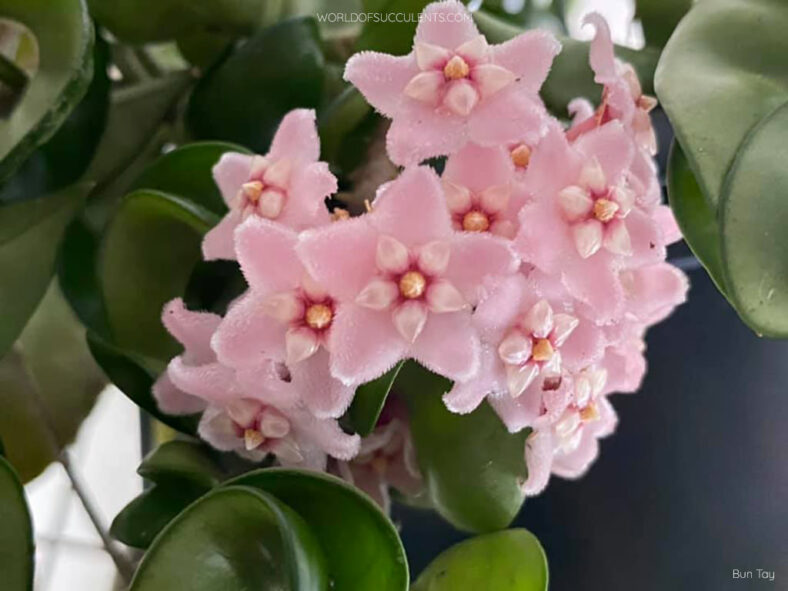
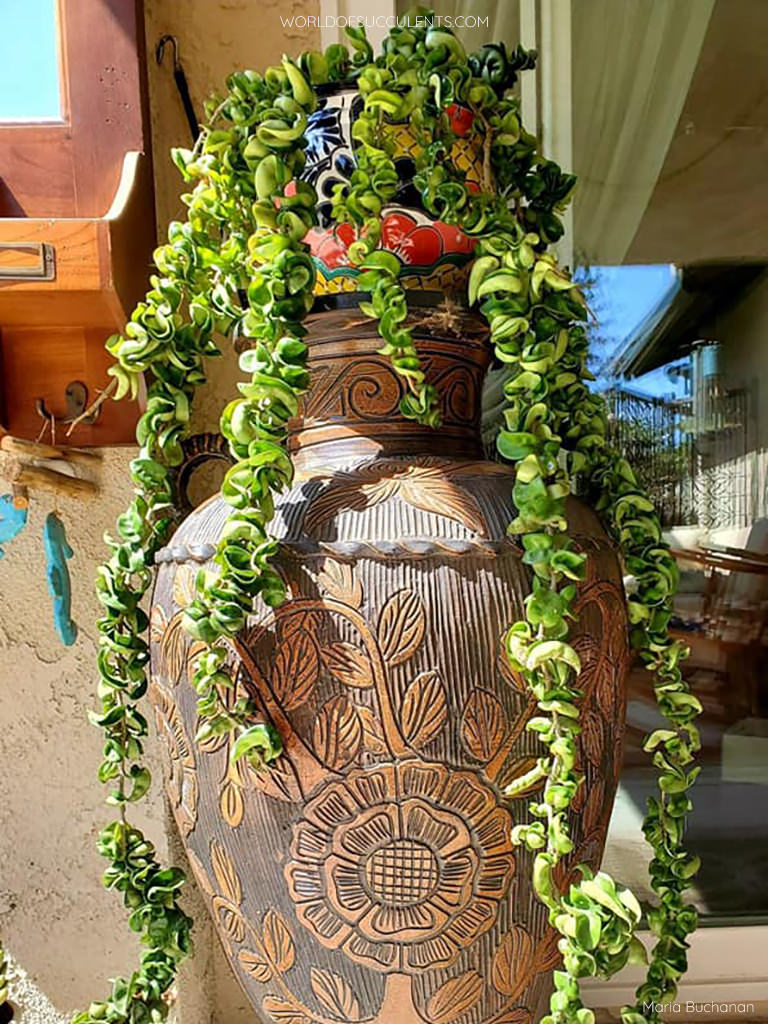
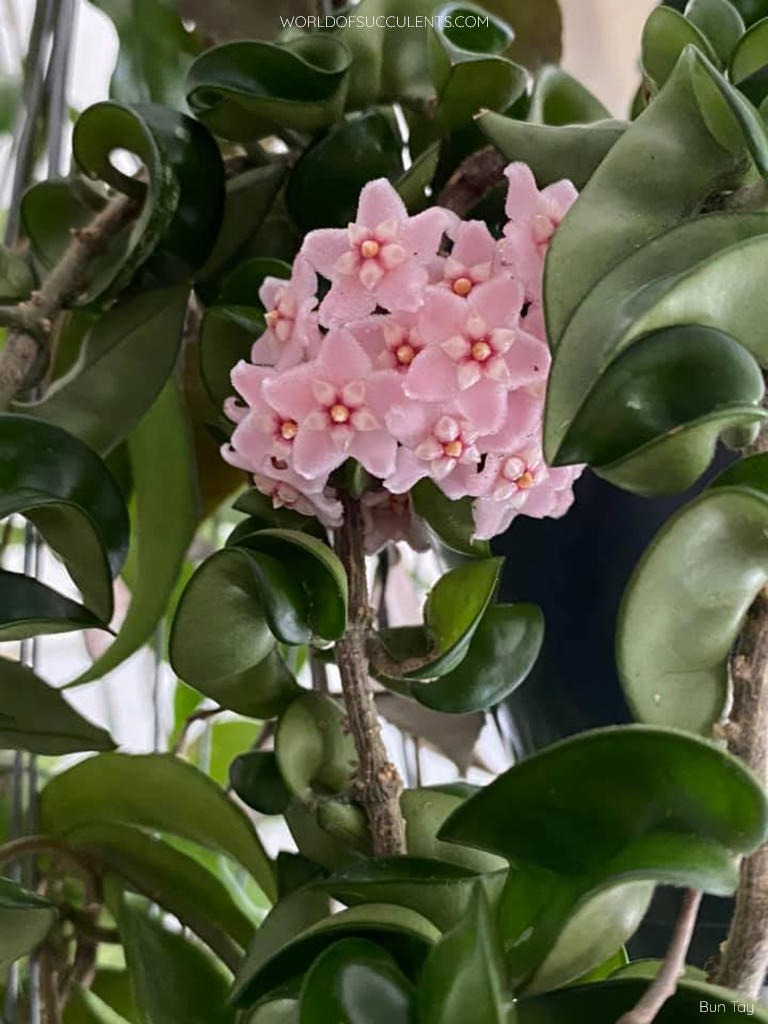
Hoya carnosa 'Compacta', also known as Hoya compacta or Hoya carnosa 'Krinkle Kurl', is a semi-succulent plant with contorted leaves closely packed along vining stems, giving them a rope-like appearance. Leaf size and color may vary, but they are generally described as curly Hoya carnosa leaves. They are mid-dark green above and dull light green below, measuring up to 2.4 inches (6 cm) long and 1.2 inches (3 cm) wide.
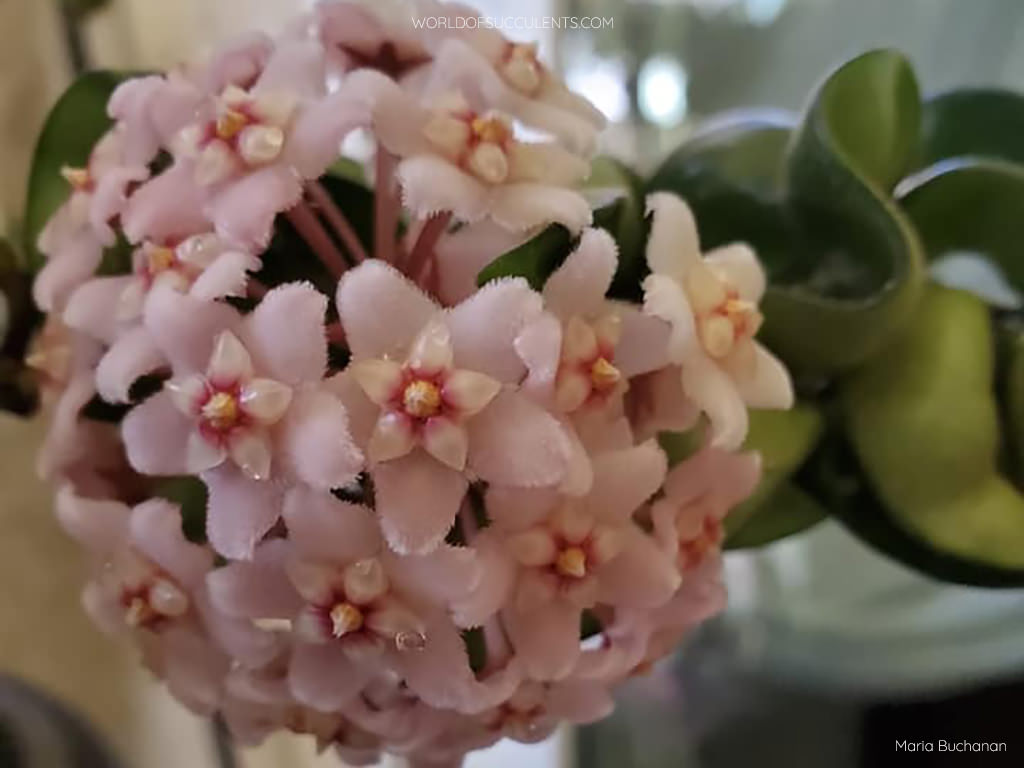
Typically, in the summer, Hoya carnosa 'Compacta' produces star-shaped, sweetly fragrant flowers in attractive round clusters of 10 to 30. They mature gradually on the same peduncle over 2 to 3 weeks and can reach a diameter of 0.6 inches (1.5 cm). The corolla is densely hairy and pinkish to pink, while the corona is white, tinged red toward the center.
Origin
This plant has never been found in the wild. It was first discovered as a branch mutation sport at Hummel's Exotic Gardens, owned by Edward and Minne Belle Hummel, in Inglewood, California, United States. In 1967, it was popularized under the trademark "Hindu Rope" by B. L. Cobia Nursery Inc. in Winter Garden, Florida, United States.
Forms of Hoya carnosa 'Compacta'
How to Grow and Care for Hoya carnosa 'Compacta'
Light: Although this plant can tolerate lower light levels, it may become weak and leggy if the light is too low, producing fewer leaves and flowers. Therefore, keep it indoors in bright, indirect sunlight.
Soil: Well-draining soil that provides excellent aeration and doesn't hold too much water is most important for a healthy plant.
Temperature: Hoya carnosa 'Compacta' thrives in hot and humid climates, so keep it away from drafty windows and doorways during the colder months. It grows best in USDA Plant Hardiness Zones 10a to 11b, with average minimum winter temperatures ranging from 35°F to 50°F (-1.1°C to 10°C).
Watering: Because this plant is sensitive to overwatering, soak the soil thoroughly in spring and summer, then let it dry out before watering again. Otherwise, you will increase the risk of root rot, and your plant will not be happy. It is relatively dormant in fall and winter, so it needs only moderate watering.
Fertilizing: While Hoya carnosa 'Compacta' is not a particularly heavy feeder, it can benefit from high-potassium fertilizer at half strength every two weeks during the growing season.
Repotting: As an epiphyte, this plant has a shallow root system and doesn't need a deep container. It also does not require frequent repotting. It prefers to be slightly rootbound, so repot it in spring only if it outgrows its container.
Propagation: Although layering is the easiest method to propagate Hoya carnosa 'Compacta', stem cuttings are the most popular way to do so. Leaf cuttings can be more challenging, while starting from seeds is the simplest but most time-consuming method. For best results, take cuttings only when the plant is actively growing and sow the seeds in spring and summer.
Learn more at How to Grow and Care for Hoya.
Toxicity of Hoya carnosa 'Compacta'
Hoya carnosa 'Compacta' is considered non-toxic, making it safe to have around children and pets.
Photo Gallery
Click on a photo to see a larger version.
Internal Links
- Explore all plants within the genus Hoya.
- Explore all plants within the family Apocynaceae.