

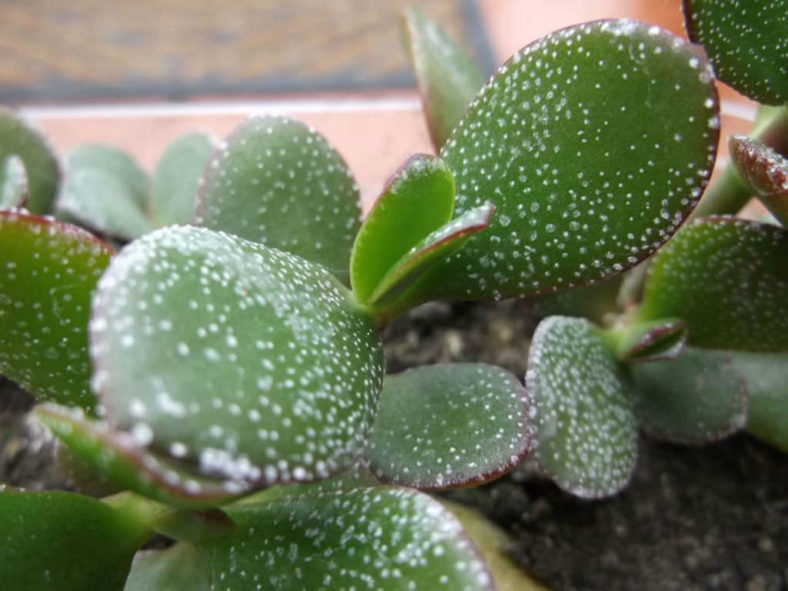
Crassula ovata, commonly known as Jade Plant, is a classic houseplant, especially for the neglectful homeowner. It prefers bright light and occasional watering in the warm season, but otherwise the plants are fairly self-sufficient. You may still find white spots on the leaves of the Jade Plant in good condition, but if the plant's overall health is good, you should not worry too much. So what causes white spots on a Jade Plant? It may be a natural phenomenon or a fungal infection, but either way, there are easy methods to identify and address the problem.
What Causes White Spots?
The actual cause of the white spots on the leaves of the Jade Plant might be powdery mildew or even a condition where the plant stores salts and "sweats" the excess out through its leaves. One cause has a quick fix, and the other requires some cultural adjustment and treatment. However, neither is particularly harmful to your plant, and learning how to get rid of white spots on Jade Plants is a matter of a few quick steps.
Powdery Mildew
Most gardeners are familiar with powdery mildew. It occurs when there is low light, improper circulation, cooler temperatures, and excess humidity. Overhead watering leaves foliage damp, which tends to stay moist for a long period in winter. This promotes the formation of fungal spores that cause powdery mildew.
Avoid overhead watering and use a fan to increase circulation. Pinch off affected foliage and discard it. A baking soda and vinegar solution is an effective way to get rid of white spots on jade plants with powdery mildew. Spray the leaves, but ensure they dry within a few hours.
Overhead watering may also leave hard water spots on the leaves.
Excess Salts
All plants take up water through their roots, with a few rare exceptions. Jade Plants store water in their fleshy leaves, making them ideal species in arid zones. They capture infrequent rainwater and store it until they need it, much like a squirrel hoarding nuts. This gives the leaves their plump appearance.
Rain and groundwater alike capture salt from the air and soil. When you water with a salty solution, the trapped moisture will move through the leaves via transpiration, and the evaporated moisture will leave a salt residue on the leaves. Therefore, your Jade Plant has white spots on the pads. A soft, lightly moistened cloth can easily wipe them away and restore the foliage's appearance.
Other Reasons for White Spots
Jade Plants often develop a condition called Edema, in which the roots take up water faster than the plant can use it. This causes corky blisters to form on the foliage. Reducing water should prevent the condition, but the blisters will remain.
Rarely may you find a Jade Plant with white spots, which are actually insects. For example, mealybugs have a whitish-silver fuzzy exterior. If your white spots are moving, take action and seclude the Jade Plant from other plants.
The spots may also appear in a variety of scales, with silvery bodies. Both can be conquered with a systemic insecticide formulated for houseplants or by dabbing them with a 70 percent rubbing alcohol solution.
Jade Plant is not usually prone to insect infestations, but if you put the plant outdoors for the summer, take a good look at it before bringing it indoors and infecting your other flora.
Source: gardeningknowhow.com
Links
- Back to genus Crassula
- Succupedia: Browse succulents by Scientific Name, Common Name, Genus, Family, USDA Hardiness Zone, Origin, or cacti by Genus